
Government Withdraws 'Minyakita' from Food Aid Programme After Supply Shortages
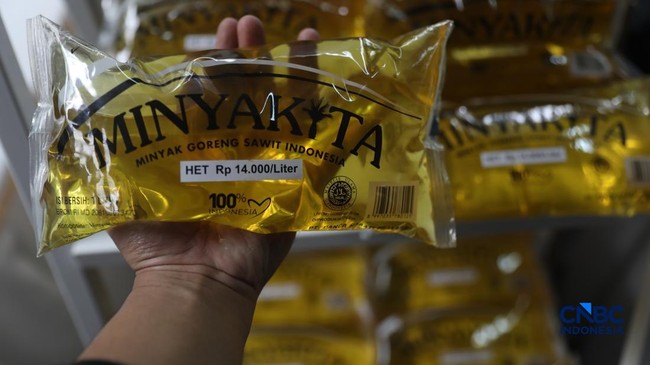
The government has confirmed that the state-branded cooking oil, Minyakita, will no longer be included in food assistance programmes. This decision follows a government evaluation of Minyakita’s distribution, which recently faced supply disruptions and price increases in several regions.
Coordinating Minister for Food Affairs, Zulkifli Hasan (Zulhas), revealed that one of the primary reasons for the reduced stock of Minyakita in the market was its previous inclusion in government food assistance programmes. According to Zulhas, this situation triggered complaints from various regions, particularly those far from distribution centres, regarding the difficulty of obtaining Minyakita at the regulated price.
“There was a slight increase in Minyakita prices in several remote areas; many people reported to us that there was a shortage,” said Zulhas during a limited coordination meeting on food commodity price developments at the Coordinating Ministry for Food Office, Jakarta, on Tuesday (9/6/2026).
He explained that using Minyakita for food assistance ultimately absorbed a portion of the supply that should have been circulating in public markets. “There was a policy previously where Minyakita was used for food assistance, which resulted in its absence from the market,” he added.
Learning from this experience, the government has decided to alter the distribution pattern so that Minyakita focuses on meeting the needs of the community in traditional markets. The policy is also intended to maintain Minyakita’s primary function as a replacement for bulk cooking oil.
“We have corrected that experience; Minyakita must no longer be used for assistance but must enter traditional markets, because the essence of Minyakita is to replace bulk oil,” he explained.
In line with this, Minister of Trade Budi Santoso emphasised that moving forward, Minyakita will no longer be part of the government’s food assistance packages. He noted that the cooking oil requirements for social assistance can be met through other products supplied directly by producers.
“Food assistance (as a replacement for Minyakita) can be coordinated directly with producers. The brand can be anything, depending on availability,” Budi said after the meeting.
Budi revealed that, until now, approximately 52% of the Minyakita allocation was absorbed by food assistance programmes, consequently reducing the supply available to the public in markets.
Therefore, the government has decided that the entire supply of Minyakita will be prioritised to meet domestic market needs, specifically for public and traditional markets. Meanwhile, the cooking oil requirements for food assistance will utilise other brands outside of the Minyakita programme.
“Food assistance can be communicated directly; we will facilitate this with producers. There are other types of oil besides Minyakita. It does not have to be Minyakita for food assistance,” he explained.
Budi reaffirmed that Minyakita was created specifically to maintain the affordability of cooking oil in public markets and must no longer be diverted to food assistance schemes.
“Minyakita will not be included in food assistance. Because Minyakita is solely for the public market. If there is to be food assistance for oil, we will communicate with products outside of the Minyakita brand, as there are many types of oil available,” he concluded.