
Government Urged to Require Salt Importers to Absorb Local Production
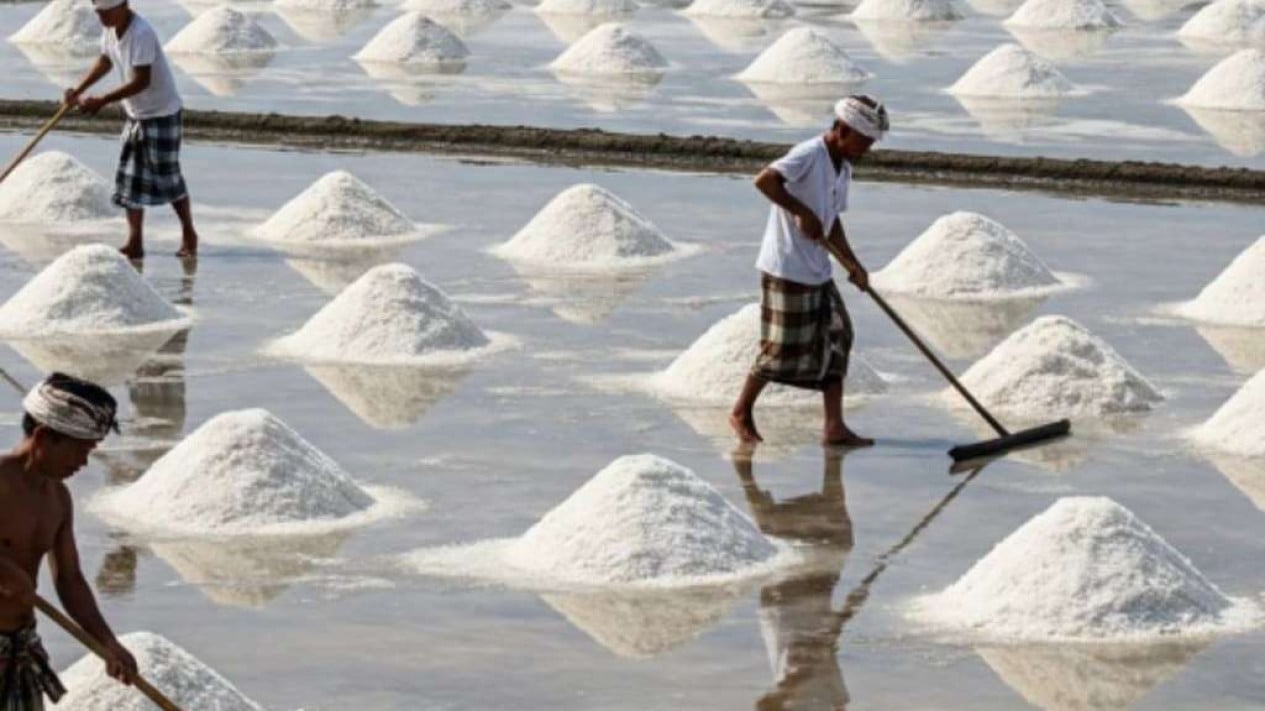
The government is being urged to ensure that every salt import policy includes an obligation to absorb local production that meets quality standards, to prevent imports from weakening domestic producers.
Muhammad Rizal Taufikurahman, Head of Macroeconomics and Finance at the Institute for Development of Economics and Finance (Indef), noted that according to planning documents from the Ministry of Marine Affairs and Fisheries, the national salt production target is set to increase from 2.25 million tonnes in 2025 to 2.5 million tonnes in 2026. “The increase in targets shows the government is indeed pushing to strengthen domestic production towards salt self-sufficiency by 2027,” Rizal said in a statement on Wednesday.
However, data from the Central Statistics Agency (BPS) indicates that imports of industrial salt under HS code 25010093 reached approximately 936,000 tonnes in January–May 2026, marking a 13.1 percent year-on-year increase. Rizal stressed that while production targets are rising, import policies must be accompanied by a mandatory absorption scheme for locally produced salt that meets specifications. Without this, increased local production may not translate into guaranteed market access.
Rizal explained that import policies should be based on an accurate industrial supply-demand balance and conducted selectively for specifications that domestic producers cannot yet fulfil. He also emphasised the need for strict distribution oversight to prevent imported salt from leaking into the consumer market.
He highlighted that the principle of mandatory local absorption was previously regulated under Minister of Marine Affairs and Fisheries Regulation No. 66 of 2017 on the Control of Salt Commodity Imports. However, this regulation was revoked by Ministerial Regulation No. 27 of 2022 without a comprehensive replacement. Rizal insisted that the revocation of the regulation should not mean the elimination of the local absorption principle from import governance. The government must ensure that any import access is accompanied by an obligation to absorb locally produced salt that meets quality standards, so that imports do not suppress the domestic producer market.
In the current context of salt import governance, controlling imports requires cross-ministerial coordination. The Coordinating Ministry for Food Affairs plays a role in ensuring that the supply-demand balance for salt is compiled transparently, while the Ministry of Trade is responsible for ensuring that import approvals go beyond mere procedural and documentary completeness.
Source: jawawa.id (https://jawawa.id/newsitem/government-urged-to-require-salt-importers-to-absorb-local-production-1785293556)
Originally published by VIVA.co.id (https://www.viva.co.id/bisnis/1917174-lindungi-industri-dalam-negeri-pemerintah-diminta-wajibkan-importir-garam-serap-produksi-lokal), translated from Indonesian