
Government Urged to Be Careful Over Proposal to Redefine Native Papuans
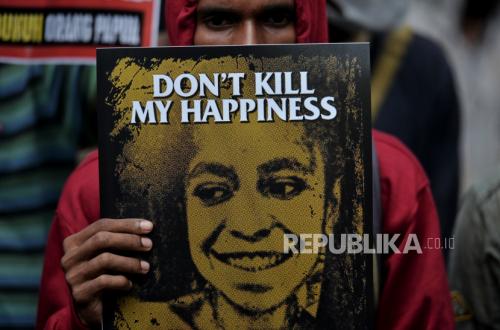
Community groups in Papua have cautioned the Ministry of Home Affairs (Kemendagri) to be careful over the proposed redefinition of Orang Asli Papua (OAP). A reinterpretation of OAP status is feared to spark new conflicts, and even deepen enmity, in the Land of the Cenderawasih. The Papua Justice and Human Dignity Foundation (YKKMP) insists that any redefinition of OAP must better guarantee justice and welfare for native Papuans.
YKKMP Executive Director Theo Hesegem said the redefinition of OAP cannot be understood merely as an administrative or bureaucratic classification exercise. OAP identity, he said, carries historical, genealogical, cultural, customary and linguistic dimensions, and even touches on a person’s relationship with their ancestral land and inherited social systems.
“Therefore, every state policy relating to the meaning and redefinition of OAP must be carried out carefully, inclusively and participatively, and based on the social realities of Papua’s customary communities,” Theo told Republika in Jakarta on Monday (14/9/2026).
Theo said the Ministry needs to understand that the definition of OAP is not solely for administrative and bureaucratic purposes, because it has direct consequences for the rights, identity, opportunities, protection and future of Papuan communities. “If the definition of OAP is drawn too narrowly, too rigidly, and without considering the diversity of Papuan society, it could give rise to a host of new problems,” he said.
Among the problems feared, Theo said, is a dichotomy between one group of OAP and another, as well as between OAP and non-OAP, which persists to this day. The first issue likely to emerge is a debate over who can truly be classified as OAP. Such a debate could become acrimonious, fuelling identity conflicts among native Papuans themselves. “Identity conflicts between clans, between tribes, and between community groups,” Theo said, noting that such conflicts are already ongoing.
When identity conflict arises, it could lead to discrimination against Papuans who fall outside the redefined OAP category. “Another problem is discrimination against Papuans who do not meet certain administrative criteria,” Theo said.
The redefinition could also threaten to reignite high levels of social resentment among Papuans over access to education, employment, political positions, economic assistance and affirmative programmes. It also risks abuse of OAP identity for political, economic or particular group interests. “Social divisions among Papuans themselves, and between Papuans and non-Papuan residents,” Theo warned.
Do Not Divide the Rights of OAP and Non-OAP
Theo reminded that the fundamental problems in Papua are deeply complex, hardened as they are in the reality of a dichotomy between OAP and non-OAP. For that reason, he said, the redefinition must not sharpen this already dangerous divide. “Recognition of the special rights of OAP must not be used as grounds to set them against non-Papuan communities in Papua,” said Theo.
He acknowledged that OAP do hold specific rights within the customary dimension. OAP, he said, occupy a position that must be recognised as customary communities and the original owners of the Land of Papua. However, non-Papuan residents living lawfully in the Land of Papua are also citizens and human beings who must equally be assured of safe, dignified lives and legal protection.
“Papua is a shared home for all communities of diverse ethnic, cultural and historical backgrounds. Therefore, protection of OAP must go hand in hand with respect for the rights of all citizens in Papua, including non-OAP,” Theo said.
Accordingly, Theo, through YKKMP, put forward eight recommendations to Home Affairs Minister Tito Karnavian regarding the proposed reinterpretation of OAP.
First, the definition of OAP must not be determined unilaterally by national authorities without the involvement of Papua’s customary communities. Second, Kemendagri should conduct deeper study of the history, anthropology, customary law, culture and social realities of Papuan society before drawing conclusions or setting policy on the OAP definition. Third, the government must ensure the reinterpretation does not contradict human rights principles prohibiting discrimination, and upholds equality and respect for customary institutions.
“The government must also avoid an approach based solely on narrow administrative and bureaucratic systems in redefining OAP,” Theo said. He added that the reinterpretation should better ensure affirmative policies that genuinely benefit Papua’s customary communities. “The redefinition of OAP must continue to uphold the rights of all residents living in Papua, both OAP and non-OAP, in accordance with human rights principles,” Theo said.
Finally, Theo urged that the discussion over the redefinition offer a way out of the more crucial problems currently facing all residents of Papua. “That means prioritising the resolution of the people’s problems in Papua, including the armed conflict, displacement, poverty, education, health, customary land issues, and human rights violations,” he said.
A proposal to redefine OAP surfaced recently. Home Affairs Minister Tito Karnavian said the reformulation was being considered as part of the problem inventory in the revision of the Papua Special Autonomy Law. The revision would raise the special allocation fund from 2 to 2.5 per cent, with the funds prioritised solely for the development of OAP communities.
“The problem now is: what exactly is the definition of Orang Asli Papua?” Tito said. He noted that differences over the definition exist within Papua itself and in national discussions. According to Tito, some require that OAP be persons born in Papua to two parents who are also OAP.
Others require only one parent to be born as OAP. There is also a definition based on customary adoption. Tito said the varying interpretations of OAP currently have no settled conclusion, leading to mistargeted use of the special allocation funds.
Source: jawawa.id (https://jawawa.id/newsitem/government-urged-to-be-careful-over-proposal-to-redefine-native-papuans-1789451603)
Originally published by Republika (https://news.republika.co.id/berita/tle41h393/pemerintah-harus-hatihati-tentang-wacana-pendefinisian-ulang-orang-asli-papua), translated from Indonesian