
Government to Restrict Pertalite Distribution, Purbaya Focuses on Improving DTSEN
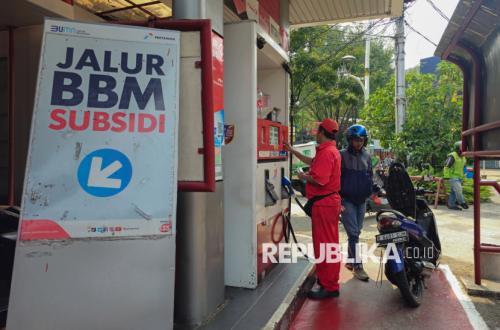
The government has stated that preparations for a system to restrict subsidised fuel (BBM) of the Pertalite type for deciles 9 and 10 are being carried out while improving the National Socio-Economic Single Data (DTSEN). Finance Minister Purbaya Yudhi Sadewa, when confirmed by journalists at the Ministry of Finance office in Jakarta on Wednesday (26/8/2026), explained that the DTSEN data is currently in the process of being improved.
The Ministry of Finance has previously provided budget support amounting to Rp 7 trillion to Statistics Indonesia (BPS) to optimise data collection, including the economic census and DTSEN data.
“The DTSEN data and the Economic Census, if I’m not mistaken, is almost Rp 7 trillion, with various components. So, they asked for time at the beginning of the year, for additional budget to ensure the DTSEN is good,” said Purbaya.
He estimates that the DTSEN data will be more accurate next year.
Meanwhile, the implementation of the Pertalite restriction policy will later take greater account of economic dynamics and the condition of the public.
“Later we will look at the economic dynamics and the public, but we are all preparing the system. Once it is ready, then we will implement it,” said Purbaya.
“But for things like that, if there is an error in decile data, it certainly won’t affect everyone. Just some people. If there is a problem, for example before the new DTSEN is released, we will handle the cases one by one,” explained the Finance Minister.
The plan to restrict Pertalite for deciles 9 and 10 is still under review, so Pertalite distribution is currently still running as usual, as conveyed by Minister of Energy and Mineral Resources (ESDM) Bahlil Lahadalia.
“The Pertalite restriction is still under discussion,” said Bahlil on Wednesday (19/8).
If the discussion has not yet produced a decision, he continued, Pertalite distribution will continue as it is at present.
Accordingly, Bahlil stated that the rules currently in force are 200 litres of Pertalite per day for buses and trucks and 50 litres per day for four-wheeled vehicles.
Regarding deciles, BPS stated that the decile figures in DTSEN need to be understood as a description of relative position in welfare ranking, not as a single measure of a family’s economic condition.
Head of BPS Amalia Adininggar Widyasanti explained that the determination of deciles is not based solely on income, ownership of one type of goods, electrical power, occupation, or any single indicator.
The ranking considers various socio-economic characteristics together, including housing conditions, drinking water sources, fuel and energy for cooking, asset ownership, electricity capacity and consumption, family composition, education, occupation, health, and disability.
This information is considered together using the Proxy Means Test (PMT) statistical method to estimate a family’s welfare level based on observable characteristics.
The decile position can change along with changes in a family’s socio-economic conditions and changes in its relative position compared to other families. Therefore, the relevance of DTSEN needs to be continuously maintained through data updating.