
Government to Reactivate and Build 14,000 km of Railway Lines Across Sumatra, Kalimantan, and Sulawesi
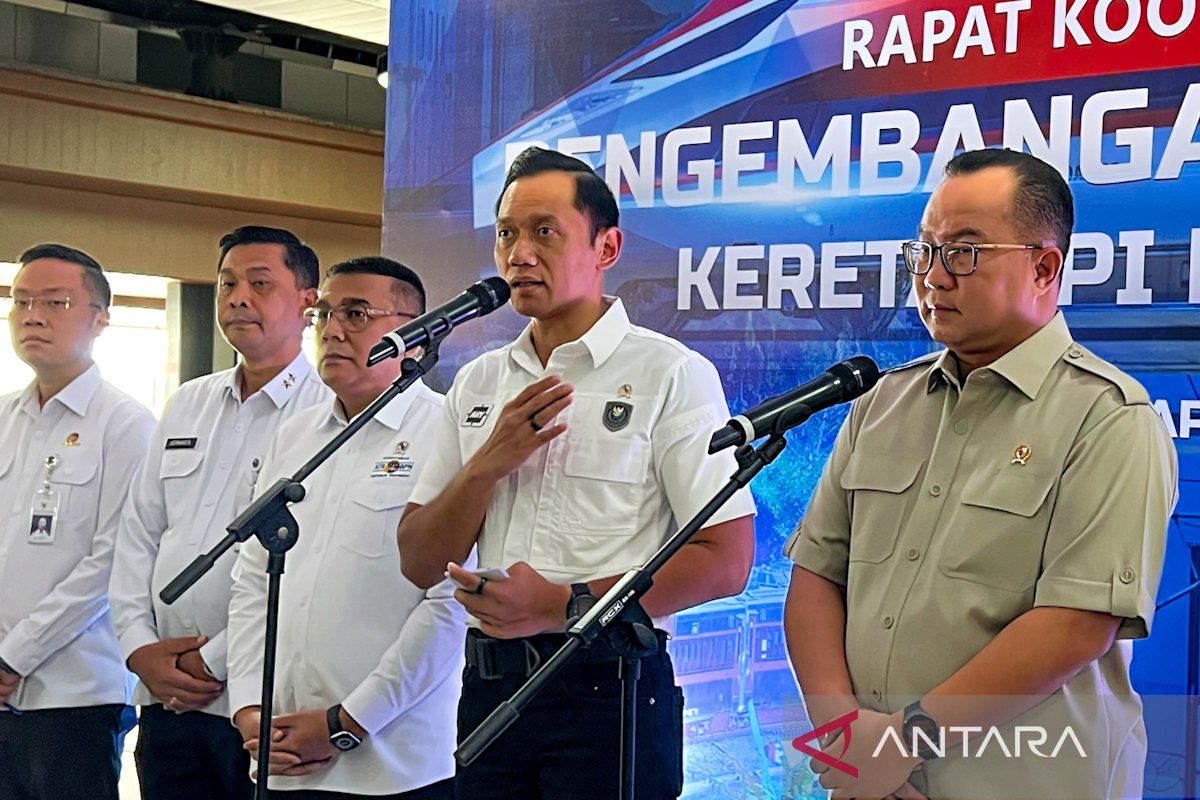
Coordinating Minister for Infrastructure and Regional Development Agus Harimurti Yudhoyono (AHY) stated that the government will undertake the reactivation and construction of approximately 14,000 km of railway lines across Sumatra, Kalimantan, and Sulawesi.
“At the very least, to achieve significant improvements, we need to build, develop, and reactivate around 14,000 km,” said AHY during a press conference following the coordination meeting on the Development of the National Railway Network in Jakarta on Wednesday.
AHY noted that the current railway lines in Sumatra span 1,871 km, requiring an additional minimum of about 7,837 km to match population needs. Meanwhile, Kalimantan has 0 km out of a minimum requirement of 2,772 km.
In Sulawesi, the existing railway lines total 109 km, with an additional 3,284 km needed.
He explained that the government is pushing for the acceleration of railway network development outside Java as a strategic step to reduce logistics costs, narrow regional disparities, and strengthen national connectivity.
“And this cannot happen overnight; it requires a medium- to long-term process, so there must be quick wins and adequate funding,” he said.
He emphasised that the development of cross-island railway networks is a direct mandate from President Prabowo Subianto as part of the National Priority Work Programme (PKPN), particularly in the infrastructure and connectivity sector.
“This is the President’s grand vision. We want to ensure that Sumatra, Kalimantan, and Sulawesi do not lag too far behind. By building an integrated railway network, we can significantly reduce logistics costs and enhance inter-regional economic competitiveness,” said Coordinating Minister AHY.
He added that significant disparities still exist in the development of rail-based transportation in Indonesia. Therefore, strategic, planned, and collaborative steps across ministries, institutions, and regional governments are needed.
“We must honestly assess the current situation. Our railway network is still very limited compared to other countries. This is not to make us pessimistic, but rather to motivate us to work harder and more directedly,” he continued.
Coordinating Minister AHY also highlighted the low contribution of railways to national mobility. He noted that rail passenger transport currently accounts for only about 4 percent, while logistics transport is around 1 percent.
“Yet, railways have significant advantages, including in terms of efficiency and emissions. Their contribution to greenhouse gas emissions is very low, less than 1 percent. We must promote this as part of our commitment to achieving net zero emissions,” he stressed.
Furthermore, Coordinating Minister AHY pointed out the significant investment gap between road and railway development, which has persisted thus far.
“We are not saying that road development is unimportant; it must certainly continue. But we also see a significant gap in railway investment. This is what we must correct together,” he said.
In the context of regional development, Coordinating Minister AHY explained that each island has different challenges and potentials.
Sumatra requires strengthening of existing networks and expansion of new lines, Kalimantan needs construction from scratch, while Sulawesi requires integration of networks with industrial areas and flagship commodities.
“Kalimantan does not even have a railway network yet. This presents a great opportunity for us to build from the beginning with better planning, including to support logistics and commodities,” he said.
To realise the development and reactivation of the network up to around 14,000 additional kilometres, Coordinating Minister AHY mentioned that an investment of Rp1,100 to Rp1,200 trillion is needed by 2045.
“The figure is indeed large, but this is a long-term investment for Indonesia’s future. We cannot rely solely on the state budget. There must be creative financing, collaboration with the private sector, and involvement of various parties,” he explained.
He also highlighted the important role of regional governments in supporting public transportation development, particularly through more proportional budget allocations.
“Regional revenue from the transportation sector is actually quite substantial, but spending on public transportation remains low. This needs to be encouraged to be more balanced and targeted,” he said.
AHY also emphasised that national railway development must be carried out in an integrated manner with spatial planning and area growth.
“We cannot build railways in a piecemeal way. It must be integrated with spatial planning, economic centres, and community needs. This is a major undertaking that requires synergy from all parties,” said AHY.
Source: jawawa.id (https://jawawa.id/newsitem/government-to-reactivate-and-build-14-000-km-of-railway-lines-across-sumatra-kalimantan-and-sulawesi-1776855157)
Originally published by Antara (Indonesian) (https://www.antaranews.com/berita/5537651/pemerintah-reaktivasi-dan-bangun-14000-km-jalur-ka-sumatra-sulawesi), translated from Indonesian