
Government Tinkers with Plans to Restrict Pertalite Fuel Consumption, What Is the Urgency?
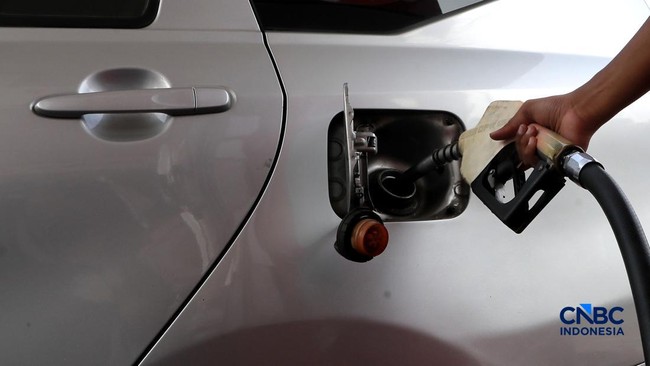
Jakarta, CNBC Indonesia - The government is preparing a policy to restrict consumption of subsidised Pertalite fuel. One option being studied is regulating which types of vehicles will no longer be permitted to use the subsidised petrol.
So, how important is this Pertalite restriction policy to implement? What is the urgency?
Director of International Collaboration at the Institute for Development of Economics and Finance (INDEF) Imaduddin Abdullah assessed that the plan to restrict Pertalite consumption is important to implement promptly. This is primarily to control the energy subsidy burden, while also improving the accuracy of subsidy targeting.
According to him, among the factors influencing the size of energy subsidies, domestic consumption is one aspect that the government can still control. This is the key reason why restricting Pertalite consumption is important.
“Indeed, what we can ultimately control is only domestic consumption. That is why I think the plan to restrict the use of Pertalite consumption is very important. Why? Because this is the next problem with our subsidies,” Imaduddin said in CNBC Indonesia’s Energy Corner programme, quoted on Friday (28/8/2026).
He explained that the main problem with fuel subsidies today is poor targeting. Based on data he holds, people in the 9th and 10th decile groups, or the affluent segments of society, still account for a large share of fuel consumption.
“Because the data shows that decile 9 and decile 10, which we categorise as the affluent group, consume around 42% of fuel. So nearly half of fuel consumption is consumed by the upper middle class,” he said.
Imaduddin assessed that the government now needs to control subsidies immediately. This is because energy subsidies continue to rise every year and the subsidised energy sources are mostly dependent on imports. As a result, if global geopolitical conditions continue to be volatile and this again affects commodity prices, it will certainly impact a surge in energy subsidies.
“So indeed, for energy subsidies, we are very dependent on imported energy sources. There are three variables that ultimately determine this. The first is the global price level, the second is the exchange rate, and the third is domestic consumption itself,” he explained.
In 2026, for example, he continued, energy subsidies and compensation are estimated to surge by Rp 200 trillion to around Rp 526 trillion, from the initial budget of Rp 338 trillion.
“Now, Rp 200 trillion is actually a large figure, and this is all money. All money, and one thing I mentioned earlier is that this subsidy is highly dependent on the three aspects mentioned, of which the first two aspects, related to global energy prices and the rupiah, are two factors that cannot be controlled. The risk is external,” he explained.
Subsidy Budget
As is known, the administration of President Prabowo Subianto has prepared a higher fuel subsidy budget in the 2027 Draft State Budget (RAPBN) compared to the estimated realisation of the 2026 State Budget.
In the Financial Note and the 2027 RAPBN document, the budget for certain types of fuel subsidies, such as Pertalite and diesel, is set at Rp 28.7 trillion, up around 8.71% compared to the 2026 outlook of Rp 26.4 trillion.
“In addition, to improve the efficiency of subsidy spending, the distribution of subsidised fuel will be carried out with consumer registration,” as quoted from the Financial Note and 2027 RAPBN document, Sunday (16/8/2026).
The increase in the fuel subsidy budget goes hand in hand with the rise in total energy subsidies. This includes the subsidy budget for 3 kg LPG canisters and electricity subsidies.
The draft energy subsidy budget for 2027 reaches Rp 272.94 trillion, an increase of 20.1% compared to the 2026 outlook of Rp 227.25 trillion.
The 3 kg LPG subsidy budget also rose to Rp 114.1 trillion from the 2026 outlook of Rp 90.4 trillion, and the electricity subsidy rose to Rp 130.1 trillion, from the estimated 2026 realisation of Rp 110.4 trillion.
The budget calculation for certain types of fuel subsidies and 3 kg LPG canisters in the 2027 RAPBN uses assumptions and parameters, including:
the rupiah exchange rate against the US dollar and the Indonesian Crude Price (ICP);
a fixed diesel subsidy of Rp 1,000 per litre;
a volume of certain types of diesel fuel of 19,558.5 thousand kilolitres and kerosene of 539.0 thousand kilolitres; and
a volume of 3 kg LPG canisters of 8,945.0 million kg.
Meanwhile, the increase in the electricity subsidy allocation is mainly influenced by the increase in the basic cost of electricity supply (BPP) and the increase in the volume of subsidised electricity. The increase in BPP is caused by, among other things:
changes in the rupiah exchange rate against the US dollar;
changes in the Indonesian Crude Price (ICP) due to global geopolitical conflicts; and
increased production at gas-fired power plants.