
Government Targets 1.45 Million Household Gas Connections by 2029 to Curb LPG Imports
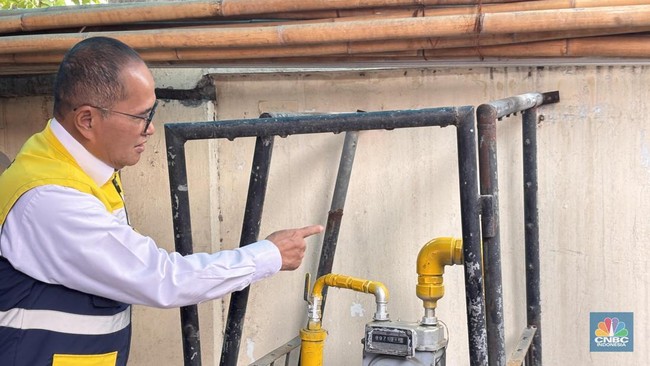
The government will intensify the construction of household gas networks to reduce imports of liquefied petroleum gas (LPG). The government’s target is 1,450,000 household connections (SR) installed by 2029.
Head of the Government Communications Agency (BAKOM) Muhammad Qodari explained that the government has prepared Front End Engineering Design (FEED) and Detail Engineering Design Construction (DEDC) plans for the household gas network programme. Between 2025 and 2028, a total of 1,119,654 household connections are targeted to be installed.
The government has also prepared three funding schemes: through the state budget (APBN), Government-Business Entity Cooperation schemes (KPBU), and investment by state-owned enterprises (BUMN).
In 2026, a projected 150,000 connections will be built through the APBN, 50,000 through KPBU schemes, and 100,000 through BUMN investment. These figures will then increase in 2027 to 150,000 connections from the APBN, 100,000 from KPBU schemes, and 100,000 from BUMN investment.
“In total, gas network construction from 2025 to 2029 is projected to reach 1,450,000 connections, comprising 600,000 through the APBN, 350,000 through KPBU schemes, and 500,000 from BUMN investment,” Qodari said in a press statement at the BAKOM office in Central Jakarta on Wednesday (5/8/2026).
Qodari also said the budget requirement for gas network construction is around Rp 10 million per household connection, which will be adjusted according to technical planning results, field conditions, construction locations, and procurement outcomes.
According to Qodari, the household gas network programme is being carried out to reduce LPG imports, which account for 72% of domestic demand. He outlined that household gas consumption reaches 5 million tonnes, while domestic LPG production is only 1.4 million tonnes.
“This means only around 30% or less can be met domestically, because the rest is imported,” he said.
The gas network will use methane and ethane, resources which Indonesia holds in abundance. This contrasts sharply with the availability of propane and butane gas, which are the raw materials for LPG.
“The volumes of methane and ethane are far greater than LPG. Perhaps around three-quarters of the gas available in Indonesia falls into the category of natural gas, namely methane and ethane,” he said.
Furthermore, Qodari outlined several benefits of supplying natural gas directly to households. According to him, the policy is more practical, households receive more stable prices, and they do not face the risk of shortages at the retailer level. Qodari also claimed that using the gas network can reduce household expenditure.
“Assuming consumption of three 3-kilogram LPG cylinders per month and a gas network tariff of around Rp 4,000 per cubic metre, households are estimated to save between Rp 50,000 and Rp 80,000 per month, or Rp 600,000 to Rp 900,000 per year, depending on the gas network tariff and LPG prices in each region,” he said.
Source: jawawa.id (https://jawawa.id/newsitem/government-targets-1-45-million-household-gas-connections-by-2029-to-curb-lpg-imports-1785916315)
Originally published by CNBC Indonesia (https://www.cnbcindonesia.com/news/20260805135440-4-756762/target-pemerintah-pasang-145-juta-jaringan-gas-rumah-tangga-di-2029), translated from Indonesian