
Government Strengthens Oversight of Food Programmes with Risk Management
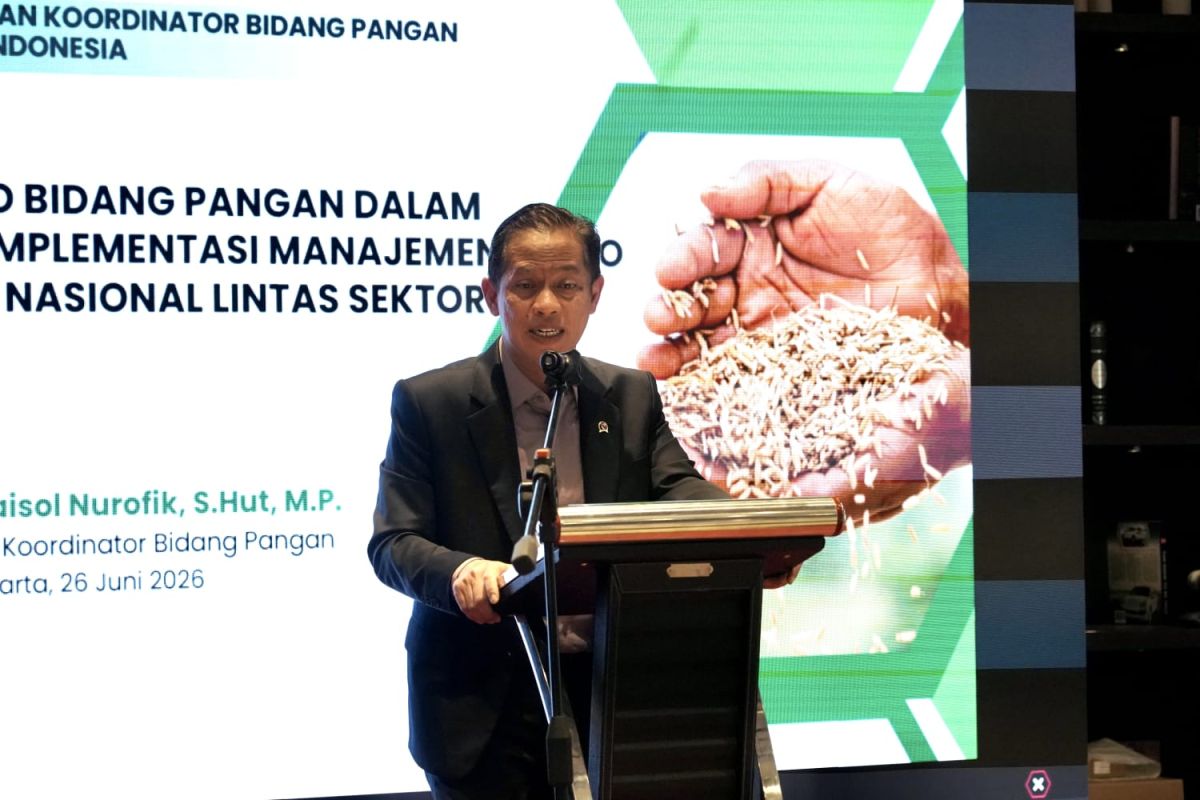
The government, through the Coordinating Ministry for Food, is strengthening oversight of various national priority programmes in the food sector by implementing Cross-Sectoral National Development Risk Management (MRPN LS) to enhance programme effectiveness and prevent food project failures.
Deputy Coordinating Minister for Food Hanif Faisol Nurofiq stated that the implementation of MRPN LS serves as a control instrument for the execution of national priority programmes involving multiple ministries and agencies. “We are carrying out the mandate of Presidential Regulation 147 of 2024 concerning the Coordinating Ministry for Food. The ministry is tasked with coordinating and controlling the implementation of national priority programmes,” Hanif said in an official statement received in Jakarta on Friday.
He explained that oversight is not only focused on the development of food, energy, and water self-sufficiency areas but also covers the Free Nutritious Meals Programme (MBG), the Merah Putih Village Cooperatives, the Merah Putih Fishermen’s Village, and waste management as part of the national development agenda.
According to Hanif, the government does not wish to repeat the shortcomings of several previous food self-sufficiency projects, such as the one-million-hectare peatland project, the Merauke Integrated Food and Energy Estate (MIFEE), and other food estates deemed to have yielded suboptimal results. “Therefore, the government believes that a large budget does not guarantee success if governance and risk control are not consistently implemented,” he said.
He added that President Prabowo Subianto is paying significant attention to the development of food, energy, and water self-sufficiency areas, making it essential to map out various potential risks from the outset so that programme implementation proceeds according to target. One of the reasons for the suboptimal performance of development projects to date, according to him, is weak governance and low accountability in programme execution.
To address this, the government is currently drafting the MRPN LS document, which will serve as a joint guideline for ministries and agencies in overseeing national priority programmes in a measurable, transparent, and accountable manner, thereby making cross-agency coordination more effective.
The Coordinating Ministry for Food held a coordination meeting in Bandung, West Java, involving the Ministry of National Development Planning/Bappenas, the Development Finance Comptroller (BPKP), the Ministry of Cooperatives, the National Nutrition Agency, the Ministry of Agriculture, and the Ministry of Environment to formulate an integrated risk mitigation strategy.
Meanwhile, Sugeng Santoso, Expert Staff for Maritime Economy at the Coordinating Ministry for Food, stated that strengthening risk management is also directed at supporting the improvement of the National Food Security Index as stipulated in the National Medium-Term Development Plan (RPJMN). “The government is targeting the Food Security Index to increase from 73 in 2025 to 82 in 2029 by strengthening aspects of food availability, affordability, and utilisation,” said Sugeng.
According to him, food availability is the most decisive factor as it is directly related to the national production capacity to meet public needs while maintaining nutritional quality. Facing the threat of a prolonged dry season and various food sector challenges this year, the government will integrate production increases with a governance transformation based on risk management to ensure priority programmes run more effectively, efficiently, and sustainably.