
Government Steps Up Irrigation Infrastructure and Rice Seed Supply in Transmigration Areas to Achieve Food Self-Sufficiency
Jakarta – Boosting food production in transmigration areas is in line with President Prabowo Subianto’s second Asta Cita priority, which sees food self-sufficiency as a path towards national independence.
Co-ordinating Minister for Infrastructure and Regional Development Agus Harimurti Yudhoyono, known as AHY, stressed that food security cannot be separated from the availability of water and supporting infrastructure.
“If we want to achieve self-sufficiency or food security, energy and water security – water, energy and food – in my view, we must further strengthen all the infrastructure related to them,” AHY said in a statement on Tuesday (13 October 2026).
Transmigration Minister M. Iftitah Sulaiman Suryanagara said that research-based assistance was also one reason the Ministry of Transmigration had sent teams to transmigration areas.
“The Patriots are our eyes and ears on the ground. Their work will become one of the important foundations for policy and the development of transmigration areas in the future,” he said.
The initiative is also intended to help farmers through the third planting season, which is consistently the most difficult period for farmers in the Salor Transmigration Area. There, the dry season coincides with rising sea tides, and rice crops often cannot be harvested properly.
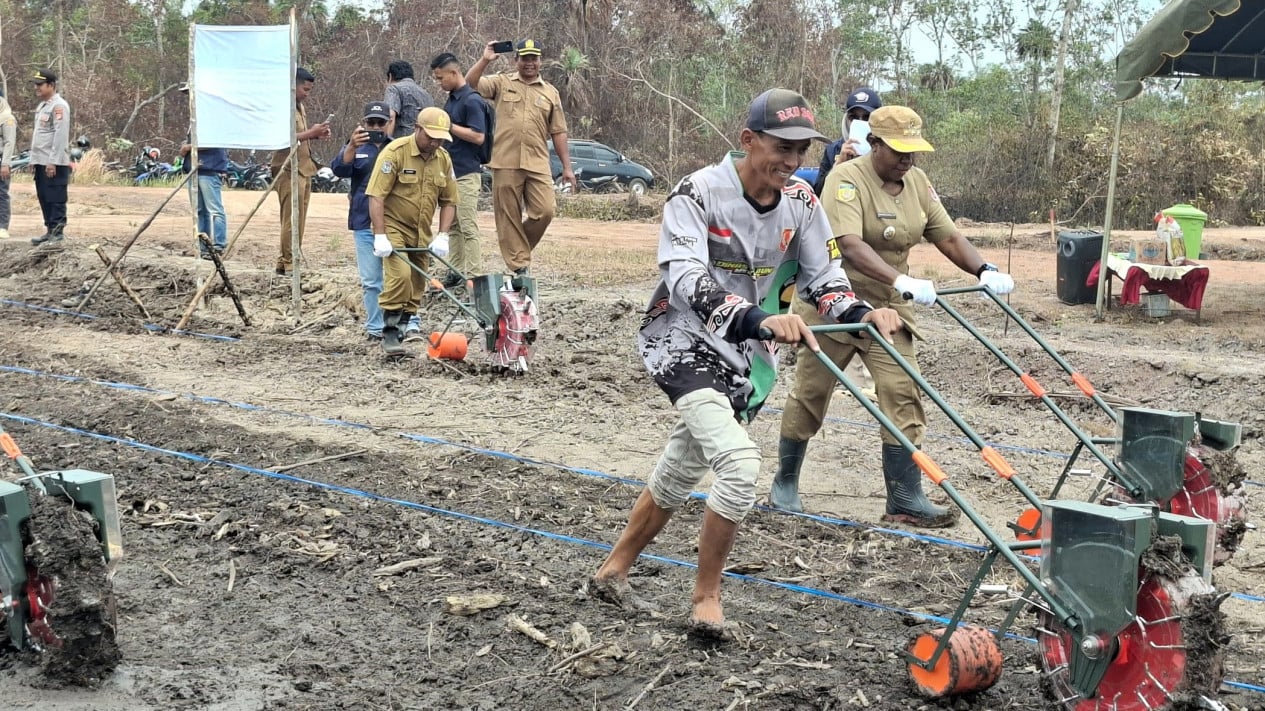
To address the problem, the Ministry of Transmigration and the Bogor Agricultural University (IPB) Patriot Expedition Team (TEP) have proposed two rice varieties, IPB 9G and IPB 15S. They were planted on a four-hectare demonstration plot in Kurik District on 21 September 2026.
IPB 9G was developed for dry land, making it more water-efficient and relatively short-maturing. The variety is therefore considered suitable for the third planting season, which is marked by drought and high tides.
Kurik District Head Mariana Belekubun said Salor farmers had so far planted Inpari 32, yielding five to six tonnes of harvested dry paddy per hectare. By comparison, IPB 15S has a potential yield of 10.16 tonnes and IPB 9G 9.09 tonnes of milled dry paddy per hectare. Both are classified as soft-textured rice varieties.
They also have shorter growing periods. IPB 15S can be harvested 100 to 105 days after sowing, while IPB 9G takes 110 to 113 days. A total of 240 kilogrammes of seed was planted on the demonstration plot, or about 60 kilogrammes per hectare.
Source: jawawa.id (https://jawawa.id/newsitem/government-steps-up-irrigation-infrastructure-and-rice-seed-supply-in-transmigration-areas-to-achieve-food-1791910287)
Originally published by VIVA.co.id (https://www.viva.co.id/bisnis/1935551-wujudkan-swasembada-pangan-pemerintah-pacu-infrastruktur-pengairan-dan-bibit-padi-di-kawasan-transmigrasi), translated from Indonesian