
Government Spokespersons Urged to Be Responsive and Humanistic in Digital Sphere
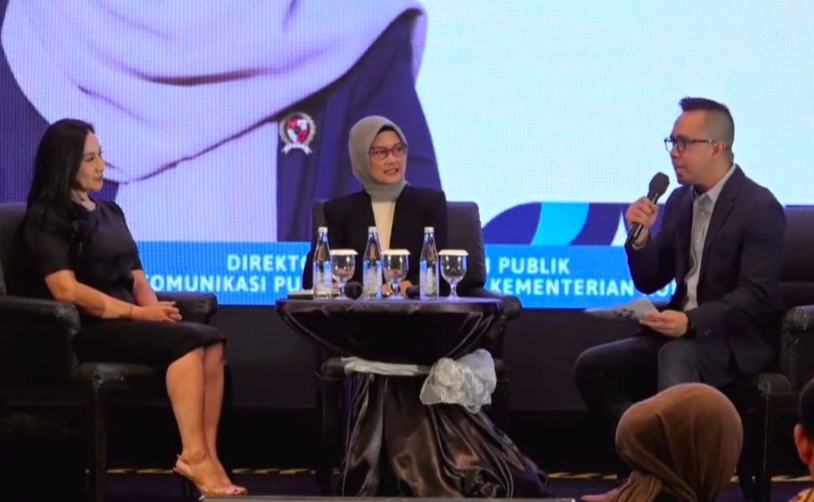
Government spokespersons are required to navigate increasingly complex public communication dynamics amid the growth of digital media and changing public information consumption habits. This emerged during a Technical Guidance (Bimtek) for Government Spokespersons themed ‘One Message, One Voice, Trusted by the Public’ held in Bandung, West Java, on Tuesday (23/6).
Communications practitioner Adita Irawati stated that the media has become a space for narrative competition that can shape public perception of policies and government institutions. Therefore, spokespersons need to understand that every statement they make has the potential to form a particular viewpoint within society. ‘The media is a space for narrative competition. Do not let the role of spokesperson open up opportunities for framing that can create conflicting perceptions,’ said Irawati.
According to her, messages delivered to the public must be consistent, accurate, and aligned with the policies they represent. She also stressed that the main challenge in interacting with the media lies not in the journalists’ questions, but in the quality of the answers provided. ‘There are no wrong questions. There are only wrong answers. Journalists are free to ask anything, and the spokesperson’s task is to respond appropriately,’ said the former spokesperson for the Presidential Communication Office (PCO).
Irawati also emphasised the importance of adapting to developments in digital communication. Government spokespersons need to understand the digital media ecosystem and be able to apply the concept of digital messaging, which involves simplifying complex information into concise, clear, and easily understood messages. She noted that the increasingly short attention span of the public on social media demands effective message delivery without reducing the substance of the information.
On the same occasion, Indonesia Indicator’s Director of Communication, Rustika Herlambang, conveyed that the development of digital algorithms has changed the way people obtain, receive, and disseminate information. This condition presents a new challenge for the government in building effective public communication. ‘The algorithm era has changed how information is created, disseminated, and received by the public. Therefore, government public relations and spokespersons must adopt a new perspective in formulating communication strategies,’ said Rustika.
She explained that a Reuters Institute survey released in June 2026 showed public trust in information from the media stood at 32 percent. This finding indicates a significant shift in public information consumption patterns.
According to Rustika, people now often obtain information first through messaging apps and social media, including TikTok. Around 54 percent of the public access news via social media, while the majority consume information in video format through platforms like TikTok and YouTube. ‘As many as 70 percent of the public receive information through video-based platforms. This means the government must be able to package messages that are easy to understand, relevant, and suited to the characteristics of the media used by the public,’ she explained.
She added that public communication strategies need to consider the evolving social, economic, and political context. An approach that prioritises empathy is considered more effective in reaching the public than delivering information that focuses solely on data and figures. ‘When conveying policies, the government must understand the context felt by the public. Empathy is an important part of building effective communication,’ she said.
Rustika Herlambang also assessed that the ability to read digital conversation trends is an essential competency for government spokespersons. Communication strategies must be developed based on audience mapping, the level of public engagement, and the characteristics of the platforms used by the public. ‘Everything has changed. Therefore, government communication strategies must also change so that the messages conveyed remain relevant, trusted, and able to reach the public effectively,’ she concluded.
Meanwhile, the Director of Public Communication at the Ministry of Communication and Digital Affairs (Kemkomdigi), Nunik Purwanti, affirmed that the ministry continues to strengthen the role of government spokespersons, which is increasingly strategic in maintaining and building public trust amidst the torrent of digital information.
Nunik added that information transparency has changed the way the public obtains, consumes, and assesses government policies. Information moves very quickly, and public opinion can form in a short time, necessitating responsive and credible communication. ‘Government spokespersons have a very strategic role in ensuring every policy can be fully understood, every piece of circulating information can be accurately explained, and every public aspiration can be heard and forwarded as input for policy improvement,’ said Nunik.
Therefore, she explained that the implementation of the Government Spokesperson Technical Guidance is part of efforts to strengthen public communication while enhancing the capacity of spokespersons to face increasingly complex communication challenges. ‘Let us make public communication an instrument to strengthen democracy, increase public participation, and deliver a government that is increasingly open and trusted by the public,’ concluded Nunik Purwanti.