
Government Rolls Out Milk Hub Plan for MBG Program
Government Rolls Out Milk Hub Plan for MBG Program
Jakarta. Indonesia is preparing to roll out a network of small-scale milk processing hubs to support the Free Nutritious Meals (MBG) program, as the government seeks to boost domestic milk production and reduce reliance on imports.
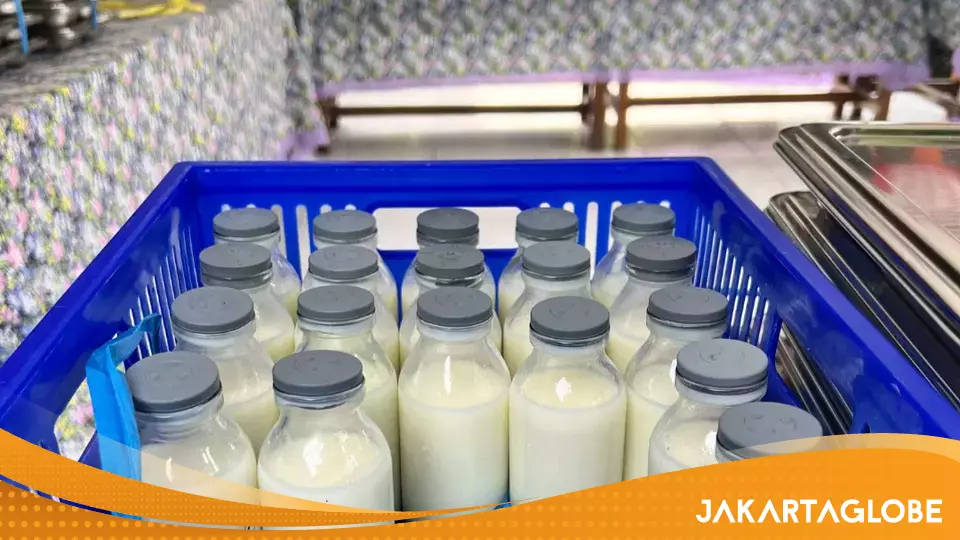
The Agriculture Ministry has introduced Dapur Susu Indonesia (Dasi), a concept that integrates small-scale milk processing hubs with Free Nutritious Meals (MBG) kitchens across the country.
Under the scheme, milk collected from local dairy farmers would be processed and supplied directly to nearby MBG kitchens, creating a more reliable market for fresh milk while supporting the expansion of dairy farming beyond Java, said Makmun, Director of Livestock Product Downstreaming at the Agriculture Ministry, at a National Milk Day 2026 press conference in Jakarta on Tuesday.
Makmun said a dairy farm with around 100 to 200 cows could be supported by a small-scale processing facility that distributes milk directly to surrounding MBG kitchens. The ministry has developed a prototype requiring less than Rp 5 billion ($305,000) in investment, capable of supplying milk to five to 10 nearby SPPGs.
“We have already developed a prototype. With an investment of less than Rp 5 billion, it is possible to build a milk kitchen that can supply around five to 10 MBG kitchens in the surrounding area,” he said.
The initiative is expected to create new market opportunities for smallholder farmers while accelerating the development of Indonesia’s dairy processing industry outside Java. Regions including Sumatra, Kalimantan, Sulawesi, Bali, Nusa Tenggara, and eastern Indonesia are seen as having significant potential for dairy farm expansion.
Indonesia’s milk consumption has remained relatively stagnant in recent years. Data from the Central Statistics Agency (BPS) and the National Food Agency (Bapanas) show annual milk consumption ranging between 16.27 kilograms and 16.6 kilograms per capita, far below the Food and Agriculture Organization’s benchmark of 30 kilograms per capita per year for countries with low milk consumption.
Makmun said advances in dairy farming technology have also enabled milk production to expand into lowland areas, reducing dependence on traditional highland farming regions.
“Many companies are now developing dairy farms in lowland areas, including in Subang and Brebes,” he said.
He described the MBG program as a major opportunity for Indonesia’s dairy sector, as milk is one of the key components of the government’s flagship nutrition initiative.
“This creates a good market. Small-scale producers used to struggle against large industries in promotion and sales. Now, through a government program, the development pathway and the off-taker are already in place,” Makmun said.
The ministry recorded Indonesia’s dairy cattle population at around 540,657 head, with more than 90% owned by smallholder farmers. However, domestic milk production currently meets only about 25% of national demand, with the remainder supplied through imports.
To reduce import dependence, the government is working to improve feed quality, animal health, and dairy cattle populations, while raising productivity.
“In many countries, average milk production exceeds 30 liters per cow per day. We want to increase productivity among our farmers from below 20 liters per day to above 20 liters, and hopefully reach 25 liters per day,” Makmun said.
As part of efforts to expand the national herd, the government and private sector imported nearly 15,000 pregnant dairy cows last year.
Separately, Tjatur Lestijaman, General Manager of Research and Development at Indolakto, said rising milk consumption is essential to improving nutrition and developing healthier human resources. He added that growing demand from the MBG program has prompted the dairy industry to expand production capacity and pursue new investments.
“For Indolakto, we have had to significantly increase production capacity because of this demand. New investment is necessary,” Tjatur said.
Tags: Keywords: