
Government Rice Programmes in Merauke Boost Production and Slash Prices
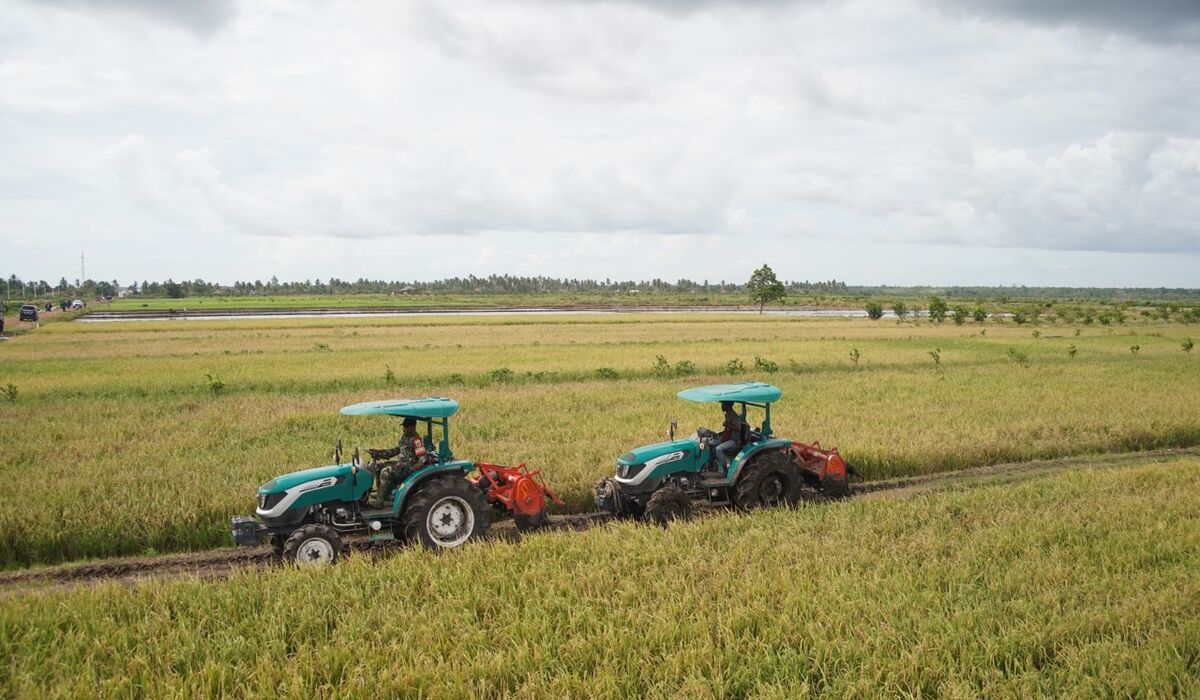
The government’s ‘Cetak Sawah Rakyat’ (CSR) and land optimisation (Oplah) programmes in Merauke Regency have proven successful in boosting food production while stabilising rice prices at the community level. Previously, the price of rice had reached Rp26,500 per kilogram, but now the public can obtain rice for around Rp13,500 to Rp15,500 per kilogram, following increased production and expanded planting areas in the region.
Head of the Merauke District Agriculture Office, Yosefa Rumaseu, stated that the drop in rice prices is a tangible impact of the production increase generated by the CSR and Oplah programmes, which are fully supported by the central government.
“Before these programmes, the price of rice in Merauke was quite high, even reaching around Rp26,500 per kilogram. After the implementation of the CSR and land optimisation, the price of rice sold at stalls and markets has fallen to around Rp15,500 per kilogram. Most importantly, the public can now buy rice at a more affordable price, while farmers still benefit from increased production,” Yosefa said.
According to Yosefa, agricultural development programmes have been in place for a long time. However, since 2024, support from the central government has significantly accelerated the utilisation of Merauke’s agricultural land potential. “In 2025, with the full attention of the central government, all existing potential is being further empowered through the CSR and Oplah programmes. Support includes substantial resources such as agricultural machinery, fertilisers, and other production inputs,” he added.
The impact of the programme is clearly visible in the 2025 production figures. Data from the Central Statistics Agency (BPS) shows that rice production in South Papua Province increased by 66.46 percent compared to the previous year. In 2024, rice production was recorded at 124,355.12 tonnes with a paddy harvest area of 47,168.57 hectares. In 2025, rice production rose to 207,006.95 tonnes with a harvest area reaching 79,433.92 hectares, an increase of 68.40 percent.
“With the major programme run by the President and the Minister of Agriculture, our production has increased by about 65 percent compared to before. This production increase has strengthened the rice supply, making prices more stable and affordable for the public,” Yosefa explained.
He added that the success of the programme is not only felt by consumers but also by farmers. The increase in production has managed to maintain a balance between affordable prices for the community and improved welfare for farmers. “There has been a decrease in rice prices, making it easier for the public to afford, while on the other hand, farmer welfare has also increased. This programme encourages a shift from traditional farming patterns to more modern ones. The value of farming enterprises has risen, and the community can obtain rice at more affordable prices,” he said.
Head of the Food Security, Livestock and Animal Health Office of Merauke Regency, Martha Bayu, echoed this sentiment. She stated that the local government routinely monitors rice prices through enumerator officers who record and report daily to the National Food Agency (Bapanas).
“We have enumerator officers who go to the field every day to monitor prices and report to Bapanas. For premium rice, the highest retail price (HET) is Rp15,800 per kilogram, while for medium rice it is Rp15,500 per kilogram,” she said.
Based on monitoring results in markets across Merauke City and other areas, rice prices are generally still below the government-mandated Highest Retail Price (HET). “From our observations, the price of rice sold in markets and stalls is still below the HET, both for premium and medium rice. There are some types of rice sold at higher prices due to transportation and distribution factors, especially to remote areas. However, overall, rice prices in Merauke remain under control and in accordance with government regulations,” Martha explained.
She added that the success of the CSR and Oplah programmes has not only impacted production increases but has also greatly helped in maintaining price stability and food affordability for the community. “From the perspective of food availability, price stabilisation, and affordability for the public, the Oplah and CSR programmes have been very helpful,” she said.
The positive impact of the programme is also directly felt by farmers, including Fransiskus Gebze, a holder of customary land rights in Merauke Regency. He acknowledged that the previously high price of rice has now become much more affordable because grain production continues to increase. “In the past, rice was very expensive. Now, people can buy it for around Rp15,000 per kilogram, down from Rp20,000. So I am grateful that the government opened up land here,” said Fransiskus.
According to him, the expansion of planting areas by the government has significantly increased grain production, ensuring the rice supply in Merauke. “Grain production continues to increase as the land is expanded. That is why the price of rice in Merauke is now more stable,” he said.
The success of the CSR and land optimisation programmes in Merauke demonstrates that production increases and price stabilisation can go hand in hand, supported by central government backing, agricultural modernisation, and the active involvement of local farmers. Merauke is not only strengthening its position as one of the nation’s food baskets but also proving that increased production can deliver more affordable food to the community.