
Government Removes Licensing Barriers for Foreign Workers, All Services Directed Through OSS
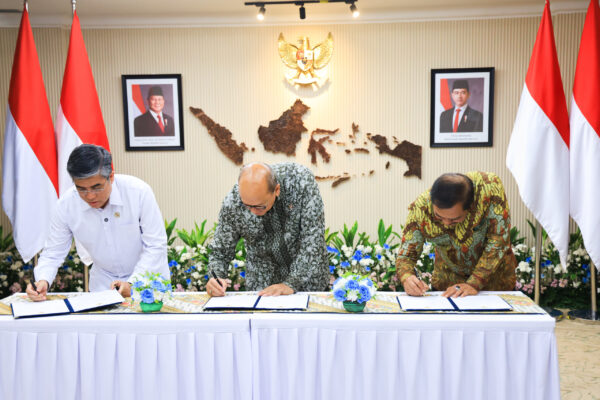
The government has begun unifying the service systems for the use of Foreign Workers (TKA) across ministries and agencies to strengthen investment governance and cut down on fragmented service processes. This integration is realised through the Online Single Submission (OSS) service, acting as a single gateway for the TKA service process.
The policy was marked by the signing of a Joint Decree (SKB) regarding the integration of cross-ministerial/agency TKA service systems based on a single entry through OSS in Jakarta on Wednesday (9/9/2026).
Minister of Manpower Yassierli stated that the unification of the system is designed to provide simpler, faster services and to offer certainty to the business world. Under this new scheme, TKA licensing services can be accessed through the OSS under the Ministry of Investment and Downstreaming. The system connects the SIAPKerja system owned by the Ministry of Manpower with the All Indonesia system under the Ministry of Immigration and Correctional Services.
“This integration of TKA services is part of the government’s effort to provide ease for the business world. The process must be simpler, faster, and certain. Integration must not add more stages, but rather provide better service,” said Yassierli.
TKA for Specific Competency Needs
Yassierli emphasised that the presence of TKA within the national investment ecosystem is not merely about the influx of foreign workers into Indonesia. Their use is directed towards meeting specific competency needs that are currently unavailable or limited. In this context, the presence of TKA is expected to provide a follow-on effect for Indonesian workers through the processes of technology and skill transfer.
At the same time, the governance of TKA must remain directed towards supporting the increase of employment opportunities for the local workforce. Therefore, service integration is considered a vital part of maintaining the balance between investment needs, service certainty, and the interests of the national labour market.
Yassierli also appreciated the cooperation between the Ministry of Manpower, the Ministry of Investment and Downstreaming/Investment Coordinating Board (BKPM), and the Ministry of Immigration and Correctional Services. According to him, cross-ministerial collaboration is the key to building a public service system that does not operate in isolation.
Rosan: Collaboration Must Impact the Economy
The Minister of Investment and Downstreaming/Head of BKPM, Rosan P. Roeslani, assessed that the service integration is a concrete form of strengthening synergy between ministries. According to Rosan, collaboration is essential because investment services involve many aspects and cannot be resolved by a single institution alone. He emphasised that this cooperation must proceed quickly and effectively, while remaining within the bounds of applicable regulations.
“Collaboration must run quickly, effectively, and remain in accordance with applicable provisions, so that it provides a positive impact on the economy, job creation, and community welfare,” said Rosan. With the unification of services, the government hopes investors will obtain a clearer administrative process and certainty in meeting TKA usage requirements.
Formalising Existing Cooperation
Meanwhile, the Minister of Immigration and Correctional Services, Agus Andrianto, stated that coordination between his ministry, the Ministry of Manpower, and the Ministry of Investment and Downstreaming/BKPM had actually been taking place before this cooperation was formalised. According to Agus, the signing of the Joint Decree is a step to provide a clearer legal basis for the collaboration that has been ongoing.
“This is the formalisation of what we have been doing. Our cooperation so far has been quite good; today we formalise it through the signing of this agreement,” said Agus. Agus noted that data unification is a crucial aspect of TKA service integration. With connected data, the government is expected to have a complete overview of the foreign worker process and the investments entering Indonesia. For investors, an integrated system is also expected to reduce administrative uncertainty.
Towards Single TKA Data
The integration of TKA services through OSS is ultimately not just a technical change in the licensing process. The policy reflects the government’s effort to build an investment ecosystem that is more interconnected between agencies. By implementing a system that unifies labour, investment, and immigration processes, the government possesses a stronger basis to ensure that the use of TKA aligns with needs and applicable regulations. On the other hand, the business community gains an integrated service pathway to fulfil their obligations. The government hopes this step will strengthen investment certainty without loosening supervision over TKA usage, while ensuring that the presence of foreign workers continues to provide added value to economic development and the enhancement of Indonesian workforce competencies.