
Government Raises Reference Price for Live Cattle by Rp1,000/kg to This Amount
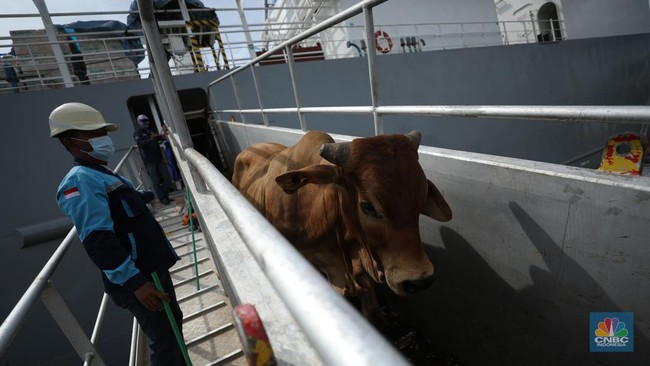
The government has officially decided to adjust the Reference Selling Price (HAP) for live cattle commodities. This increase is one response to global pressures beginning to affect imported food prices. Coordinating Minister for Food Affairs, Zulkifli Hasan (Zulhas), stated that the HAP increase for live cattle is estimated at around Rp1,000 per kilogram (kg). With this adjustment, the reference price for live cattle is in the range of Rp59,000 per kg. “There is an adjustment of about a thousand rupiah or more per kg for live cattle. From Rp58,000 to Rp59,000 something,” Zulhas said during a press conference at his office in Jakarta on Wednesday (22/4/2026). He explained that this increase is inseparable from the impact of global geopolitical conditions that are also driving up prices of several imported commodities, including live cattle. “Indeed, even though the war is far away, geopolitics does affect shipping tariffs. Because of that, several imported foods are making adjustments. For example, live cattle,” he said. Although there is an adjustment at the upstream level, the government assures that beef prices in the market remain within the set limits. Currently, consumer-level beef prices are said to still be in the range of Rp130,000 to Rp140,000 per kg. “The others remain the same. Still within the HAP (previously set). For example, the price (of beef) in the market is between Rp130,000 maximum Rp140,000 per kg. Still within the HAP range,” Zulhas explained. On the other hand, the rise in beef prices is also shifting consumer patterns. Demand for buffalo meat is said to be increasing as a more affordable alternative. “Then (buffalo) meat. Buffalo (previous price) from Rp80,000 to over Rp90,000 now per kg,” he said. Ministry of Agriculture Pushes for Relaxation of Live Cattle HAP Previously, the Ministry of Agriculture (Kementan) issued a warning regarding the surge in prices of imported feeder cattle from Australia, which is deemed to have exceeded normal assumptions. This condition is seen as potentially pressuring business actors and impacting beef prices, especially in regions dependent on imports like Jabodetabek. Director of Livestock Product Downstreaming at Kementan, Makmun, revealed that the price increase of cattle in the country of origin has been significant in recent times. “This is also a warning for all of us. Because the price of cattle in Australia has risen. So feeder heifer (fattening female cattle) as of 20 April the price is already US$4,” Makmun revealed during the Regional Inflation Control Coordination Meeting broadcast via YouTube of the Ministry of Home Affairs (Kemendagri), on Monday (20/4/2026). According to him, that figure is far above historical trends. “Our experience in previous years has never exceeded US$3.5,” he added. Meanwhile, for male feeder cattle, prices have also surged. “Whereas for male feeder cattle, it’s already at US$4.56, and if averaged US$4.32,” he explained. Based on Kementan’s calculations, the price increase directly impacts the CIF (Cost, Insurance and Freight) value up to the landed price in Indonesia. After factoring in shipping costs, insurance, exchange rates, as well as handling and loss costs, the price of imported feeder cattle is recorded as far above the Reference Purchase Price (HAP). “Added with travel insurance until then quarantine actions in Indonesia, the price per kg of live female feeder cattle is at Rp77,177. For male feeder cattle, it’s already Rp86,139. Meanwhile, our HAP maximum is Rp58,000 per kg live weight,” said Makmun. He assessed that this condition poses a dilemma for business actors due to the quite wide price disparity. “This looks like a somewhat complicated position. Because our HAP price is a maximum of Rp58,000 per kg live, while the buying price for friends (importers) is already very high like this,” he said. Therefore, Kementan is urging the National Food Agency (Bapanas) to immediately take policy adjustment steps. “This is a warning, hopefully friends from the Food Agency are on this opportunity, maybe later how our steps to bridge the price increase at the origin,” he said.