
Government pushes renewable energy development amidst geopolitical instability
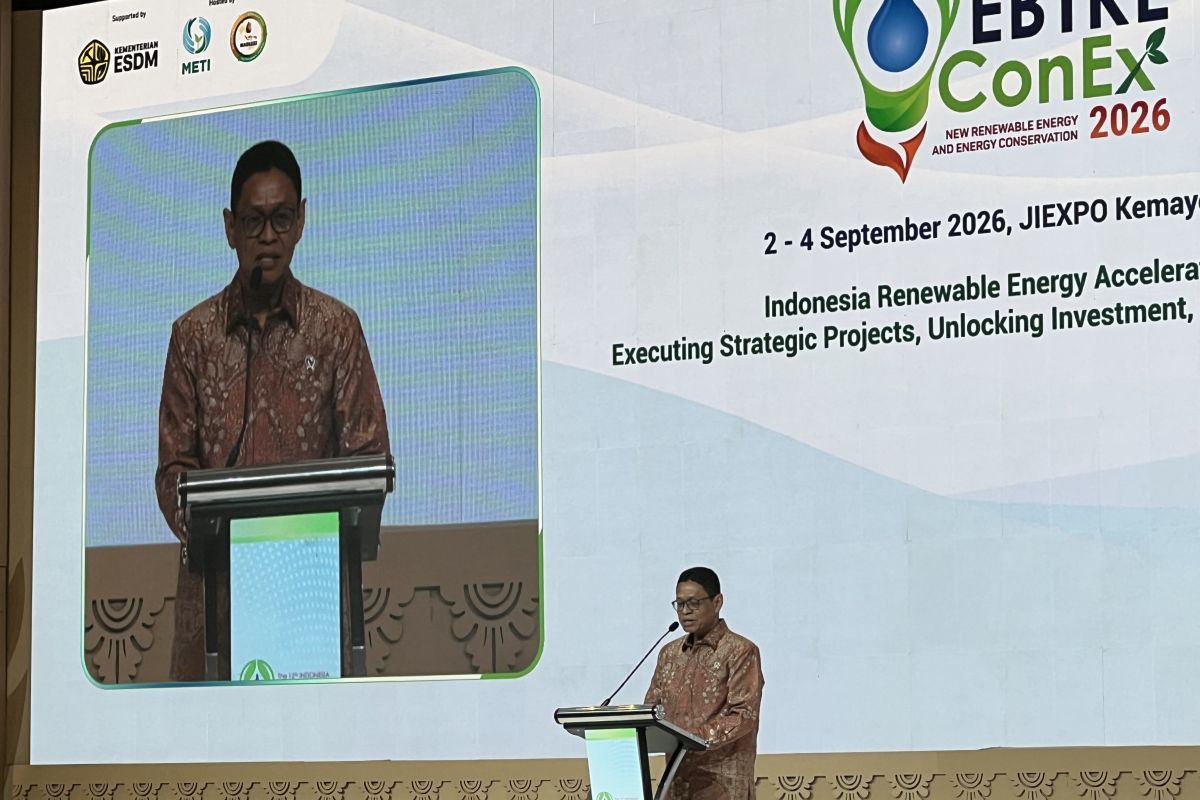
Jakarta (ANTARA) - The Government, through the Ministry of Energy and Mineral Resources (ESDM), is encouraging the development of new and renewable energy (EBT) amidst geopolitical instability that is disrupting global energy supply chains.
“This is part of our effort to promote the increase of new and renewable energy. It is part of the government’s priority programme outlined in the Astacita,” said the Deputy Minister of Energy and Mineral Resources, Yuliot, during The 12th IndoEBTKE ConEx 2026 held in Jakarta on Wednesday.
Yuliot believes that the development of renewable energy will contribute to energy self-sufficiency. He noted that once energy self-sufficiency is achieved, all economic activities can be carried out effectively.
Conversely, without sufficient energy availability, all economic and transport activities will face significant obstacles.
“Furthermore, through renewable energy, we hope to see the creation of jobs,” Yundiot added.
This job creation, he continued, can be realised through investment and entrepreneurship opportunities that can be utilised by the Indonesian people.
Several efforts already undertaken by Indonesia to develop renewable energy include implementing the B50 biodiesel programme, converting conventional fuel-based vehicles to electric vehicles, and promoting the construction of renewable power plants sourced from solar, geothermal, and hydro energy.
Previously, Yuliot stated that if the government does not anticipate geopolitical instability with renewable energy, the inflation of energy compensation and subsidies could reach Rp300 trillion above the previously allocated budget.
Currently, the government has allocated Rp210.1 trillion for energy subsidies, representing approximately 65.87 per cent of the total subsidy budget in the 2026 State Budget (APBN), which is set at Rp318.9 trillion.
When combined with compensation, the total budget disbursed by the government for energy security amounts to Rp381.3 trillion.
Meanwhile, quoting Sputnik, global Brent crude oil prices have risen to exceed US$96 per barrel amidst a new wave of attacks between the United States and Iran, according to trade data.
At 00:58 GMT, Brent crude oil futures for December delivery rose 1.48 per cent from the previous close to US$96.65 per barrel. Meanwhile, WTI crude oil futures for October delivery rose 1.98 per cent to US$92.20 per barrel.
These figures represent a significant surge compared to the end of August.
Brent crude prices had previously dropped in late August 2026 to the range of US$86.2 per barrel, continuing a 2.4 per cent decline in the previous session. Similarly, West Texas Intermediate (WTI) also fell 5.5 per cent to US$80.40 per barrel.