
Government Pursues National Milk Self-Sufficiency from Upstream to Downstream
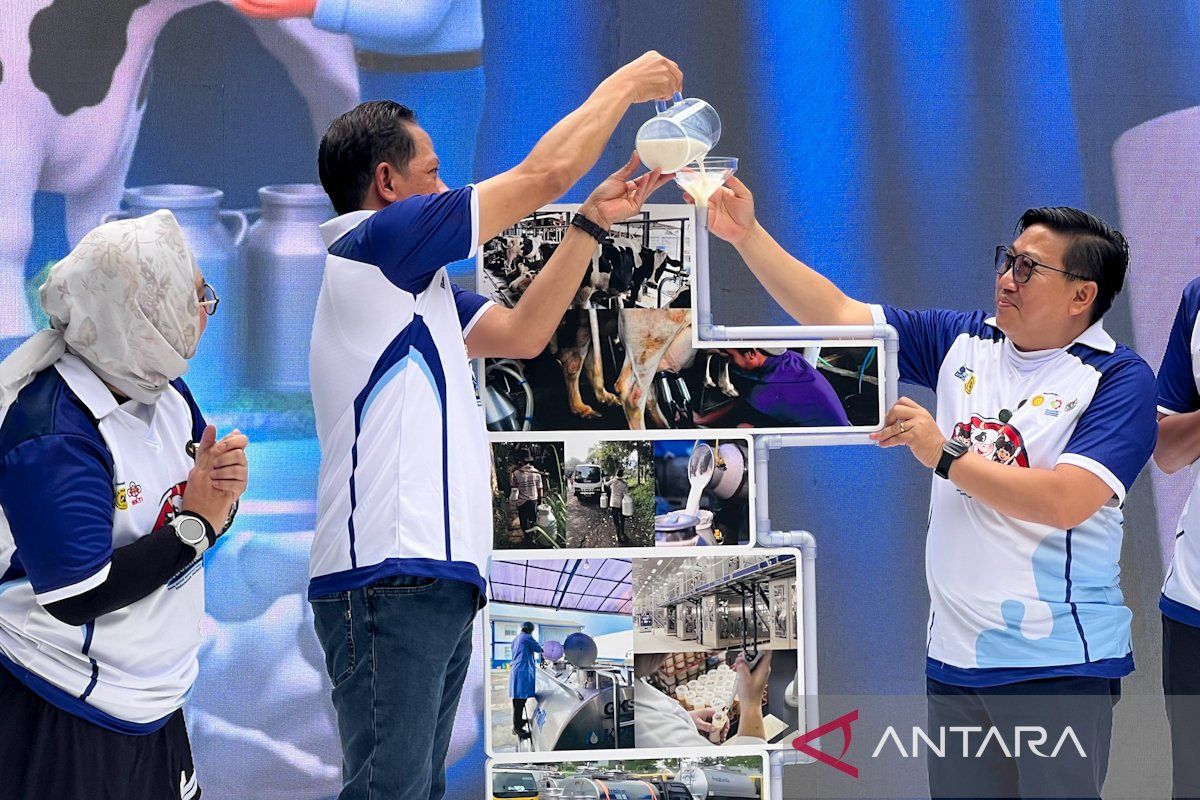
The government is pursuing national milk self-sufficiency from upstream to downstream by strengthening production, research, downstream processing, and cross-sector collaboration to support food security and the development of a quality generation towards Golden Indonesia 2045.
Deputy Coordinating Minister for Food Hanif Faisol Nurofiq stated that around 80 percent of national milk demand is still met through imports, so the sector’s self-sufficiency needs to be strengthened gradually and sustainably. Indonesia is currently only able to produce 1 million tonnes of the 4 million tonnes required annually.
“This commemoration of Nusantara Milk Day must not be interpreted merely as a ceremonial event. Instead, today we should evaluate how much homework we still must do together,” Hanif said during the opening of Nusantara Milk Day 2026 in Jakarta.
He stressed that Nusantara Milk Day must be a momentum for joint evaluation to accelerate the development of the national dairy sector, which has long faced various challenges. He noted that the development of the dairy sector cannot be solely burdened on the Ministry of Agriculture, but requires mutual cooperation from all stakeholders, from the government and businesses to academics and the wider community.
He revealed that the national milk consumption level remains low, at around 16.2 to 16.8 litres per capita per year, equivalent to one spoonful of milk per day, far below the ideal requirement. Milk contains various essential nutrients such as protein, calcium, potassium, vitamins A, B12, and D, and probiotics, which play a major role in building bone strength, muscles, and brain development in the younger generation.
He said human resource development must be a primary concern because Indonesia currently has around 70 percent productive-age population, a vital asset in realising Golden Indonesia 2045.
“We must pay serious attention to this. Learning from the development of milk, this must also be a serious concern for all of us. Since the 1920s, investment entered to fulfil our national milk supply. It then developed rapidly from 2000 to 2020,” he explained. “However, everything is still import-oriented. Our milk needs, that one spoonful a day, 80 percent is obtained from imports. We have been shackled by importation for quite a long time.”
He added that dependence on imports could pose a risk to national food security when global geopolitical upheavals potentially disrupt food supplies from the world’s major supplier countries. “What President Prabowo Subianto conveyed, to truly make food security a national priority programme, can no longer be postponed,” Hanif stressed.
Therefore, the government is encouraging the strengthening of the national dairy ecosystem through the development of an integrated system from the upstream, midstream, to downstream sectors to meet domestic needs. Hanif assessed that upstream sector development needs to focus on increasing livestock population and productivity suited to Indonesia’s tropical climate characteristics, so as not to be completely dependent on livestock from subtropical regions.
Furthermore, research and innovation need to be strengthened to produce livestock varieties adaptive to local conditions while increasing milk productivity, making the national industry more competitive and sustainable. Hanif explained that the development of the national dairy sector still faces challenges because most of the dairy cows currently used originate from subtropical regions such as Europe, Australia, and New Zealand, which have different climatic characteristics from Indonesia.
He noted that Indonesia is a tropical country located around the equator, thus requiring livestock types capable of optimally adapting to tropical temperatures, humidity, and environment to support milk productivity. He assessed that using livestock from subtropical regions often requires specific environmental adjustments, including rearing in highland areas, making the development of livestock varieties suited to Indonesia’s tropical character a crucial necessity.
In addition to strengthening the upstream sector, the government also emphasised the importance of increasing the capacity of the milk processing industry in the midstream and downstream sectors through building integrated industries so that the national dairy supply chain becomes stronger and more sustainable. “This is what we must really think about. Starting from the upstream, how much milk production can we actually generate in our country,” Hanif concluded.