
Government prepares strategy to achieve garlic self-sufficiency
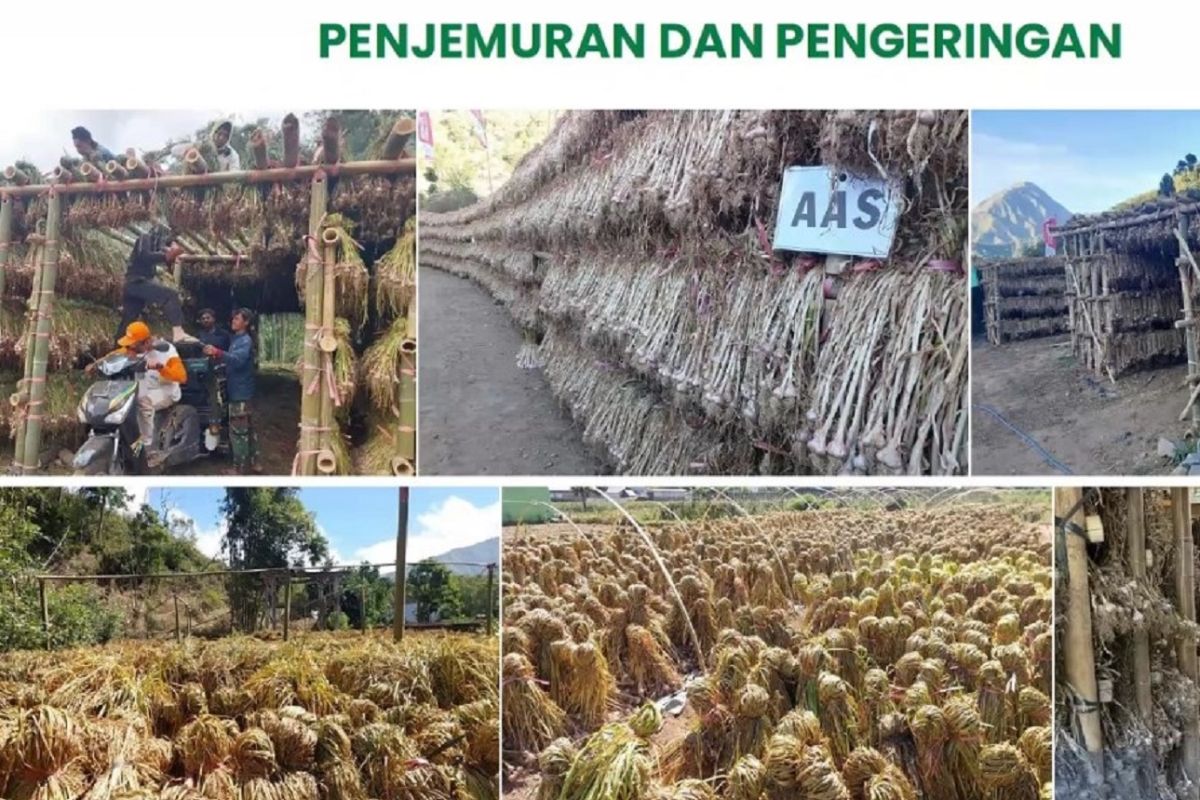
We are optimistic about the existing land potential for garlic development; Indonesia can return to achieving self-sufficiency.
Jakarta (ANTARA) - The government is preparing several strategies to achieve garlic self-sufficiency, with a target to meet domestic needs within three years. The Director of Horticulture Seed, Ministry of Agriculture, Muhammad Agung Sunusi, stated in Jakarta on Wednesday that Indonesia once achieved garlic self-sufficiency in 1995, with a production of 152,421 tonnes.
However, garlic production has continued to decline, reaching only 39,438 tonnes in 2023. Consequently, Indonesia has become a major importer, with imports reaching 602,745 tonnes in 2019, 555,886 tonnes in 2024, and projected to reach 525,640 tonnes in 2025.
“We are optimistic that with the existing land potential for garlic development, Indonesia can once again achieve self-sufficiency,” said M. Agung Sunusi during a webinar titled “Subsidised Fertiliser Support for the Acceleration of Garlic Self-Sufficiency.”
Agung stated that by leveraging potential garlic hubs such as Temanggung (Central Java), East Lombok (West Nusa Tenggara), and Enrekang (South Sulawesi) which previously supported self-sufficiency, the government is now prioritising domestic garlic development. Furthermore, garlic has been designated as a strategic commodity receiving special budget support and subsidies for production inputs, particularly fertiliser.
Based on data from the Agricultural Land Resources Modernisation and Assembly Centre (BRMP SDLP), the potential land for garlic cultivation reaches 1.52 million hectares (ha). This land is distributed across Sumatra (699,048 ha), Java (327,081 ha), Kalimantan (14,065 ha), Sulawesi (247,232 ha), Bali and Nusa Tenggara (180,454 ha), and Maluku and Papua (55,577 ha).
For this year, the government has allocated 5,000 ha for garlic development, covering Central Java (2,240 ha), West Nusa Tenggara (762 ha), North Sumatra (563 ha), East Java (358 ha), and West Java (245 ha).
However, Agung acknowledged several challenges in achieving self-sufficiency, including improving competitiveness in terms of size and price, increasing local garlic consumption, and enhancing human resources among farmers. Therefore, the government is accelerating production from upstream to downstream, supported by the state budget (APBN).
“With the challenge of high garlic imports, steps must be taken to reduce imports gradually. The government has created a scenario to achieve self-sufficiency in both garlic seeds and consumption garlic,” he said during an event organised by Tabloid Sinar Tani in collaboration with PT Pupuk Indonesia.
The scenario involves expanding seed production areas to 5,000 ha for a 20,000-tonne yield by 2026. By 2027, planting areas are expected to reach 20,000 ha with a seed production of 80,000 tonnes. In 2028, the planting area is targeted at 80,000 ha to produce 120,000 tonnes of seeds and approximately 320,000 tonnes of consumption garlic. By 2029, the planting area is projected to reach 120,000 ha, producing 120,000 tonnes of seeds and 630,000 tonnes of consumption garlic.
Upstream strategies include research to increase productivity, specifically bulb size and accelerated dormancy, alongside cultivation technologies for high yields. Downstream strategies will focus on promotion, market access, and partnerships. The government has also proposed regulations for the Government Purchase Price (HPP) of wet bulb garlic at Rp 12,000/kg and the Government Reference Price for dry seed bulbs at Rp 46,000/kg.
Strengthening Seed Production
The Head of the BRMP Horticulture Centre, Inti Pertiwi Nashwari, added that they are strengthening the garlic seed system through the development of new superior varieties (VUB) that are climate-adaptive and suitable for medium altitudes, as well as rapid and mass seed technology such as tissue culture.
Currently, the BRMP Horticulture source seed production for 2026 covers 177 ha, with a target of 593 tonnes of source seeds. Locations include North Sumatra (13 ha), Jambi (5 ha), South Sumatra (3 ha), West Java (106 ha), Central Java (20 ha), East Java (5 ha), and West Nusa Tenggara (25 ha).
“We are also continuously seeking technology so that in the future, garlic can be planted off-season. Additionally, we are conducting purification to improve seed quality,” she added. Furthermore, the government is preparing Standard Operating Procedures (SOP) for garlic cultivation to increase productivity up to 20 tonnes/ha through the ‘Proliga’ (Multiplied Production) technology.
Robin Radhian Lee, Vice President of Customer Management at Pupuk Indonesia, noted that fertilisation is a key factor in increasing garlic productivity, contributing 25 per cent. Therefore, he stated that the use of subsidised fertiliser for garlic must be optimised to ensure it is ‘Five Corrects’: Correct Target, Correct Type, Correct Dose, Correct Time, and Correct Method.
“We support the government in achieving self-sufficiency. We are ready to collaborate to enhance garlic production achievements,” he concluded.