
Government Prepares Rp195 Trillion for Food Security, How Much for Fertiliser?
The government has again increased the food security budget in the 2027 State Budget Draft (RAPBN). The value reaches Rp195.3 trillion, up 2.3% compared with the 2026 outlook of Rp190.9 trillion.
This increase continues the upward trend in food budgets in recent years.
The Ministry of Finance noted that the food security budget grew by an average of 17.4% in 2022–2025, while in 2026 it is estimated to jump by 32.7%. Land development, agricultural infrastructure, and support for production tools and facilities are the main drivers of the increase.
Entering 2027, the government is directing the food budget towards increasing production capacity while maintaining supply and prices.
The focus includes agricultural intensification and extensification, modernisation of agriculture and fisheries, infrastructure, food reserves, and strengthening supply chains.
In terms of implementation, the food security budget through ministry and agency spending reaches Rp72.9 trillion. The allocation is spread among the Ministry of Agriculture, the Ministry of Marine Affairs and Fisheries, the National Food Agency, the Indonesian Quarantine Agency, the Ministry of Public Works, and the Coordinating Ministry for Food.
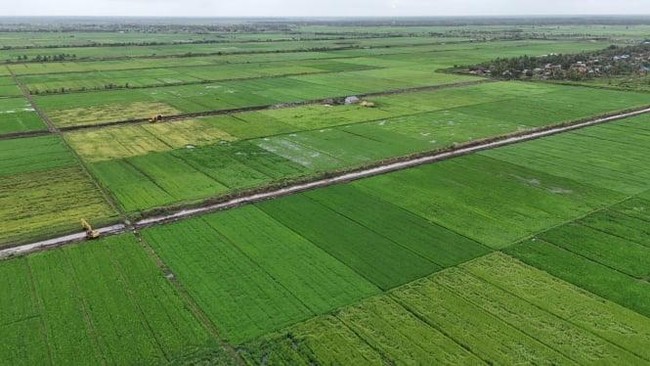
The government has also set more concrete production targets. Rice areas are targeted to reach 2.7 million hectares in 2027, with 100,000 hectares of new rice fields and 200,000 hectares of agricultural land optimisation.
Production support includes 23,528 units of pre-harvest agricultural machinery, 55,765 hectares of irrigation networks, and the construction of 14 dams that are still ongoing.
Productivity figures show why the government remains aggressive in expanding production capacity.
Based on data from Statistics Indonesia (BPS) cited by the Ministry of Finance, rice productivity rose from 52.38 quintals per hectare in 2022 to 53.18 quintals per hectare in 2025.
Maize productivity also increased from 57.08 to 57.74 quintals per hectare over the same period.
Improvements are also visible in a number of commodities. Broiler chicken production increased from 3.77 million tonnes in 2022 to 4.17 million tonnes in 2025. Laying hen egg production rose from 5.57 million tonnes to 6.41 million tonnes. On the welfare side, the Farmers’ Terms of Trade (NTP) in June 2026 reached 127.65, up 4.87% compared with 121.72 in June 2025. The Fishermen’s Terms of Trade (NTN) also rose 5.89% to 107.47.
On the financing side, the government has prepared Rp22.1 trillion to support food security. A total of Rp22 trillion is directed towards food security investment, while Rp66.8 billion is allocated for investment in the International Fund for Agricultural Development.
Fertiliser Subsidy
One of the main pillars of this budget is the allocation for fertiliser subsidies, which has been increased to Rp48.2 trillion in 2027. This increase is intended to guarantee farmers’ access to fertiliser at affordable prices in order to boost the productivity of strategic agricultural products.
The government also emphasises the importance of the ‘7 Tepat’ principle in fertiliser distribution, namely the right quantity, type, price, time, quality, place, and recipient. In addition to physical subsidies, financing support is also strengthened through interest subsidies on loans for the management of Government Food Reserves (CPP) and the Warehouse Receipt System Subsidy (SSRG) scheme.
Source: jawawa.id (https://jawawa.id/newsitem/government-prepares-rp195-trillion-for-food-security-how-much-for-fertiliser-1787050313)
Originally published by CNBC Indonesia (https://www.cnbcindonesia.com/research/20260818103048-128-760199/pemerintah-siapkan-rp195-t-untuk-ketahanan-pangan-berapa-untuk-pupuk), translated from Indonesian