
Government Prepares Electric Vehicle Incentives, Regulatory Certainty Poses a Challenge
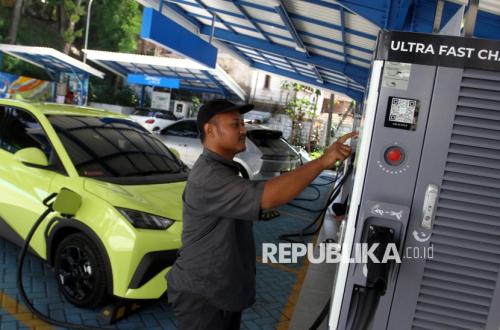
An energy analyst and Project Coordinator at ENTREV, Eko Adji Buwono, says incentives specifically for nickel manganese cobalt (NMC)-based electric vehicles are a key factor in strengthening the national EV ecosystem, which should be built around domestic natural resources. He notes policy support should extend across the battery value chain from upstream to downstream.
‘Incentives should not be limited to consumers of electric vehicles. The government should broaden fiscal support for the NMC battery industry—from smelters, precursors, cathodes to cell manufacturing—to foster a more integrated domestic EV ecosystem,’ he said in Jakarta on Thursday (21 May 2026).
Currently, the government is preparing subsidies for electric vehicles with a total allocation of 200,000 units for motorbikes and cars, planned to start in June 2026. The policy aims to curb imports and long-term gasoline consumption.
In the proposed scheme, the government would provide a 100% government-borne VAT (PPn) for battery-electric vehicles based on nickel-based NMC, while EVs with other battery chemistries would receive a 40% government-borne VAT.
The government is also preparing a Rp 5 million subsidy for electric motorcycles per unit.
Eko cautions that policy consistency is crucial to sustain investment in the national EV battery industry. The government needs to deliver long-term regulatory certainty, at least for three to five years, to give industry players confidence to develop the domestic NMC battery supply chain.
Market growth for electric vehicles in Indonesia has been notable in recent years. According to data from Gaikindo, BEV sales reached 56,204 units in 2024 and rose to 114,413 units in 2025. EV sales are still dominated by lithium iron phosphate (LFP) batteries. In 2024, LFP EVs accounted for 46,814 units or 83.3% of the market. By contrast, NMC/NCMA-based EVs stood at 9,390 units or 16.7%.
LFP dominance began to wane in 2025, accounting for 77.2% with 88,344 units. Meanwhile, NMC-based EVs rose to 26,069 units (22.8% of total national EV sales). NMC-based EVs grew faster, with sales rising 177.6% in 2025, compared to an 88.7% growth for LFP.
Eko emphasises that this growth momentum must be safeguarded through more comprehensive fiscal policy to support the development of the domestic NMC battery ecosystem. The support package would include VAT relief (PPnBM DTP), zero import duties, and VAT relief linked directly to the development of NMC battery technology and its components. He also urged the government to provide tax allowances or royalty allowances for domestically sourced mineral-based precursors, a move seen as vital to strengthening the downstreams of the national battery industry.