
Government Prepares 28 Sites for Nuclear Power Plant Projects
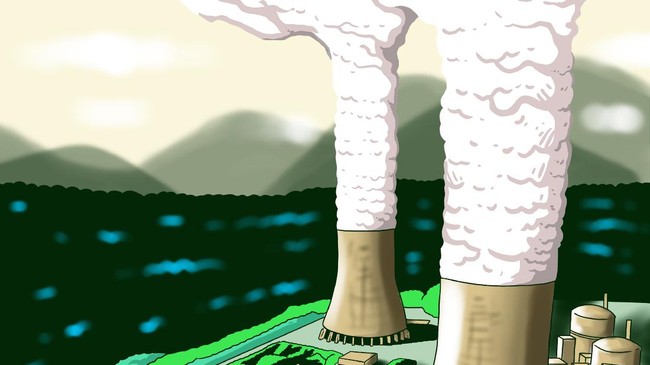
The Energy and Mineral Resources Ministry (ESDM) is preparing 28 sites for nuclear power plant projects in Indonesia.
Site preparations are being carried out in line with the target for nuclear power plants to begin operating under the 2025–2034 Electricity Supply Business Plan (RUPTL).
Deputy Energy and Mineral Resources Minister Yuliot Tanjung said the government was discussing national nuclear energy planning with state-owned electricity company PT PLN (Persero). He stressed that sites must be prepared early because power plant construction takes a long time.
“There are 28 sites that were prepared some time ago, and there are several additional sites that we will soon [prepare]. Some of those previously considered were floating sites,” Yuliot said at the Energy Ministry office in Jakarta on Thursday, 22 October 2026.
The government aims for Indonesia to have at least 500 megawatts (MW) of nuclear power connected to the electricity grid by 2032–2034. Preparing sites now is considered important because nuclear power plant construction takes between seven and 10 years.
“If we do not start consolidating and planning, our RUPTL target is to have at least 500 MW on-grid by 2032–2034. Since there is a target date, we need to prepare now: nuclear power plants take seven to 10 years to build. If the target is 2034, we must start preparing the sites now,” Yuliot said.
He said large-scale electricity needs in some regions could not be met by relying solely on new and renewable energy. Nuclear power plants would be needed to provide stable and continuous electricity at a large capacity.
“In some areas, the electricity system has significant potential demand that cannot be met only by new and renewable energy. We also need to develop substantial electricity capacity, including supply from nuclear power plants. In many countries, such as France, nuclear power provides the largest share of electricity—nearly 70%,” he said.
Previously, to support nuclear power plant development planning, the government, through BATAN and the National Research and Innovation Agency (BRIN), conducted site surveys in various regions. The assessments considered seismic conditions, peak ground acceleration (PGA), volcanic hazards and surface faulting.
All 28 surveyed areas were deemed to have potential for nuclear power plants, with a combined development capacity estimated at up to 70 gigawatts (GW).
Based on these potential areas and national electricity system requirements, the initial phase of nuclear power development is planned for the Sumatra and Kalimantan power systems.
Indonesia plans to build nuclear power plants with a total capacity of up to 7 GW by 2040. The plan is included in a draft of the RUPTL through 2040.
Darmawan Prasodjo, who was PLN president director at the time, said the current 2025–2034 RUPTL officially includes a 500 MW nuclear power plant, using small modular reactor (SMR) technology.
The draft RUPTL through 2040, meanwhile, proposes nuclear power capacity of up to 7 GW—an additional 6.5 GW over five years.
“The 500 MW in the RUPTL is only the first phase. The RUPTL currently being discussed, which runs through 2040, could bring the total to around 7 GW,” Darmawan said at a hearing with Commission XII of the House of Representatives in Jakarta in late August 2025.
PLN has called for stronger legal provisions to support domestic nuclear power plant development, particularly through a planned revision of Law No. 30 of 2009 on Electricity.
The company has also stressed the importance of building transmission networks to deliver electricity generated by nuclear power plants. PLN says it needs government support, particularly financial assistance.
Darmawan said transmission network development would require substantial investment, while returns in Indonesia were relatively low.
“The required funding is around Rp434 trillion. The rate of return is only around 2–4%, while the current average cost of funds is about 8%,” he said.