
Government plans to rejuvenate 9,000 hectares of coconut plantations in 2027
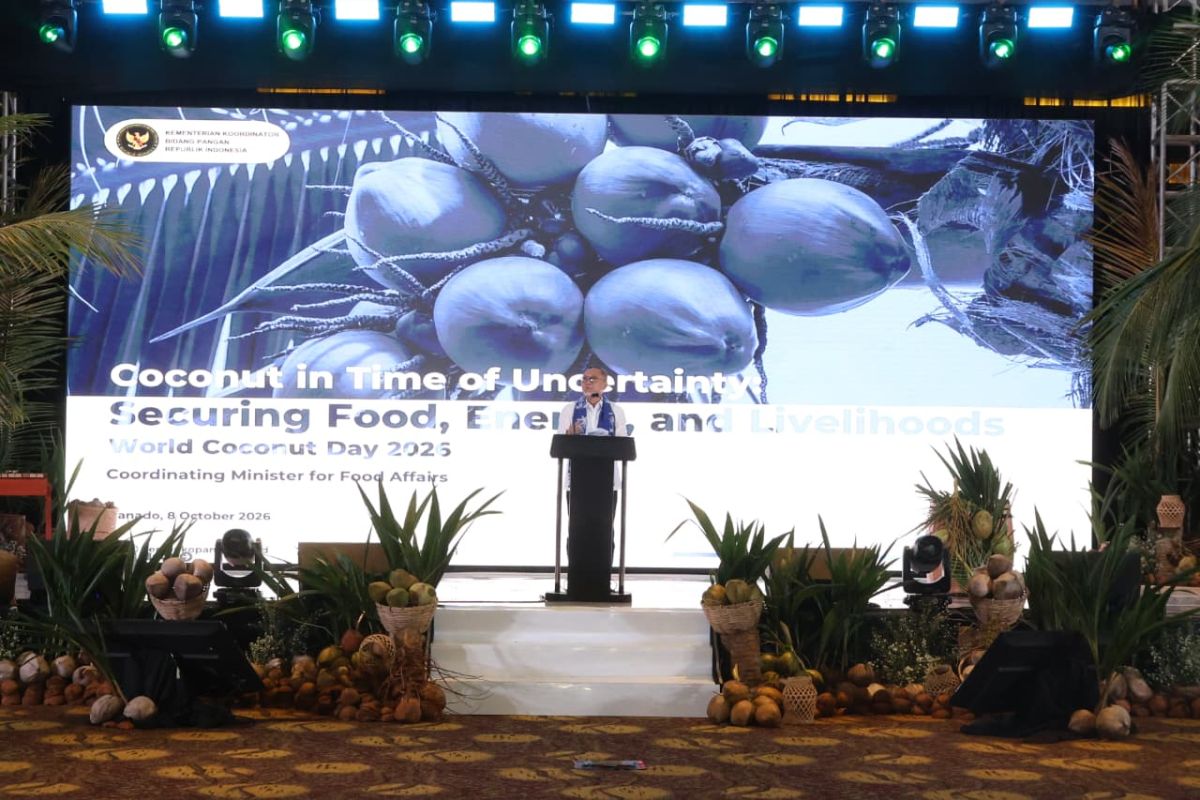
Jakarta (ANTARA) — The government is preparing to rejuvenate 9,000 hectares of coconut plantations in 2027 as part of efforts to improve the productivity of ageing crops and strengthen the supply of raw materials for Indonesia’s coconut-processing industry.
Food Affairs Coordinating Minister Zulkifli Hasan said rejuvenation needed to be accompanied by the development of high-quality seedlings capable of bearing fruit sooner, in order to increase smallholder plantation productivity.
“Tall coconut varieties take a long time — six to seven years. So we need new varieties that can bear fruit in three years. We must not let ourselves fall far behind Thailand,” Zulkifli said in a statement received in Jakarta on Friday.
He made the remarks at the World Coconut Day 2026 event in Manado, North Sulawesi, on Thursday (8 October).
Under the Coconut Area Development Plan 2027, the government’s programme covers the development of 51,721 hectares: 42,721 hectares of plantation expansion and 9,000 hectares of crop rejuvenation.
The development is planned across several parts of Indonesia, from Sumatra, Java, Kalimantan and Sulawesi to Maluku and Papua.
Zulkifli said higher productivity was a government priority because many coconut trees in Indonesia were ageing, while international demand for the commodity continued to grow.
He said demand for coconuts now came not only from traditional food uses, but also from the food and beverage industry, which increasingly uses coconut-based products.
“People nowadays drink coffee without milk and use coconut, or coconut milk, instead. This is happening in China, Asia, India and elsewhere, so coconuts are becoming highly sought after,” he said.
Zulkifli said the increase in demand needed to be matched by stronger domestic production so farmers and the national processing industry could benefit from expanding market opportunities.
The government is therefore preparing a comprehensive approach to coconut development, from supplying seedlings and improving plantation management to expanding the capacity of processing industries.
He said downstream industry development was needed to ensure Indonesia did not rely solely on selling coconuts as raw materials, but could also produce processed goods with greater added value.
“We have to catch up quickly: with seedlings, plantation management, and industry and processing,” he said.
The Food Affairs Coordinating Minister said the programme involved the Ministry of Agriculture, the Ministry of Investment and Downstreaming, and the Daya Anagata Nusantara Investment Management Agency (Danantara), each according to its respective role.
He said strengthening coconut production and downstream processing was consistent with government policy to make smallholder plantations a priority in agricultural development.
“Coconuts will become one of the main commodities we develop,” Zulkifli said.
Through crop rejuvenation, the development of high-quality seedlings and expanded processing industries, the government aims to strengthen the competitiveness of Indonesian coconuts and increase the economic benefits for plantation communities.
Source: jawawa.id (https://jawawa.id/newsitem/government-plans-to-rejuvenate-9-000-hectares-of-coconut-plantations-in-2027-1791561200)
Originally published by Antara (Indonesian) (https://www.antaranews.com/berita/5779301/pemerintah-siapkan-peremajaan-9000-hektare-kelapa-pada-2027), translated from Indonesian