
Government invites Hipmi to participate in 100 GW solar power project
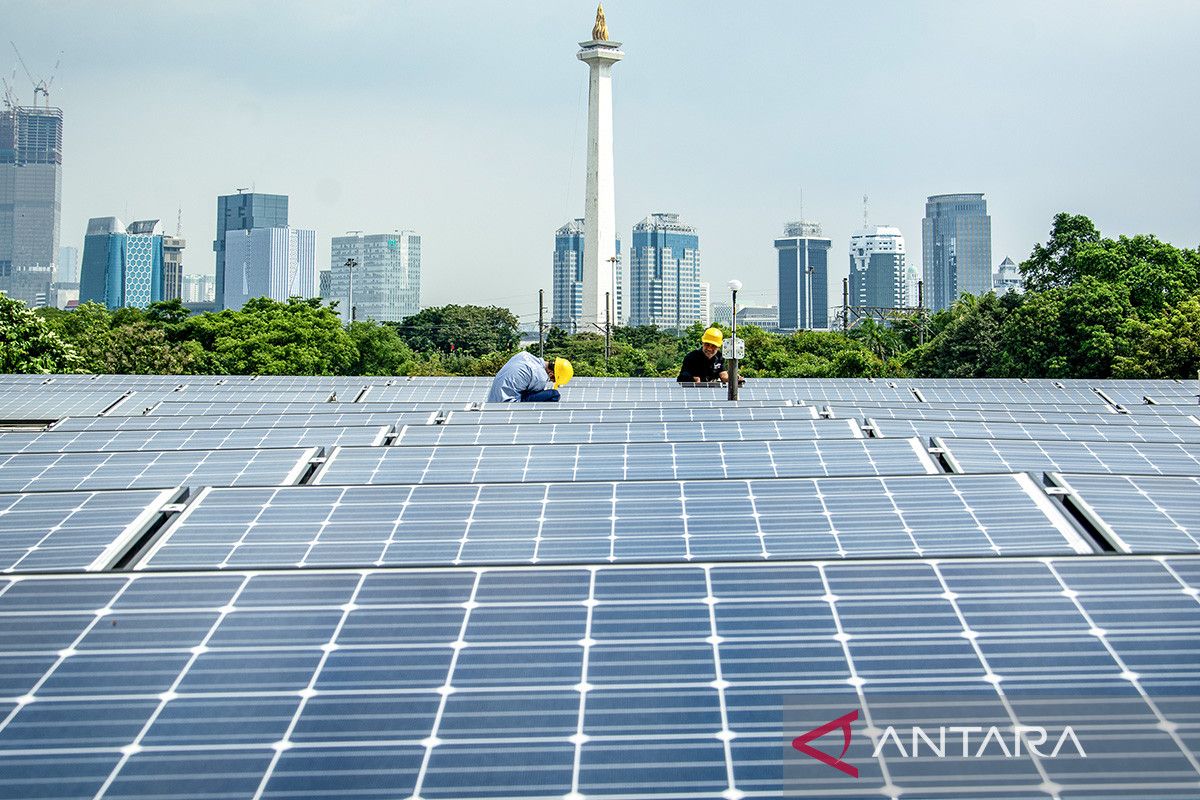
Jakarta (ANTARA) – The Ministry of Energy and Mineral Resources (ESDM) has invited entrepreneurs affiliated with the Indonesian Young Entrepreneurs Association (Hipmi) to participate in the development of solar power plants (PLTS) with a capacity of up to 100 gigawatts (GW).
During the Hipmi Power Development Forum 2026 in Jakarta on Wednesday, Jisman P. Hutajulu, Expert Staff to the Minister of ESDM for Strategic Planning, said the government targets the construction of PLTS with a total capacity of 100 GW within two years, from 2026 to 2028.
He noted that developing 100 GW of PLTS is estimated to require an investment of around USD 71.3 billion, or equivalent to IDR 1,140 trillion.
For the initial phase, the government targets a capacity of 17 GW.
“For domestic entrepreneurs, we provide facilitation and priority to ensure they can participate, especially in electricity (PLTS),” said Jisman.
He added that aside from opening business opportunities, the project is also expected to have a significant economic impact. The development of PLTS has the potential to create millions of jobs, both in construction and manufacturing sectors.
In the ESDM presentation, the development of 100 GW PLTS could absorb up to 2.8 million workers in the construction sector.
Meanwhile, in the manufacturing sector, the potential employment absorption ranges from 1.5 million to 3.1 million people, depending on the level of domestic product usage.
Economically, this project also has the potential to make a significant contribution to the national economy. The value of imports substitution is estimated to reach USD 14.4 billion to 28.9 billion, while its contribution to GDP ranges from USD 13.3 billion to 26.6 billion.
Additionally, the use of PLTS combined with energy storage systems (Battery Energy Storage System/BESS) is projected to save costs of up to IDR 73.9 trillion per year compared with fossil-fuel-based power plants such as gas and diesel.
Nevertheless, large-scale solar development also requires infrastructure support, especially transmission networks. The government estimates a need to build 48,000 kilometres of transmission lines with an investment value of around IDR 300 trillion.
“There is no energy transition without transmission… especially given that our renewable energy potential is far from current load centres,” Jisman said.