
Government Finalises Regulation for Village Cooperative Operations, New Law in the Pipeline
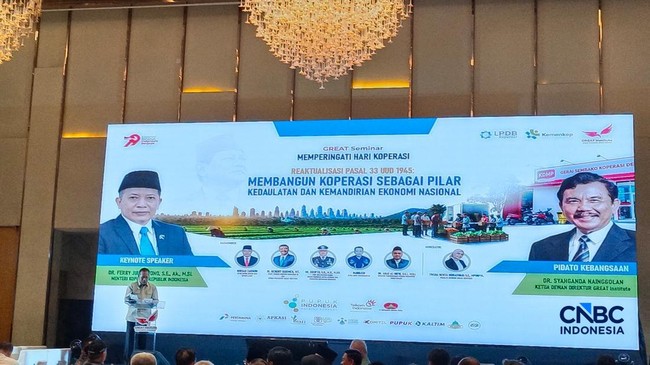
Jakarta, CNBC Indonesia — Minister of Cooperatives (Menkop) Ferry Juliantono has revealed the contents of a Presidential Regulation (Perpres) concerning the operational governance of the Red-and-White Village/Urban Ward Cooperatives (KDKMP), which the government is currently finalising.
The regulation will serve as the operational foundation for tens of thousands of cooperatives being prepared as state-owned distribution infrastructure.
Ferry said the government is not only completing the physical construction of the cooperatives, but also preparing the operational aspects through the Perpres, including the placement of cooperative managers who have undergone training.
“We are now finalising the presidential regulation on its operationalisation. Because we are also currently training and educating the managers of the Red-and-White Village/Urban Ward Cooperatives, who in early August will be placed and deployed across all the completed physical buildings — warehouses, outlets and their equipment — and then we will begin operations,” Ferry said at the GREAT Institute National Seminar in Jakarta on Tuesday (28/7/2026).
He explained that the construction of the Red-and-White Village/Urban Ward Cooperatives follows President Prabowo Subianto’s instruction to establish cooperatives in every village and nearly every urban ward across Indonesia.
According to Ferry, the legal entities for the cooperatives were established through Presidential Instruction (Inpres) Number 9 of 2025, followed by Inpres Number 17 of 2025, which governs the physical construction of warehouses, outlets and supporting facilities.
“And as of today, based on a 100% updated report from the Deputy Commander of the Indonesian National Armed Forces at a meeting at the Office of the Coordinating Minister for Food this morning, there are around 19,000 Red-and-White Cooperatives that are 100% complete, and God willing, by the end of August there will be 35,000 physical buildings — warehouses, outlets and their equipment — completed,” he said.
Ferry stressed that President Prabowo has designated the Red-and-White Village/Urban Ward Cooperatives as state infrastructure that will play an important role in distributing various community necessities.
“By the President’s decision, the Red-and-White Village/Urban Ward Cooperatives, now numbering in the tens of thousands across Indonesia, will become state infrastructure. They will replace the system of practices carried out by non-state actors, where the supply chain mechanisms for goods — subsidised goods, staple necessities, daily needs and central government assistance — have often been poorly targeted,” he explained.
He revealed that one of the President’s key decisions, which will become part of the cooperatives’ governance, is the distribution of subsidised goods and government assistance through the Red-and-White Village/Urban Ward Cooperatives.
According to him, the scheme will cut the distribution chains that have so far been considered too long, making subsidised goods more expensive and their distribution frequently misdirected.
“Cutting the overly long distribution chain, so that subsidised goods — which indeed should not be sold on and belong to the intended beneficiaries — can be received directly by the people at more affordable prices and with adequate availability,” Ferry said.
He said the move is part of the government’s effort to strengthen the state’s role in regulating the supply chain of staple goods.
“Therefore, President Prabowo wants to ensure that the state must be present again — not only making policy, but also present to regulate economic practice so it works for everyone,” he said.
“So we are not against private enterprises or state-owned enterprises, but now the cooperative vehicle is being used by President Prabowo to participate in regulating the supply chain of goods to the people,” he continued.
In his presentation, Ferry also said the government is preparing an update to the legal umbrella for cooperatives through a new Cooperatives Law to replace Law Number 25 of 1992.
“Perhaps, before I conclude, I would like to add one piece of information: God willing, a new Cooperatives Law will be issued this year, replacing the Cooperatives Law currently used as the legal umbrella, Law Number 25 of 1992. It can no longer be used and is no longer relevant,” Ferry concluded.
Source: jawawa.id (https://jawawa.id/newsitem/government-finalises-regulation-for-village-cooperative-operations-new-law-in-the-pipeline-1785244811)
Originally published by CNBC Indonesia (https://www.cnbcindonesia.com/news/20260728170326-4-754493/aturan-koperasi-dirombak-regulasi-baru-dikebut-ternyata-ini-alasannya), translated from Indonesian