
Government Dissects Impact of Special Economic Zones on National and Regional Economies
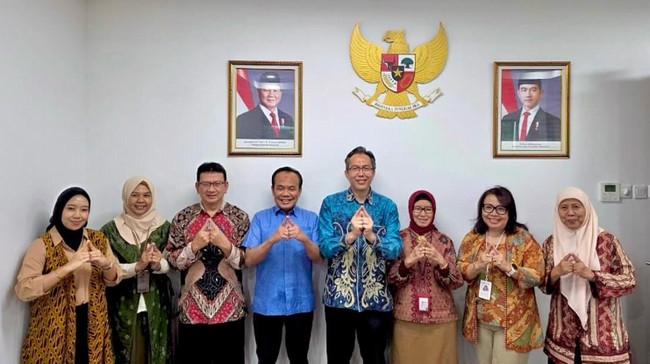
The government is working to improve the quality of macroeconomic data, particularly regarding the measurement of the economic impact of Special Economic Zones (KEK) on national economic growth (PDB) and regional economic growth (PDRB). This is considered crucial to ensure that the contribution of these zones to the regional and national economy can be measured accurately, credibly, and accountably.
To this end, the National KEK Council, the Central Statistics Agency (BPS), and relevant stakeholders are continuously strengthening coordination, including through a Data Review and Economic Impact Study Coordination Meeting held at the KEK Gresik (JIIPE) Development and Management Agency (BUPP) office in Gresik on Friday (12/06). The results of this study aim not only to provide a more accurate picture of the economic contribution and impact of KEK but also to review data on the contribution of economic activities within KEK to economic growth (PDB and PDRB).
The meeting was chaired by the Secretary of the Coordinating Ministry for Economic Affairs, Susiwijono Moegiarso, in his capacity as Chair of the National KEK Council Implementation Team. It was attended by leaders from the Central BPS, the East Java Provincial BPS, the Gresik Regency BPS, as well as officials from relevant ministries and agencies, the East Java KEK Regional Council, the KEK Gresik BUPP, and PT. Freeport Indonesia representing business actors in the KEK.
“We need to continuously maintain the quality of data, especially data from economic and industrial activities in KEK, which is used as one of our economic growth indicators, because this data will form the basis for the Government in formulating various priority policies and programmes,” said Susiwijono, as quoted from an official statement by the Secretary General of the National KEK Council on Saturday (13/6/2026).
For the Government, economic growth data (PDB/PDRB) serves as a primary indicator of the national economic condition, a basis for policy and programme formulation, a tool to measure government performance, and a benchmark for comparing our economic progress with other countries. Furthermore, the urgency of calculating PDB/PDRB lies in its role as an indicator for market determination, investment realisation, and measuring the impact of national policies.
Starting in 2025, BPS, in collaboration with the National KEK Council and the National Single Window (LNSW) agency, has been conducting a complete data collection of all economic and industrial activities in KEK, carried out across 25 KEK throughout Indonesia involving 528 companies. In addition to KEK, data collection on economic and industrial activities is also being conducted in 178 industrial estates (KI) across Indonesia. This comprehensive data collection is expected to fully capture economic and industrial activities in all zones.
As of the first quarter of 2026, KEK in Indonesia have cumulatively recorded investment realisation of Rp353.3 trillion, absorbed 266,188 workers, and hosted 471 operating business entities across 25 KEK nationwide. KEK Gresik itself is one of the main contributors to national KEK development, having cumulatively recorded investment of Rp107.32 trillion and absorbed 47,201 workers, supported by various strategic industrial activities oriented towards downstreaming and value addition.
KEK Gresik plays a role in strengthening downstream industries, increasing added value, and attracting investment, particularly in the manufacturing sector. Therefore, the availability of accurate and verified data is a key factor in producing more representative measurements of KEK’s contribution to economic growth, investment, job creation, and downstream industrial development in Indonesia. Going forward, the results of this review and study will serve as a guideline for developing a more comprehensive methodology to measure the economic impact of KEK. High-quality Indonesian GDP data cannot be separated from the collaboration and support of various data providers, including the 25 KEK spread across Indonesia.
Source: jawawa.id (https://jawawa.id/newsitem/government-dissects-impact-of-special-economic-zones-on-national-and-regional-economies-1781344290)
Originally published by CNBC Indonesia (https://www.cnbcindonesia.com/news/20260613093434-4-742537/pemerintah-kuliti-dampak-kek-buat-ekonomi-nasional-dan-daerah), translated from Indonesian