
Government Deploys New Weapon to Control Food Inflation in Traditional Markets
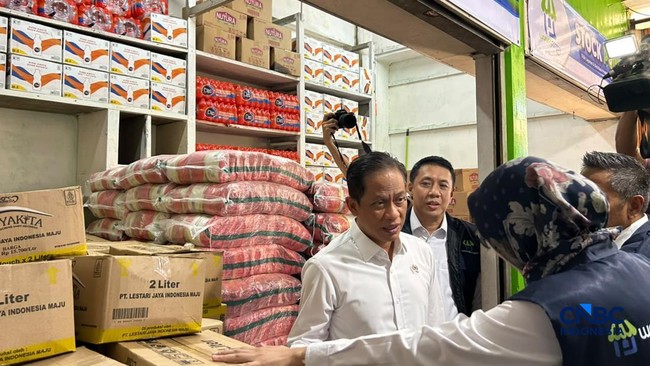
The government is supporting state-owned enterprise PT Rajawali Nusantara Indonesia (ID FOOD) to strengthen the food distribution ecosystem and expand partnerships with traders, most recently through the launch of ‘Warung Pangan’ (Food Stalls) across Indonesia. Deputy Coordinating Minister for Food, Hanif Faisol Nurofiq, stated that this innovation could become vital infrastructure for reinforcing national food distribution, noting that Indonesia’s extensive network of traditional markets has not been optimally utilised. “We have many traditional markets spread across 514 regencies and cities. However, access to wholesalers and industry is typically limited to modern markets, leaving traditional markets struggling to secure stock. We hope ID FOOD’s Warung Pangan will become a massive infrastructure to maintain affordability and price stability,” he said at the launch in Pasar Tebet Timur, South Jakarta, on Monday (20/7/2026). He explained that ID FOOD is mandated to maintain price stability and food affordability as a trading unit. Warung Pangan provides both subsidised and commercial products, and is expected to serve not only as a food provider but also as an intervention tool when prices become unstable. The programme is also seen as a solution to the need for massive market operations, as it leverages existing market structures rather than setting up temporary stalls. Hanif expressed hope that ID FOOD would intensify guidance, analysis, and evaluation of Warung Pangan, particularly to enhance stock points. He stressed that ID FOOD’s branches should act as aggregators for local trade issues, enabling the company to determine which commodities should be sourced directly from producers or factories for the stalls. ID FOOD President Director Ghimoyo clarified that the Warung Pangan programme would not overlap with the government’s Village Cooperative programme, as they serve different but complementary roles in strengthening national food distribution. ID FOOD will focus on price stabilisation for non-subsidised goods, while also collaborating with village cooperatives to aggregate local commodities and distribute them to areas in need. The company’s primary focus is partnering with traditional market traders to stabilise prices, with partners committing to a minimum purchase price and a maximum selling price. ID FOOD’s Commercial Director, Dwi Sutoro, noted that there are currently around 8,000 Warung Pangan partners nationwide, with a target of reaching 25,000 to 27,000 by the end of the year. The programme will be active across all 42 ID FOOD branches, from Aceh to Papua, with each branch tasked with expanding the network. Warung Pangan consists of trader-owned stalls connected to ID FOOD’s distribution and logistics system, selling staples such as rice, sugar, cooking oil, flour, and bottled water, with the possibility of also distributing other brands.