
Government Delays EV Tax Incentives: Purbaya Explains
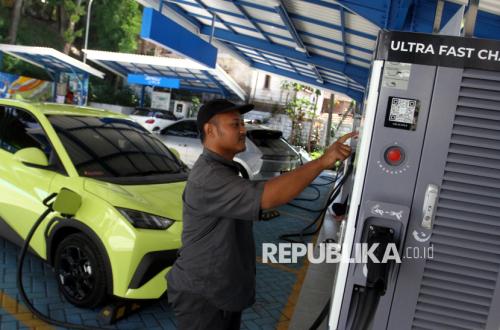
Finance Minister Purbaya Yudhi Sadewa stated the government has delayed tax incentives for electric vehicles (EVs) by one month.
‘EV incentives are postponed for another month,’ he said during an interview at the Coordinating Ministry for Economic Affairs office in Jakarta on Tuesday, 26 May 2026.
The delay is due to ongoing calculations.
‘Further calculations are still required,’ the Finance Minister said.
Previously, the Indonesian government, through the Ministry of Finance, had planned to provide incentives for 100,000 electric cars and 100,000 electric motorcycles this year.
For electric motorcycles, Purbaya allocated Rp5 million per unit. Electric cars would receive a Government-Borne Value-Added Tax (PPN DTP) incentive of 40-100% on purchases. The PPN DTP applies exclusively to EVs, not hybrids. The incentive amount will depend on battery type—nickel-based or non-nickel.
Economist Fahmi Radhi from Gadjah Mada University (UGM) said the nickel-based EV incentive policy is a key opportunity to bolster the national battery industry and deepen mineral processing. He described the policy as a crucial instrument to align domestic EV development with local resource strengths.
‘The government is now more selective. Incentives for nickel-based vehicles are beneficial as we have nickel production, which can drive mineral processing as part of the national EV ecosystem,’ Radhi stated.
He added that differentiating between nickel-based and non-nickel vehicles is more targeted than previous measures, including reduced incentives for fully imported vehicles (completely built up or CBU).
Radhi noted the policy’s relevance given Indonesia’s rapidly growing EV market. According to data from the Indonesian Automotive Industry Association (Gaikindo), battery electric vehicle (BEV) sales reached 56,204 units in 2024 and rose to 114,413 units in 2025.
However, market growth remains dominated by lithium iron phosphate (LFP) battery vehicles, whose technology and raw materials are not yet produced domestically.