
Government clarifies current rupiah depreciation differs from 1998 crisis
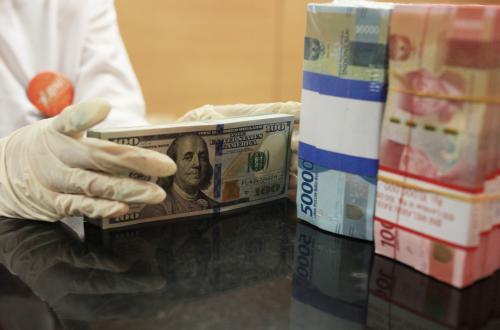
Recently, the rupiah’s continued depreciation, breaking past Rp17,700 per US dollar, has sparked public concern, with some narratives linking it to the 1998 crisis.
House of Representatives Commission XI Chairman Mukhamad Misbakhun addressed the public discourse, stating there is a misunderstanding regarding the current rupiah situation, particularly when compared to the late New Order crisis when the currency plummeted to around Rp17,000 per dollar.
“Many people incorrectly equate today’s rupiah value with the 1998 crisis. While the rupiah did reach Rp17,000–19,000 in 1998, it started from around Rp2,000 per dollar. Today’s Rp17,000 level began from Rp16,800–16,900 and has experienced controlled volatility,” Misbakhun said during his speech at the 2026 National Conference on Regional Economic Development (KNPED) in Jakarta on Monday (25 May 2026).
He noted the current depreciation is approximately 5%, whereas during the 1998 crisis, the rupiah fell by hundreds of percent—around 750%.
“This is what we must clarify to the public. We must prevent public panic by avoiding phrases like ‘the rupiah is falling’ which might create a psychological crisis,” he stressed.
Meanwhile, Deputy Finance Minister Juda Agung agreed with Misbakhun’s assessment, stating Indonesia’s current economic conditions are far from the 1998 crisis, citing various economic data.
“Many in the media and social media claim our economy is in crisis like 1997–1998. But looking at the economic data, it’s far from that situation,” Juda said.
He explained that despite global economic uncertainties, Indonesia’s economy grew strongly by 5.61% year-on-year in the first quarter of 2026. Inflation remained contained at 2.42% year-on-year as of April 2026.
Household consumption stood at 5.52%, above the 5% threshold which signals economic weakness. Domestic consumption is a key driver of national economic growth.
Government spending also rose significantly by 22%.
“These figures prove fiscal policies are effectively boosting economic growth,” Juda said.
He added that this year, the government has implemented a strategy to evenly distribute National Revenue and Expenditure Budget (APBN) absorption across quarters, unlike previous years when spending was concentrated at year-end. This approach ensures the APBN functions as a true engine of growth.