
Government clarifies boundaries of “Living Law” in new Criminal Code
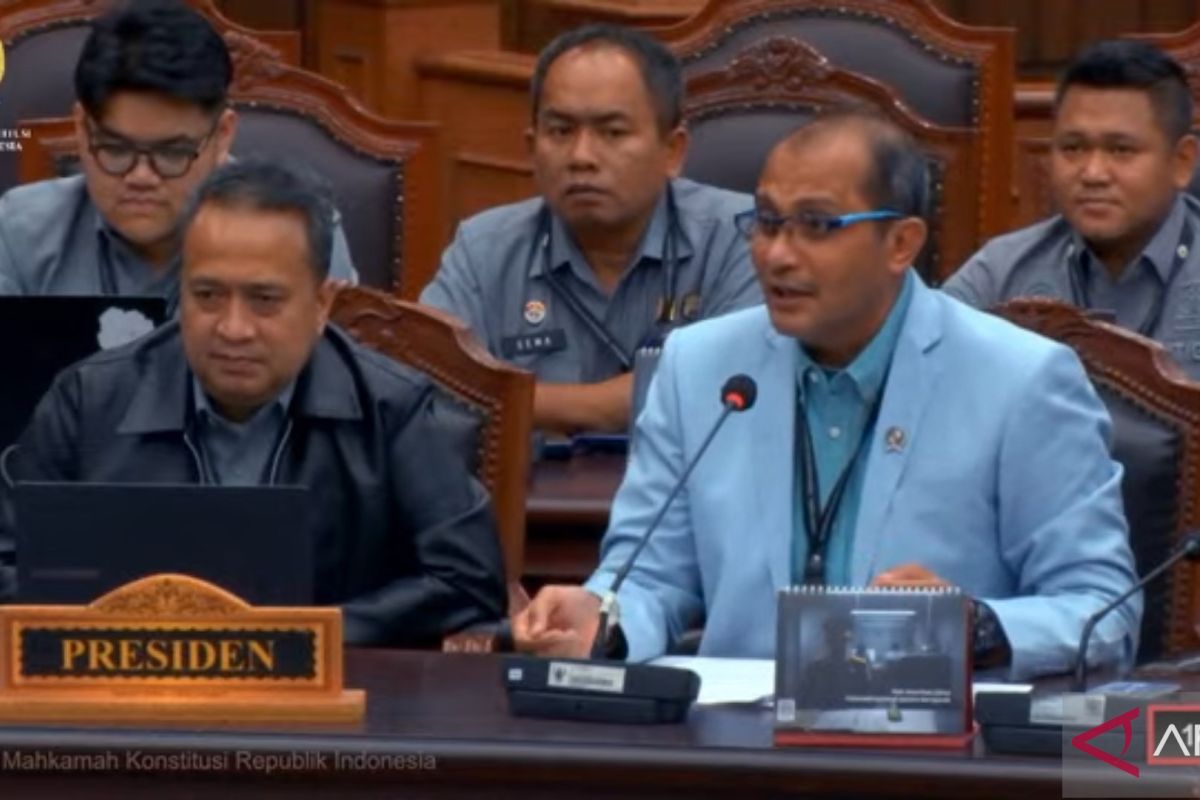
Jakarta (ANTARA) - The Deputy Minister of Law, Edward Omar Sharif Hiddariej, has explained the legal boundaries of the law living within society, or “living law”, as stipulated in Article 2, paragraph (1) of Law Number 1 of 2023 regarding the new Criminal Code (KUHP).
During the third hearing of Petition Number 295/PUU-XXIV/2026 held at the Constitutional Court in Jakarta on Monday, the Deputy Minister stated that the contention that Article 2, paragraph (1) of the new Criminal Code contradicts the principles of a constitutional state is not a new argument. This is because the provision in the new Criminal Code already exists within the Judicial Law, which mandates that judges must explore the law living within society.
“In essence, the substance of this article is not new,” said Eddy, as the Deputy Minister is affectionately known.
Furthermore, Eddy explained that the application of living law is not intended solely for imposing criminal penalties, but can also be used to exempt an individual from criminal liability, serving as an embodiment of the principle of balance within the Criminal Code.
He continued that Article 2, paragraph (1) of the Criminal Code is applied only when an act is not regulated at all within the Criminal Code, and specifically for minor offences.
“This article is not intended to revive dead customary criminal law institutions, but rather to provide state legitimacy for customary criminal law institutions that are still in effect,” said Eddy.
Additionally, Eddy emphasised that the petitioners’ argument—claiming that Article 2, paragraph (1) allows for direct criminalisation based on unwritten customary norms—is incorrect. The validity of living law as a criminal offence does not occur automatically; instead, it must first be regulated within Regional Regulations regarding customary offences, as stipulated in Government Regulation Number 55 of 2025.
“Therefore, the law living in society is not a norm that law enforcement officers can directly use as a basis for criminal prosecution,” Eddy asserted.
Eddy appeared as legal counsel for the President to provide testimony in the judicial review of Article 2, paragraph (1) of the new Criminal Code, requested by nine advocates belonging to the Rumah Advocare Indonesia organisation.
In the preliminary hearing on Tuesday (11/8), the petitioners challenged the phrase “law living in society” within the three norms, arguing that it is unwritten, not officially published, and lacks clear boundaries. The petitioners explained that the article in question has caused constitutional loss, specifically the loss of legal certainty for advocates in performing their professional duties. Advocates have an obligation to provide legal defence based on clear, written, and predictable positive law. The petitioners believe the loss is potential, as the implementation of Article 2, paragraphs (1), (2), and (3), along with its explanations, creates a state of legal uncertainty where an act could be declared a criminal offence based on unwritten, unpublished, and parameterless living law.