
Government Builds Superior Plantation Nursery in South Lampung
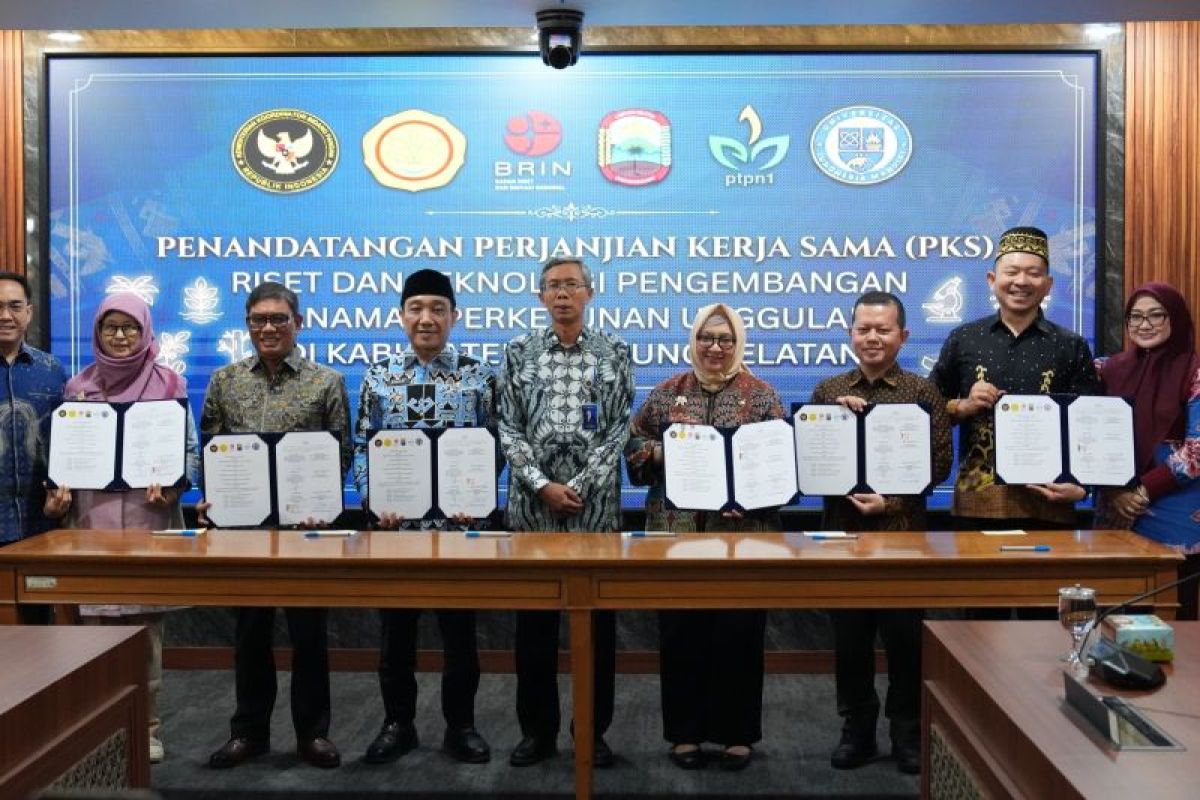
Jakarta (ANTARA) - The government is building a superior plantation seedling nursery covering around five hectares in South Lampung to strengthen the availability of certified seedlings and increase the productivity of smallholder plantations.
The Coordinating Ministry for Food is coordinating research and technological cooperation involving the Ministry of Agriculture, the National Research and Innovation Agency (BRIN), PT Perkebunan Nusantara (PTN) I, the South Lampung district government, and Universitas Indonesia Mandiri.
“This synergy across ministries, agencies, state-owned enterprises, regional governments, and academics is concrete proof of the government’s commitment to building a national seed ecosystem that is self-reliant, resilient, and grounded in scientific research,” said Widiastuti, Deputy for Food and Agriculture Business Coordination at the Coordinating Ministry for Food, in an official statement received in Jakarta on Wednesday.
According to her, the Coordinating Ministry for Food plays a role in coordinating the resolution of regulatory and technical obstacles so that the availability of superior seedlings for farmers can be guaranteed on a sustainable basis.
Under the cooperation, PT Perkebunan Nusantara I is providing around five hectares of land under right-of-use (HGU) title for the construction of the seedling nursery, research activities, plant breeding, and cultivation trials.
Widiastuti explained that the initial phase of the nursery’s development focuses on three priority plantation commodities — coconut, cocoa, and coffee — which enjoy high demand and strategic economic value.
Research and technological development in plant breeding are directed at producing seedlings that meet national feasibility standards, are adaptive to climate change, and can enhance the competitiveness of Indonesian plantation commodities.
“This seedling nursery is designed so that its outputs integrate directly with improving the productivity of smallholder plantations,” said Widiastuti.
She explained that superior seedlings that have passed the maintenance and quality certification period can become a sustainable source of planting material for farmers and communities in South Lampung.
The government, she added, is also opening up the possibility of expanding the nursery activities to other plantation commodities in subsequent phases.
The nursery’s construction forms part of the government’s programme to strengthen the national plantation sector through the provision of quality planting materials.
On 9 June 2026, the government prepared around 280 million cocoa and coconut seedlings to support plantation development and improve farmers’ welfare.
More broadly, the government is developing around 870,000 hectares of strategic plantation commodities in various regions. A budget of approximately Rp9.95 trillion has been allocated to support the provision of superior seedlings and the development of smallholder plantations.
The seed provision programme also covers coffee, cocoa, coconut, nutmeg, cashew, and pepper, totalling around 200 million seedlings, as well as 5.8 billion sugarcane buds.
Kasan, Secretary of the Coordinating Ministry for Food, said the signing of the cooperation agreement (PKS) marks the initial foundation for building an integrated national plantation seedling nursery.
“The main benchmark for this programme’s success lies not merely in the agreement document, but in real implementation on the ground and the nursery’s capacity to produce certified superior seedlings ready for widespread use by farmers and communities,” said Kasan.
The seedling nursery’s development is expected to foster smallholder plantation partnerships based on certified seedlings while strengthening collaboration between the government, research institutions, state-owned enterprises, universities, and farmers.
The Coordinating Ministry for Food believes the nursery’s development has the potential to generate a multiplier effect for the South Lampung economy through increased productivity, improved quality of plantation output, and growth in economic activity around production centres.
The nursery is also expected to serve as a reference for quality planting material development in other regions, strengthen national seed self-sufficiency, and improve the welfare of plantation farmers.
Source: jawawa.id (https://jawawa.id/newsitem/government-builds-superior-plantation-nursery-in-south-lampung-1785286344)
Originally published by Antara (Indonesian) (https://www.antaranews.com/berita/5670264/pemerintah-bangun-kebun-pembibitan-unggul-di-lampung-selatan), translated from Indonesian