
Government, BSSN, and Telkom Collaborate to Face Quantum Computing Era
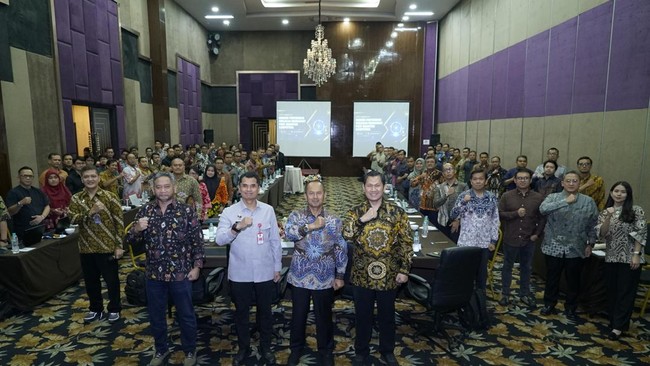
The government is accelerating anticipatory steps to face potential cybersecurity threats arising from the development of quantum computing technology. Through a Coordination Meeting on the Urgency of Policy Formulation for Post-Quantum Computing (PQC) held on Thursday (6/8), the Coordinating Ministry for Political and Security Affairs (Kemenko Polkam), together with the National Cyber and Crypto Agency (BSSN), PT Telkom Indonesia (Persero) Tbk (Telkom), academics, industry players, and the cybersecurity community, strengthened synergy to prepare Indonesia for the post-quantum era. The meeting was chaired by the Deputy for Communication and Information Coordination at Kemenko Polkam, Marsda TNI Eko Dono Indarto, and attended by the Deputy for Cyber Security and Crypto Strategy and Policy at BSSN, Marsda TNI R. Tjahjo Kurniawan, Chairman of the Communication and Information System Security Research Center (CISSReC) Pratama Persadha, Assistant Deputy for Cyber Security Prevention and Capacity Building Marsma TNI Budi Eko Pratomo, Assistant Deputy for Telecommunications and Information Marsma TNI Agus Pandu Purnama, Telkom’s Director of Strategic Business Development & Portfolio Seno Soemadji, as well as representatives from ministries, agencies, state-owned enterprises, industry, academia, and the cybersecurity community. This forum served as a platform to gather input from various stakeholders as a basis for formulating national policy in facing the development of quantum computing technology. It is predicted that quantum computers will bring a huge leap in computing capability, opening various opportunities for innovation and digital transformation. On the other hand, this technology also has the potential to weaken the cryptographic systems that currently protect digital transactions, communications, and strategic data. Therefore, anticipatory steps need to be prepared early so that the security of the national digital ecosystem is maintained. Deputy for Communication and Information Coordination at Kemenko Polkam, Marsda TNI Eko Dono Indarto, stressed that readiness to face the quantum computing era must become a national strategic agenda. “Regarding Post-Quantum Cryptography, the world is moving much faster than we imagine. We must catch up and make a leap. Preparation for the post-quantum era is no longer a sectoral issue, but a national strategic agenda that requires close collaboration between government, industry, academia, and the community so that Indonesia has adequate readiness to face the changing cybersecurity landscape in the future,” Eko stated in a written release on Tuesday (11/8/2026). As a follow-up, the forum formulated a number of priority steps, including the drafting of a National Roadmap for Post-Quantum Cryptography Migration, determining protection priorities for data with a high level of confidentiality, strengthening the cross-ministerial and institutional coordination forum, and proposing the establishment of a National Quantum Center as a national collaboration hub for research, standardisation, talent development, and quantum technology implementation. The Assistant Deputy for Cyber Security Prevention and Capacity Building at Kemenko Polkam, Marsma TNI Budi Eko Pratomo, along with the Assistant Deputy for Telecommunications and Information, Marsma TNI Agus Pandu Purnama, also encouraged the strengthening of cross-sector coordination so that national policy formulation can proceed in an integrated manner and be capable of addressing increasingly complex digital security challenges. In line with this, the Deputy for Cyber Security and Crypto Strategy and Policy at BSSN, Marsda TNI R. Tjahjo Kurniawan, explained that cybersecurity is the main foundation for the success of digital transformation. According to him, all stakeholders need to increase awareness of the risk of quantum attacks and immediately prepare for a gradual and measured cryptographic migration. He said BSSN has formed a National Task Force for the Preparation of Post-Quantum Cryptography Migration to support the drafting of the national roadmap and accelerate Indonesia’s readiness towards a more resilient digital ecosystem. From the industry side, Telkom affirmed its commitment to being a strategic partner for the government in building national readiness to face the quantum computing era. Through Telkom University, various research on PQC has begun to be developed, including research in the field of quantum error correction and the development of digital talent expected to strengthen the foundation of Indonesia’s cybersecurity ecosystem. At the same time, Telkom is also conducting a study on preparations towards the quantum-safe era by providing quantum-safe networks and quantum-safe data centres. Telkom’s Director of Strategic Business Development & Portfolio, Seno Soemadji, mentioned that the challenge of quantum computing cannot be answered solely through technology adoption but also requires comprehensive strengthening of national capabilities. “The quantum computing era will fundamentally change the paradigm of digital security. Therefore, what needs to be built is not just technological readiness, but also national capability. Collaboration between government, industry, academia, and the community is the foundation for accelerating Indonesia’s readiness to face this era,” he explained. For this reason, Seno continued, Telkom is ready to take on a role as a strategic partner through strengthening research and innovation, developing talent with Telkom University, and building digital capabilities that support the realisation of a quantum-safe ecosystem as part of strengthening Indonesia’s digital sovereignty. CISSReC Chairman Pratama Persadha added that organisations do not need to wait until quantum computers are truly capable of breaking the cryptographic systems currently in use to start preparing. According to him, the most realistic step is to conduct an inventory of digital assets and identify the most critical data so that the migration process towards a security system resistant to quantum computer threats can be carried out gradually without having to wait.