
Government assures Hajj pilgrims' food supply remains safe despite geopolitical tensions
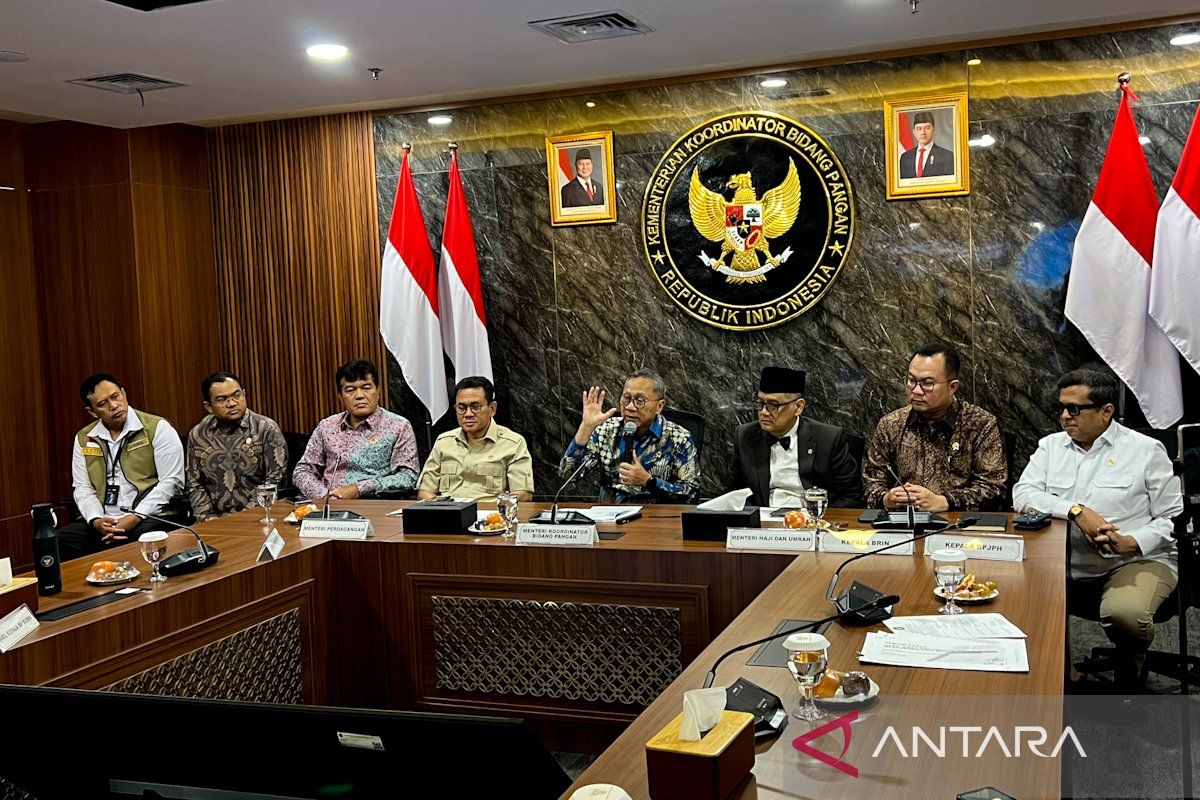
Jakarta (ANTARA) - The government has assured that food supplies for Indonesian prospective Hajj pilgrims remain secure amid global geopolitical dynamics. Coordinating Minister for Food Affairs Zulkifli Hasan (Zulhas) stated that food provisions for Indonesian Hajj pilgrims are fully guaranteed, so pilgrims need not worry about food availability while in the Holy Land. “Regarding the food for Hajj pilgrims, the Minister of Hajj said it’s safe, even with the geopolitical situation there, but don’t worry about the food,” Zulhas said after the coordination meeting on Food Provision Preparations for Hajj 2026 at the Coordinating Ministry for Food Affairs in Jakarta on Tuesday. According to him, various types of food have been adequately prepared, from ready-to-eat meals to those produced directly on site, ensuring pilgrims’ consumption needs are fully met. The government also ensures that the quality of the provided food remains well-maintained, making it safe for Hajj pilgrims to consume during their religious rites in Saudi Arabia. In addition, the government continues to strengthen coordination with various parties to ensure smooth food distribution without significant obstacles throughout the Hajj pilgrimage. These efforts aim to provide a sense of security and comfort to prospective Indonesian Hajj pilgrims, particularly in fulfilling their basic needs for decent and quality consumption. “Now there are fresh ready-to-eat meals, called RTE, ready to eat,” he explained. The government also utilises technological advancements in food provision, including practical ready-to-eat meals that maintain quality and nutritional content for pilgrims. He further stated that the government, through the Ministry of Trade of the Republic of Indonesia, has signed an MoU with Saudi Arabia, facilitating easier shipment of food for Indonesian Hajj pilgrims. “We can send food to our pilgrims freely. Saudi Arabia doesn’t complicate it. But the food (sent) is only for our pilgrims. Not for distribution in their country. Because if distributed domestically in Saudi Arabia, there are other requirements,” Zulhas added. Meanwhile, Minister of Hajj and Umrah (Menhaj) Moch Irfan Yusuf stated that food provision for pilgrims is not directly impacted by global price dynamics, despite fluctuations in Saudi Arabia’s local markets. He emphasised that catering providers have not requested price changes, so consumption services for pilgrims proceed as planned without adjustments that could disrupt services. In the consumption provision scheme, the majority of food for Hajj pilgrims is still prepared through cooking in kitchens to maintain freshness and daily nutritional quality. However, during certain periods of high mobility, the government also prepares ready-to-eat meals as a more practical and efficient distribution solution. These ready-to-eat meals are supplied from Indonesia and have begun to be shipped to support pilgrims’ needs during the peak Hajj worship phase in the Holy Land. The use of ready-to-eat meals is focused on times of very dense pilgrim movement, where fresh food distribution becomes more limited. During that period, the government prepares around 3 million ready-to-eat meal packets to meet the needs of approximately 200,000 pilgrims over six days of worship. This measure is specifically for the Armuzna phase, covering Arafah, Muzdalifah, and Mina as the peak series of Hajj rites with high density. “3 million packets over six days, because for 200,000 people, 6 days. Just multiply it. That’s only for dates 7, 8, 9, to 13. Because at that time the traffic is very dense, so we use RTE (ready to eat) for the Armuzna phase,” Menhaj explained. The government also ensures that all provided food, whether from kitchens or in ready-to-eat form, meets established food safety standards. The meeting was also attended by Minister of Trade Budi Santoso, Head of the Halal Product Assurance Agency (BPJPH) Haikal Hassan, Head of the National Research and Innovation Agency (BRIN) Arif Satria, Head of the Indonesian Quarantine Agency (Barantin) Sahat Manaor Panggabean, President Director of Perum Bulog Ahmad Rizal Ramdhani, and other officials.