
Government Announces Ramadan Begins 19 February, MUI Urges Respect for Differences
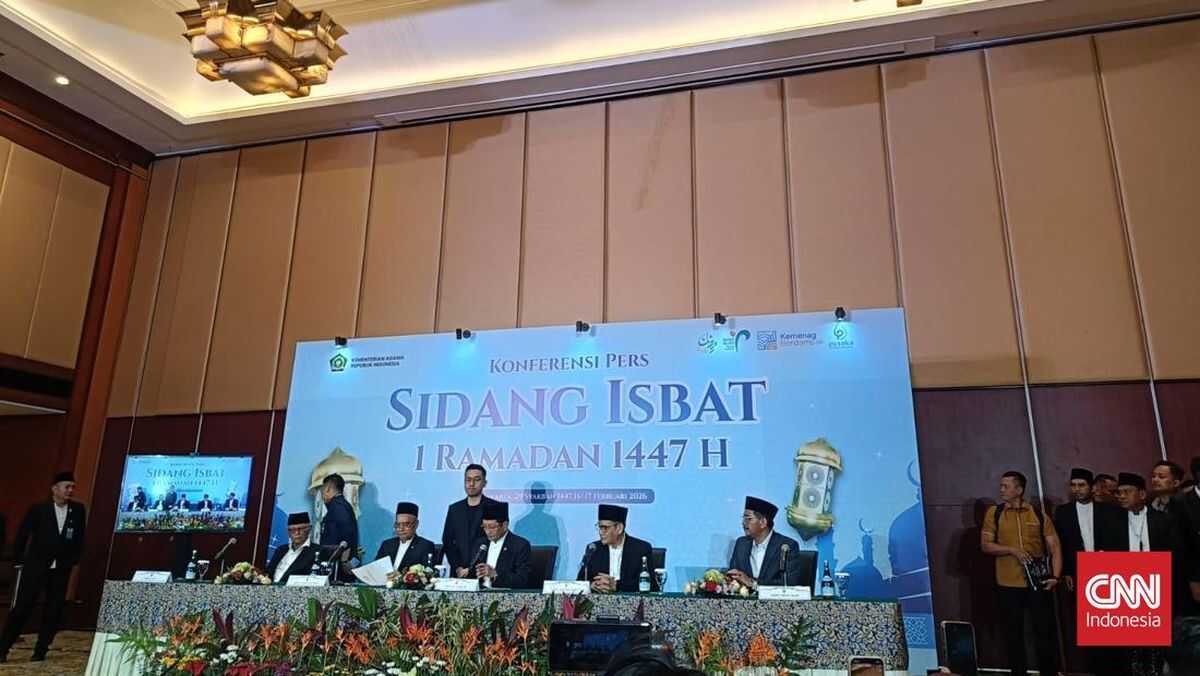
Indonesian Ulema Council (MUI) Chairman Anwar Iskandar has urged citizens to respect differences following the determination of 1 Ramadan 1447 Hijriah.
Anwar made the appeal at a press conference after the isbat session to determine 1 Ramadan 1447 Hijriah at Hotel Borobudur, Jakarta, on Tuesday (17 February) evening.
“Our nation is one composed of diverse backgrounds. This is an inevitability. An inevitability as a nation founded on Bhinneka Tunggal Ika [Unity in Diversity], including among Muslims,” said Anwar.
In Indonesia, he continued, there are more than 80 Islamic mass organisations. These organisational differences make it possible for there to be varying forms of worship and religious practice.
However, Anwar viewed these differences as pertaining only to matters of ijtihad (interpretive reasoning) or technical issues, whilst on matters of qath’i (definitive rulings) all are in agreement.
“Therefore, the possibility of beginning or ending the fast on different dates is an inevitability that we can understand and accept,” he said.
“But what is most important is that our unity as Muslims must always be preserved. Therefore, it is vital to understand and respect one another,” Anwar added.
As a democratic nation, he said, Indonesian citizens need to accustom themselves to differences. In doing so, such diversity becomes part of a dynamic that enriches the treasury of knowledge.
Anwar also assessed that differences managed well would create a beautiful harmony and ultimately become something important for Indonesian unity.
“And Indonesian unity is a vital part of creating national stability,” he said.
The government has determined that 1 Ramadan 1447 Hijriah falls on 19 February. The decision was taken because the hilal (crescent moon) was not visible according to visibility criteria during observations conducted on that day.
Meanwhile, Muhammadiyah has determined that the beginning of the fast falls on 18 February.
This determination uses the Unified Global Hijri Calendar (KHGT) as a new method that has become Muhammadiyah’s official reference, replacing the wujudul hilal (existence of the crescent moon) method previously used.
In Muhammadiyah’s view, the implementation of the KHGT requires the integration of three main elements known as the Principle, Condition, and Parameter (PSP) framework.
One important parameter is the fulfilment of the hilal’s position after conjunction with a minimum altitude of 5 degrees and elongation of 8 degrees anywhere on the Earth’s surface, rather than being limited to a specific territory.