
Government and Banking Sector Synergise to Achieve Economic Growth Targets
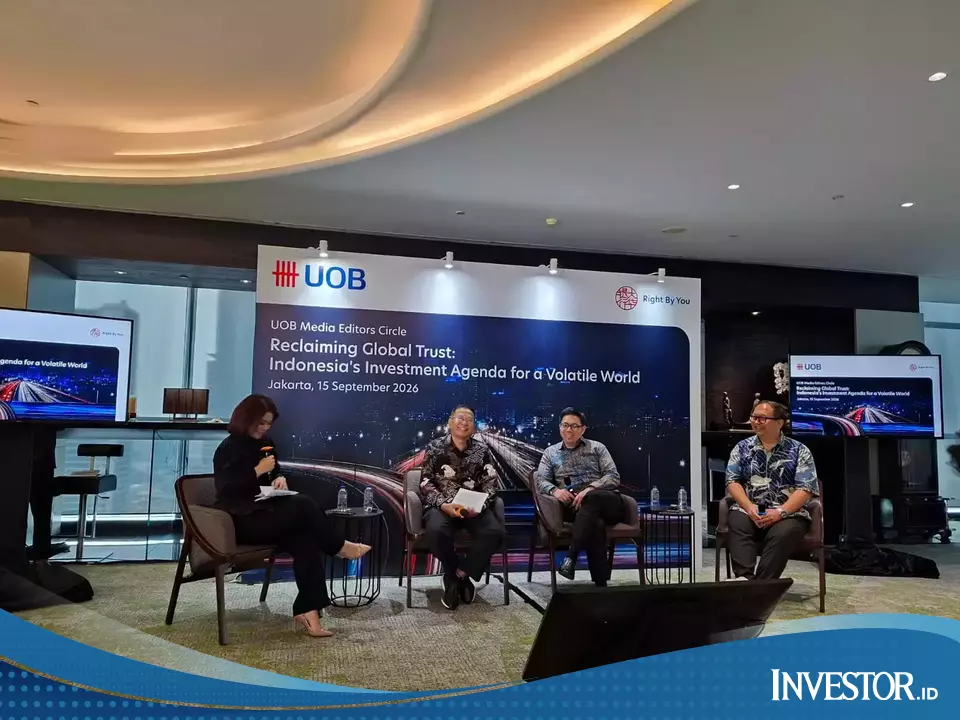
The Indonesian government and the banking sector are synergising to strengthen strategies aimed at chasing an economic growth target of 8 per cent by 2029. This strategic move was discussed in depth during the UOB Media Editors Circle event titled “Reclaiming Global Trust: Indonesia’s Investment Agenda for a Volatile World” in Jakarta on Tuesday (15/09/2026).
Based on data from the Ministry of Investment and Downstreaming/BKPM, investment realisation contributes approximately 26 to 30 per cent to national economic growth. Consequently, Indonesia requires a consolidation of investment realisation amounting to around Rp13,000 trillion over the next five years to secure this ambitious target.
Under these policies, investors are granted direct permission to construct factories or projects within industrial estates even while basic permits are still being processed. Additionally, a “positive fiction” system has been implemented, where permit applications are automatically deemed approved if the government fails to respond within the stipulated timeframe.
Saribua Siahaan, Director of Regional Promotion for Southeast Asia, Australia, New Zealand, and the Pacific at the Ministry of Investment and Downstreaming/BKSB, emphasised the importance of this legal certainty to prevent investors from moving to other countries offering more attractive conditions. “The government is providing industrial breakthroughs so that investors have certainty regarding land, location, and their business needs. If these basic requirements are met before they decide to invest, the eight per cent economic growth target can be achieved. The key lies in robust coordination between ministries and regional authorities,” said Saribua.
Furthermore, the government is ensuring that the influx of foreign capital brings a direct impact to regional economies. Foreign companies investing in Indonesia are now strongly encouraged to collaborate with local businesses, such as utilising catering or garment services from local entrepreneurs. This strategy is expected to create a more stable business environment while simultaneously improving the welfare of communities surrounding project areas.
The need for such certainty was supported by the Head of Corporate Banking at UOB Indonesia, Edwin Kadir. He noted that amidst domestic and global uncertainty, the business world requires predictability and flexibility in conducting operations. “The business world has already accounted for business risks, such as fluctuations in oil prices or market demand. However, what they seek is certainty in legal regulations and business convenience to create a Sustainable Business Framework. The government, business players, and the banking sector must undertake a collective effort to ensure this economic growth moves towards the eight per cent target,” explained Edwin.
To reclaim global trust, the government is committed to maintaining regulatory stability, bureaucratic ease, and transparency in fund transfers to regions. The effort to build a healthy investment ecosystem is fully supported by the banking sector, such as UOB Bank. According to the UOB Business Outlook Study, businesses in Indonesia are also actively strengthening business resilience through digitalisation and the diversification of supply chains within the ASEAN region to face global economic volatility.
Commenting on Indonesia’s competitive position in Southeast Asia, UOB ASEAN Economist Enrico Tanuwidjaja revealed that Indonesia’s position in attracting Foreign Direct Investment (FDI) still faces consolidation challenges. Enrico disclosed that, based on the latest report in 2025, there was a slight capital pullback as global investors tended to adopt a “wait and see” approach.
Nevertheless, market optimism regarding Indonesia remains high, though there is a shift in investment commitments towards future sectors such as green energy, alongside increased merger and acquisition (M&A) activity. “Actually, from the last 2025 report, there was a slight pullback. But do not be mistaken, they remain optimistic; they are simply shifting. It is moving towards the future, such as future commitments to green energy and an increase in M&A,” he stated.
Furthermore, Enrico emphasised that Indonesia’s future competitiveness will depend heavily on real-world execution rather than mere plans on paper. He stressed that crucial issues highlighted by investors, such as legality, legal certainty, and land acquisition, must be resolved through concrete actions to rebuild both domestic and global trust quickly and measurably.
Source: jawawa.id (https://jawawa.id/newsitem/government-and-banking-sector-synergise-to-achieve-economic-growth-targets-1789624370)
Originally published by investor.id (https://investor.id/finance/454461/pemerintah-dan-perbankan-sinergi-untuk-capai-target-pertumbuhan-ekonomi), translated from Indonesian