
Government Affirms No New Tax for Online Merchants
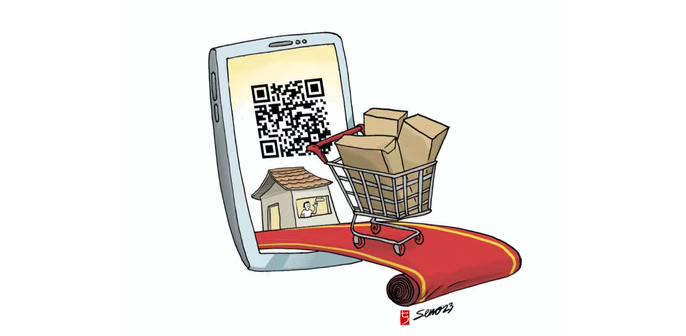
The government has affirmed that the policy of appointing e-commerce platforms as tax collectors does not represent a new tax imposition for business operators selling online. The policy aims to create equal treatment between offline and online business operators while improving tax compliance.
Deputy for Small Business at the Ministry of Micro, Small, and Medium Enterprises (UMKM), Temmy Satya Permana, stated that the substance of the policy to be implemented through digital platforms essentially only changes the tax collection mechanism, not adding a new burden for business operators.
“Conceptually, this creates equality. Offline businesses are taxed, so why shouldn’t online businesses be taxed? But I feel there is no difference. The tax deduction is the same. If they are individual taxpayers with annual turnover below Rp4.8 billion, the tax remains the same. Only the collector is now the platform,” Temmy said at the UMKM Ministry office in Jakarta on Wednesday (24/6).
According to him, business operators’ tax obligations have so far been fulfilled independently. Through the new scheme, e-commerce platforms will assist in collecting and reporting taxes, making the administrative process simpler for business operators.
Meanwhile, Director of Counselling, Services, and Public Relations at the Directorate General of Taxes, Ministry of Finance, Inge Diana Rismawanti, stressed that tax on e-commerce transactions has actually been in effect for a long time.
“What needs to be underlined is that the e-commerce tax is not a new tax. All this time, those selling directly have paid their own taxes. With e-commerce, the platform through which sales are made will collect the tax,” Inge said.
She explained that some online business operators have assumed that transactions conducted through digital platforms carry no tax obligations. In fact, Inge continued, all income earned, whether through physical shops, social media, or marketplaces, must still be calculated as taxable income according to the provisions.
Under the scheme prepared by the government, designated platforms will deduct final Income Tax (PPh) from business operators who meet the criteria. However, this deduction does not result in double taxation because all tax collected will be recorded as a tax credit that can be accounted for when the business operator submits their Annual Tax Return (SPT).
“What is paid by the platform will become a tax credit for the entrepreneur. So when preparing the SPT, it becomes a deduction from the tax that must be paid. There is no double deduction,” Inge stated.
The government also ensures that business operators with annual turnover below Rp500 million remain exempt from income tax, in accordance with current regulations. To obtain this facility, business operators are asked to inform the platform that their turnover is still below the threshold. “If their turnover has not yet reached Rp500 million, the platform is not allowed to deduct their income tax,” Inge mentioned.
Nevertheless, the Directorate General of Taxes will continue to monitor the accumulated turnover of business operators through data received from various digital platforms. The system enables the tax authority to view a seller’s total transactions even if they operate on more than one marketplace.