
Government accelerates recovery of disaster-affected rice fields in Aceh
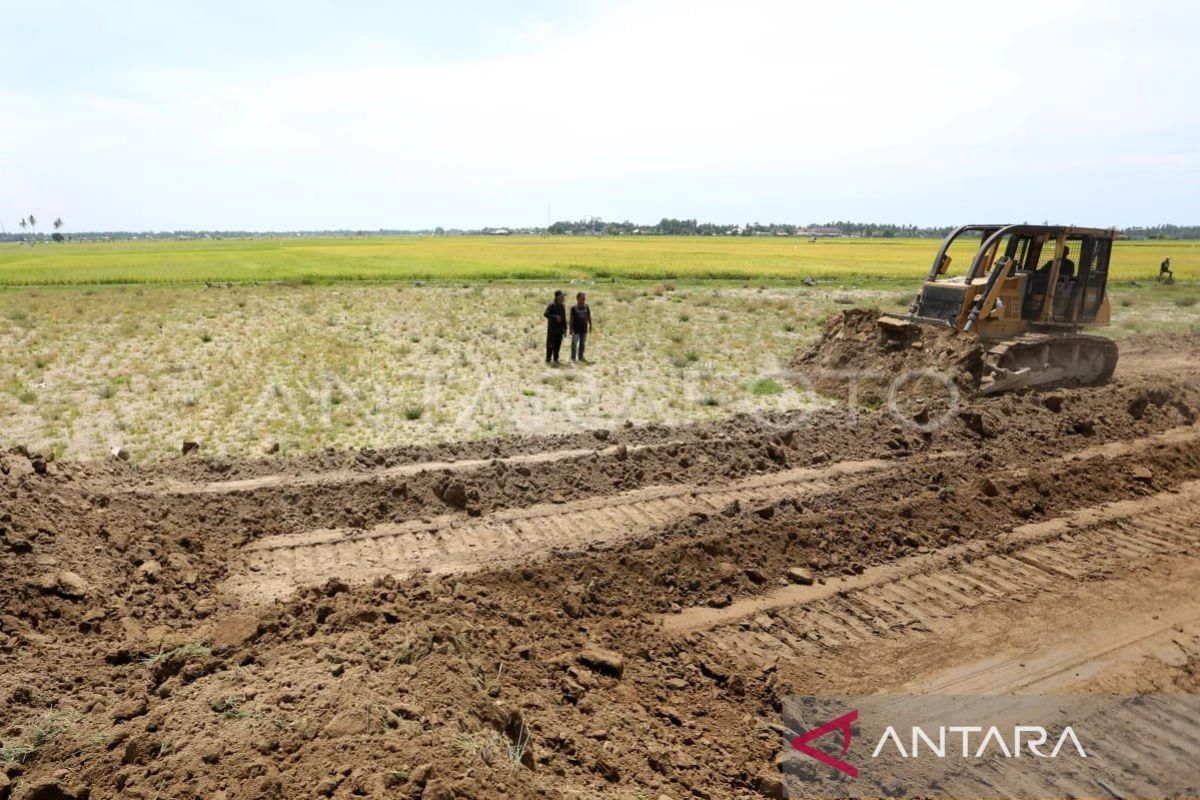
The Aceh government is accelerating the recovery of agricultural land following hydrometeorological disasters, with rehabilitation and reconstruction progress coordinated by the Aceh Agriculture and Plantation Service (Distanbun) now showing positive results.
“Distanbun Aceh has worked optimally and delivered positive results,” said Aceh Government Spokesperson Nurlis Effendi in Banda Aceh on Wednesday.
Nurlis stated that, based on Distanbun Aceh data, the recent hydrometeorological disasters damaged 57,485 hectares of rice fields, divided into four categories. Light damage affected approximately 27,437 hectares, moderate damage 13,651 hectares, heavy damage 16,276 hectares, and 120 hectares of rice fields were completely lost.
Currently, land optimisation and rehabilitation are underway or in process for around 40,852 hectares, covering both light and heavy damage. This means approximately 16,633 hectares of heavily damaged and lost rice fields remain unaddressed.
Nevertheless, he continued, recovery has begun to show positive results, with the commencement of rice planting on restored disaster-affected land in Bukit Village, Aceh Tamiang Regency, and Kutablang in Bireuen Regency, North Aceh, among other areas.
“In fact, Distanbun Aceh’s performance has also yielded positive results in terms of budget increases, evidenced by the rise in funding from the Ministry of Agriculture. In phase I, ministry assistance was Rp380 billion, and now in phase II it has increased to Rp515 billion,” he said.
Nurlis explained that the rice field rehabilitation is being carried out by the Ministry of Agriculture in cooperation with provincial and affected district/city governments in Aceh.
He detailed that post-disaster land optimisation activities for lightly damaged rice fields have been allocated Rp155.6 billion in government assistance, covering 16 districts/cities with a total area of 27,071 hectares.
For moderately damaged land, the Aceh government is implementing a rehabilitation programme with a total budget of Rp186 billion, covering 11 districts with an area of 13,781 hectares. Currently, construction progress carried out by farmer groups together with the Indonesian National Armed Forces (TNI) has reached approximately 4,393 hectares, or 32 percent of the total target.
In the irrigation sector, the Aceh government is also constructing various supporting infrastructure. For pump-based irrigation, 641 units are planned across 16 districts/cities with a budget of Rp98 billion. To date, 456 units have been built, with financial realisation at around 53.2 percent.
“The remainder is in progress, with some locations still in the administrative and planning stages,” he said.
Meanwhile, the construction of 149 piped irrigation units in 13 districts/cities, with a budget of Rp14 billion, has shown approximately 50 percent progress. The construction of 45 conservation structures, valued at Rp5.4 billion, has achieved around 36 percent financial realisation.
Furthermore, Nurlis added, out of a planned 300 tertiary irrigation network units with a budget of Rp30 billion, around 78 percent, or 235 units, have been built. Additionally, the construction of 106 farm access roads with a budget of Rp11.6 billion has reached 31 percent financial realisation.
“In total, the overall financial realisation for all these activities had reached 48.48 percent as of 21 July 2026,” he said.
Nurlis added that Aceh Governor Muzakir Manaf hopes the accelerated rehabilitation and reconstruction will not only restore land conditions but also increase agricultural productivity and the welfare of farmers in all affected areas.
Therefore, the Aceh Agriculture and Plantation Service has been instructed to continue working hard for the welfare of the people, especially affected farmers, and to always build and strengthen communication with various parties, including the Ministry of Agriculture, the Ministry of Home Affairs’ task force, district and city governments, universities, the TNI, the National Police, and other relevant parties, to ensure all programmes run according to target.