
Government Accelerates Household Gas Networks to Cut LPG Imports
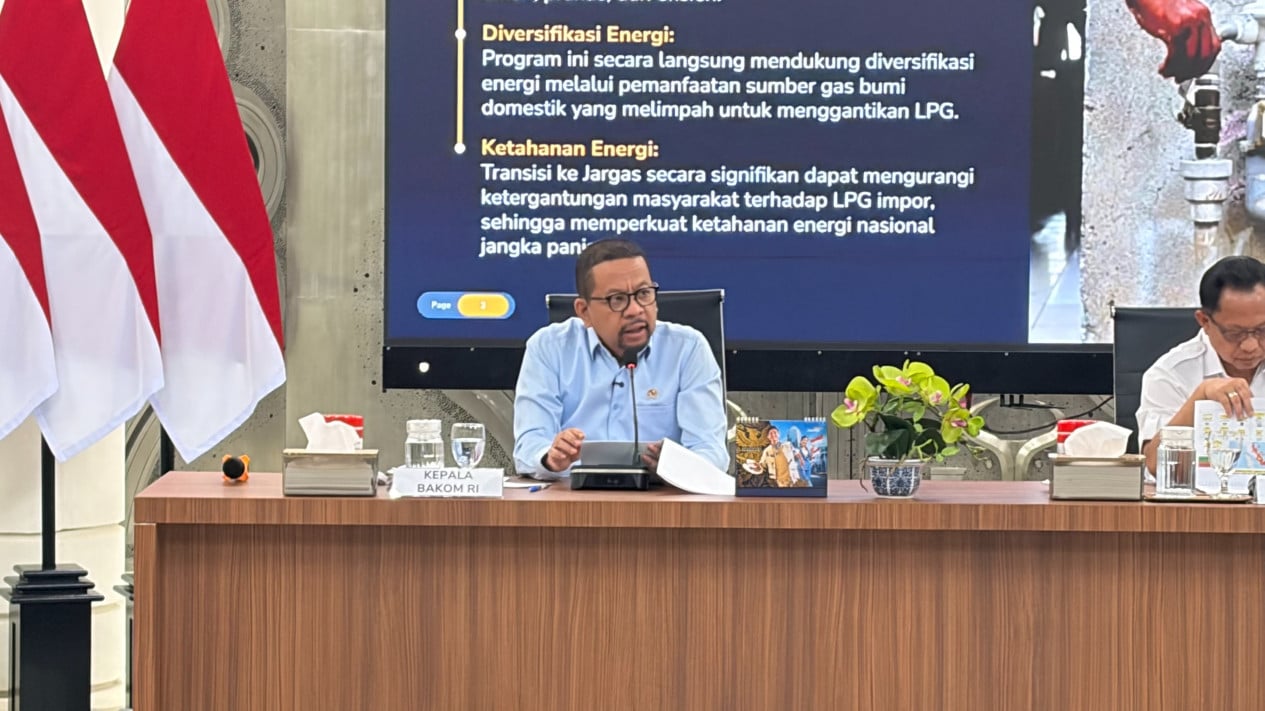
Jakarta, VIVA – The government is accelerating the development of the household gas network (jargas) as a major strategy to reduce Indonesia’s dependence on LPG imports.
Head of the Public Communication Agency (Bakom RI), M Qodari, emphasised that the jargas programme is not merely an energy infrastructure project. It also serves as a solution to the problem of high LPG imports resulting from limited domestic production.
He explained that national LPG demand for cooking reaches around five million metric tonnes each year. However, domestic production capacity stands at only about 1.4 million tonnes, meaning most of the demand must still be met through imports.
“For your information, our gas needs for cooking amount to five million metric tonnes a year, but domestic production is 1.4 million tonnes, if we are talking about LPG. That means only around less than 30 per cent can be produced domestically, and the rest is imported,” Qodari said at a press conference on Wednesday, 5 August 2026.
According to Qodari, the household gas network utilises natural gas, which differs from LPG. While LPG consists of propane and butane, jargas uses natural gas in the form of methane and ethane, reserves of which are far more abundant in Indonesia.
“LPG’s composition differs from jargas, because jargas is natural gas. Natural gas is methane and ethane, whereas LPG is propane and butane,” he explained.
Qodari argued that this situation is a strong reason for the government to shift household energy use to natural gas, as the resource is available domestically.
“Our domestic availability, our natural potential for natural gas — methane and ethane — is far greater compared to LPG. Perhaps around three-quarters of the gas available in Indonesia falls into the category of natural gas, or methane and ethane, so the real potential lies in methane and ethane,” he said.
Nevertheless, he acknowledged that natural gas development still faces a major challenge in distribution. For this reason, building the gas network is an important instrument so that natural gas supplies can be enjoyed directly by the public.
“There is indeed a challenge in distribution. And this is what we are trying to address, among other things, through the gas network,” Qodari concluded.