
Gorontalo Provincial Government pushes Red and White Fishermen's Villages to drive coastal economy
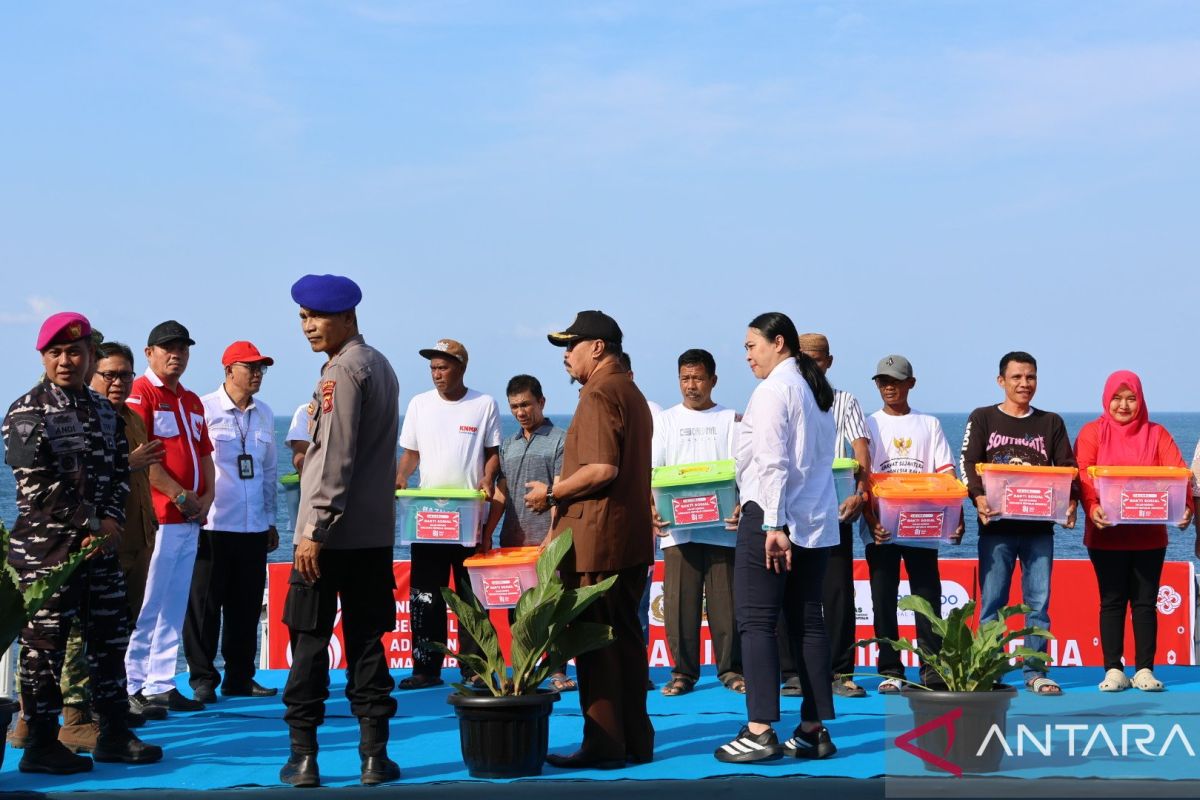
The Gorontalo Provincial Government is pushing for the Red-and-White Fishermen’s Villages (KNMP) to go beyond the construction of facilities and infrastructure, and to develop into drivers of economic activity that can improve the welfare of coastal communities.
Mohamad Dikky Sidiki, Head of the Economy and Natural Resources Division at the Gorontalo Provincial Development Planning Agency (Bappeda), said the Fishermen’s Village concept is designed to strengthen the economic activities of fishermen through cooperative-based management.
“The concept is that all fishermen become members, and there is a collective agreement on how the catch is purchased, resold, or processed so that it has added value,” he said in Gorontalo on Monday.
According to him, one of the problems fishermen often face is maintaining the quality of fish while at sea, especially when the journey takes three to four hours or more.
For this reason, the Fishermen’s Villages are equipped with ice production facilities that fishermen can use to keep their catch fresh until they return to shore.
In addition, fish storage facilities are available so that catches not yet absorbed by the market can be stored rather than being forced to be sold at low prices.
“There are also facilities for boat repairs, so there is a workshop. There are also outlets or shops that can sell fishermen’s products if the cooperative is able to carry out production,” he said.
Dikky believes these facilities open up opportunities for fishermen not only to sell fish in the form of raw catches, but also to develop processing that provides higher economic value.
However, he said the success of the Red-and-White Fishermen’s Villages is determined not only by the availability of infrastructure, but also by the ability of cooperative managers to manage the facilities and run business activities.
According to him, cooperatives are an important part of the scheme because all fishermen are directed to become members and have a shared interest in managing the catch.
“If the cooperative managers are capable, there will certainly be quite significant results that they can achieve,” he said.
He said the cooperative business model requires a change in the community’s mindset, particularly in building collective economic strength through cooperation and joint business management.
Dikky noted that the fishermen’s cooperative model has long been applied in a number of countries, including Japan, where it has been able to provide profits to fishermen even though some of their fleets still use small boats.
He expressed hope that a similar concept can develop in Gorontalo so that fishermen’s catches can be absorbed and not much is wasted simply because there is no immediate buyer.
Bappeda noted that the Gorontalo Provincial Government has previously proposed around 60 KNMP sites, with around 30 sites planned to be built in the next phase by the end of 2026.
Meanwhile, a number of Fishermen’s Villages that have already been established are located in Bone Bolango Regency, Boalemo Regency and Gorontalo Regency.
Dikky said more detailed management and evaluation of the use of KNMP assets falls under the authority of the district and city governments according to the location of development.
With optimal management, the KNMP is expected not only to become a service centre for fishermen, but also to form an economic chain from the provision of fishing supplies, storage of catches, to the processing and marketing of fishery products.
Source: jawawa.id (https://jawawa.id/newsitem/gorontalo-provincial-government-pushes-red-and-white-fishermens-villages-to-drive-coastal-economy-1787565317)
Originally published by Antara (Indonesian) (https://www.antaranews.com/berita/5709093/pemprov-gorontalo-dorong-knmp-jadi-penggerak-ekonomi-pesisir-gorontalo), translated from Indonesian