
Google Earth Finally Displays Destruction in Gaza, Here is How It Looks
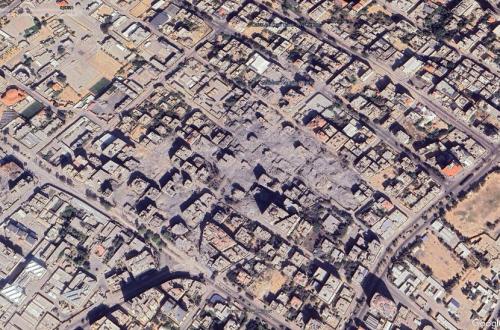
Latest satellite imagery from Google Earth has revealed vast areas of Gaza that have been transformed by destructive Israeli military attacks. Entire districts are now left as nothing more than debris and empty land.
The latest images appeared online on Sunday, according to social media users who expressed shock at the sheer scale of the destruction. Google has not yet provided clarification regarding when the imagery was published or became available.
According to The National, the imagery shows residential areas that have turned into expanses of rubble due to buildings being levelled to the ground. While roads remain visible, mosques, schools, and various other important buildings appear surrounded by widespread devastation.
“This shows the reality of Gaza with shocking image sharpness,” wrote Nathan Ruser, an analyst at the Australian Strategic Policy Institute, on the X platform.
The city of Rafah in the south is clearly visible in the latest imagery; areas previously densely packed with rows of houses now appear largely levelled. Other views show large concentrations of emergency shelters scattered across open land.
In Gaza City, satellite imagery shows severe damage within and around Al-Shifa Hospital. The surrounding urban landscape appears to have changed drastically compared to previous imagery.
These conditions reflect the immense destruction occurring during the war in Gaza, which began following the Hamas-led attacks on southern Israel on 7 October 2023.
In a report published on 12 August, the UN Satellite Centre stated that 82 per cent of all buildings in Gaza have sustained damage to varying degrees, with two-thirds being totally destroyed.
Barry Andrews, an Irish member of the European Parliament, highlighted the imagery on X on Sunday. “The latest Google satellite imagery of Gaza is truly staggering and can be seen by anyone,” he wrote. The post went viral, reaching approximately two million views, 18,000 likes, and thousands of reposts.
Users on other platforms responded with equally striking descriptions. One post featuring satellite footage stated: “Google Earth has updated Gaza imagery. Truly heartbreaking.”
Palestinian journalist Abubaker Abed described the imagery as something “truly unimaginable”. “I have witnessed much of the destruction in Gaza firsthand, but I cannot bear to look at that map,” he wrote on X.
The destruction visible in the satellite imagery is the impact of a war that has been ongoing for nearly three years, alongside intensive Israeli military operations and bombardments throughout the Gaza Strip since 7 October 2023.
Shortly after the latest imagery was published, screenshots and videos showing the conditions in Rafah, Khan Younis, and Gaza City circulated widely on social media, with netizens comparing the new views to satellite imagery from previous periods.
The exact date the images were taken is not yet known with certainty. Several reports suggest that high-resolution imagery of the Gaza region has been captured throughout this year, but Google has not yet provided official confirmation regarding the upload date of the latest imagery.
The Hamas-led attacks on southern Israel on 7 October killed approximately 1,200 people and resulted in about 250 people being taken hostage, according to Israeli authorities.
Israel responded with military operations that, according to Gaza health authorities, have killed more than 74,000 Palestinians and left tens of thousands others injured.
Israel faces allegations of committing war crimes related to its actions during the massive military campaign, including alleged attacks on civilians and civilian infrastructure, forced displacement of populations, and the restriction of humanitarian aid access.
Source: jawawa.id (https://jawawa.id/newsitem/google-earth-finally-displays-destruction-in-gaza-here-is-how-it-looks-1790600340)
Originally published by Republika (https://news.republika.co.id/berita/tm2psu393/google-earth-akhirnya-tampilkan-kehancuran-di-gaza-ini-penampakannya), translated from Indonesian