
Gontor and the Call of Civilisation in the Second Century
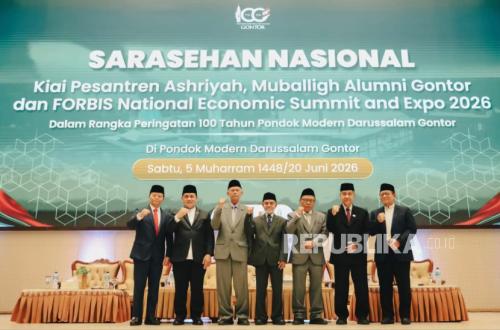
Not every century produces a historical momentum, but every historical momentum presents questions that determine the direction of an era. During the National Sarasehan of Ashriyah Pesantren, Gontor Alumni Preachers, and the FORBIS National Economic Summit and Expo 2026, commemorating the 100th anniversary of Pondok Modern Darussalam Gontor, a profound question resurfaced: after a century of educating generations, where will Gontor lead its civilisation? 100 years is not merely a historical figure, but a point of civilisational reflection that shifts the question from mere survival to contribution towards the direction of the age.
At the forum, the Deputy Minister of Religious Affairs of the Republic of Indonesia, Dr. K.H. Romo R. Muhammad Syafi’i, S.H., M.Hum., presented a framework that can be read as the architecture of the pesantren’s role in the 21st century. This framework unfolded into four interconnected major ideas.
The first idea reaffirmed the historical role of pesantren as a space for leadership formation. As Romo Syafi’i stated, ‘Indonesia does not lack intelligent people. However, Indonesia still needs more honest leaders with integrity and a commitment to the people.’ This statement contains a deep critique of the nation’s development paradox: progress in education does not necessarily correlate with the emergence of moral leadership. In this landscape, pesantren must not only produce intelligent individuals but also shape personalities ready to bear the mantle of leadership. Leadership is understood not as a social position, but as a moral responsibility demanding honesty, courage, and a commitment to the people. Therefore, pesantren are called upon to produce a generation that does not stop at being job seekers. As the Deputy Minister urged, ‘Do not just be job seekers, but also become job creators, community mobilisers, and future leaders.’ It is here that pesantren education finds its relevance: shaping human beings who are ready to lead, mobilise, and serve.
The second idea directs pesantren towards the dimension of community economic independence, inseparable from the revival of waqf as a civilisational instrument. Romo Syafi’i firmly reminded, ‘Pesantren must become centres of community economic empowerment.’ This message is not merely an expansion of the pesantren’s function, but a reaffirmation of its social role in building community self-reliance. Pesantren can no longer suffice as centres of moral education; they must become real engines of economic empowerment. This mandate aligns with the 2019 Pesantren Law, which affirms the function of community empowerment as an integral part of the pesantren’s role.