
Golkar: Falling Oil Prices a Momentum for Government to Improve Fiscal Conditions
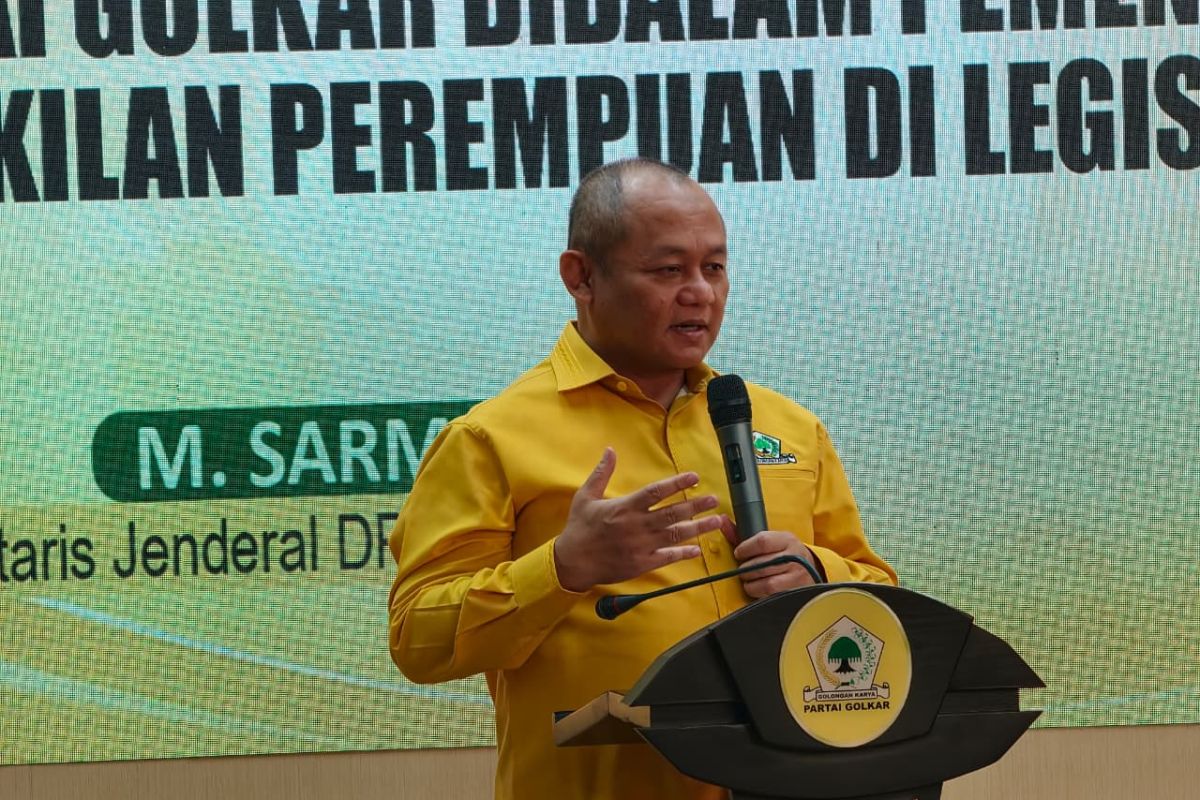
Jakarta - Golkar Party faction chairman in the House of Representatives, Muhammad Sarmuji, stated that the decline in global oil prices, driven by the peace agreement between the United States and Iran, is a momentum for the Indonesian government to improve its fiscal condition. “This is a momentum that must not be wasted. The government must move quickly and measurably to convert this peace into tangible benefits for the Indonesian people,” Sarmuji said in a written statement received in Jakarta on Tuesday. He noted that market signals had already reacted, with Brent crude oil prices immediately dropping nearly 4 percent to around 83.92 US dollars per barrel in Monday morning trading, down from Friday’s close of 87.33 US dollars per barrel.
Sarmuji detailed several urgent concrete steps. First, the government needs to undertake fiscal repair by evaluating and gradually adjusting energy subsidies in line with the normalisation of global oil prices. The Secretary-General of the Golkar Party stressed that fiscal space, which had previously been eroded by ballooning fuel subsidies, is now opening up again and must be utilised optimally. “The budget that was previously forced to cover the subsidy overrun can be reallocated and focused on strategic and priority sectors, such as infrastructure, education, and social protection, whose benefits are more directly felt by the people,” he said.
Second, the easing of geopolitical risk premiums allows for more efficient oil and gas import costs, which will directly impact lower domestic production costs and inflationary pressures. Third, the full opening of the Strait of Hormuz must be immediately leveraged to smooth export-import supply chains that have been disrupted for months, while simultaneously cutting international logistics costs that burden businesses. Fourth, Indonesia needs to boost non-oil and gas exports to the Middle East region and countries previously affected by the conflict, including re-establishing trade agreements with Iran in the agricultural and manufacturing sectors that had been delayed.
Sarmuji welcomed the announcement of the peace agreement between the United States and Iran. Pakistan’s Prime Minister Shehbaz Sharif, acting as mediator, announced that both parties had declared an immediate and permanent cessation of military operations on all fronts, including in Lebanon. The official signing ceremony is scheduled for 19 June 2026 in Switzerland. US President Donald Trump subsequently confirmed this, while Iran’s Deputy Foreign Minister Kazem Gharibabadi confirmed that the agreement text had been finalised and would be signed on Friday (19/6). “This is news that the entire world, longing for peace, has been waiting for. The Golkar Party Faction in the DPR RI welcomes and gives high appreciation for the achievement of this agreement,” said Sarmuji.
He emphasised that the agreement is not only a victory for the two conflicting parties but also a victory for the multilateral order and the active diplomacy of developing nations. Pakistan, together with Turkey, Qatar, and Saudi Arabia, played a key role as facilitators in the long and arduous negotiation process. “This proves that the path of diplomacy, however difficult and winding, is always more dignified than war,” he asserted. Sarmuji stressed that peace on paper must be quickly translated into tangible economic recovery. The US-Iran war left deep economic scars, not only for the Middle East region but for the entire world, including Indonesia. “We hope this peace agreement will immediately impact the decline in world oil prices, which have been affected by the escalation of the conflict and the closure of the Strait of Hormuz. High oil prices burdened our state budget through ballooning fuel subsidies, suppressed people’s purchasing power, and added inflationary pressure. The normalisation of global energy prices is a direct interest of the Indonesian people,” he said.
He added that the knock-on effects of the conflict extended beyond oil prices. Global supply chain disruptions triggered by the Strait of Hormuz closure led to spikes in international logistics and shipping costs, ultimately felt by consumers and businesses in Indonesia. Beyond the short-term agenda, Sarmuji highlighted a structural lesson that must not be forgotten even as the situation improves. The Strait of Hormuz crisis exposed gaps in Indonesia’s energy security when one strategic chokepoint was blocked. “This peace does not erase that vulnerability. Just now, in a calmer situation, is the right time to build genuine resilience. We must diversify our energy sources and not be overly dependent on just one or two supplier countries. The government needs to explore alternative energy sources from various regions and partners so that such an event does not recur and leave us powerless,” Sarmuji said. He encouraged the government to strengthen bilateral cooperation with Middle Eastern countries more broadly, including Iran, to build long-term partnerships in the energy and non-oil and gas trade sectors. “Golkar hopes this agreement becomes the starting point for a more stable, just, and peaceful regional reconstruction, not just a ceasefire on paper,” he concluded.
Source: jawawa.id (https://jawawa.id/newsitem/golkar-falling-oil-prices-a-momentum-for-government-to-improve-fiscal-conditions-1781618050)
Originally published by Antara (Indonesian) (https://www.antaranews.com/berita/5610485/golkar-harga-minyak-turun-momentum-pemerintah-perbaiki-fiskal), translated from Indonesian