
Golkar Deputy Chair Calls for Party Leaders to Discuss Gibran’s Diploma
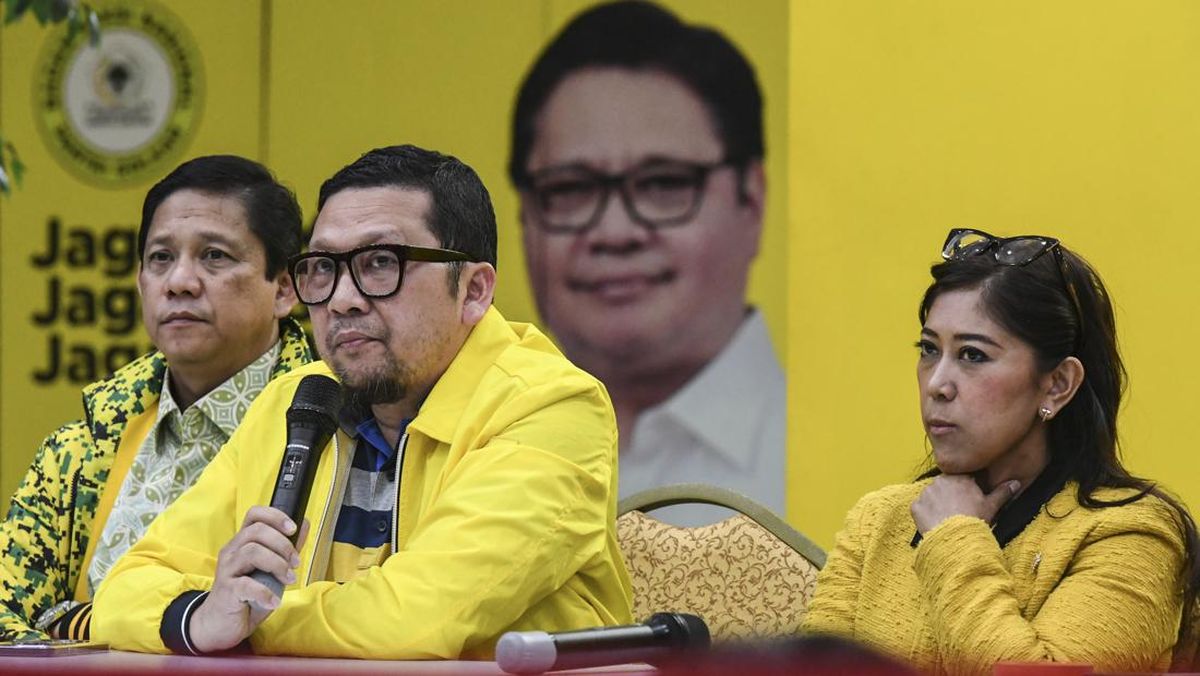
Golkar Deputy Chair Ahmad Doli Kurnia has urged leaders of political parties represented in the House of Representatives (DPR RI) to follow up on Supreme Court and Constitutional Court rulings concerning the validity of Vice-President Gibran Rakabuming Raka’s educational qualification.
Doli said the issue needed to be discussed by the parties’ respective chairmen, as it had become more urgent after the Supreme Court also ruled that Gibran’s senior high school qualification was invalid.
“Since the DPR comprises political parties, I continue to urge party leaders to meet and discuss this. The urgency has increased because of the Supreme Court ruling. If it had only been the Constitutional Court ruling, perhaps we would still have had time, but with the Supreme Court ruling, I think it is more urgent to discuss this promptly,” Doli told reporters at the Parliament Complex in Senayan, Jakarta, on Monday (2 November).
Doli said the leaders of the political parties met frequently and would certainly have heard about the controversy that has been widely discussed in society.
He therefore was not surprised if Gibran’s diploma had already been discussed, although he could not say how far those conversations had progressed.
“It is impossible that it has not been discussed. Political party leaders have eyes and ears, and the media to hear about developments in our society, so there will certainly always be discussions. We do not know what level they have reached,” Doli said.
He added that the issue had also been discussed within Golkar. However, the party had not yet received instructions from its chairman to address it with other political parties at a formal meeting.
“Within Golkar, whenever there are discussions between political parties, the chairman is given the authority and mandate. So far, we have not received further information about a formal meeting between party leaders,” Doli said.
Nonetheless, Doli said that any future formal meeting of party leaders should be guided by at least three principles.
First, any action or decision should put the public interest first. “That means the genuine aspirations of the public must truly be heard. They cannot be ignored,” he said.
Second, any decision should demonstrate respect for the Constitution and the law, as well as uphold ethical standards in public life. Third, it should aim to preserve the country’s unity and sovereignty.
“Whatever decision is taken, whether to proceed or not, it must not disrupt the running of the state or government,” he said.
Doli said prolonged polarisation between political parties must be avoided. “Prolonged polarisation, or division, must not happen. Those are the three minimum principles that I think party leaders must uphold in their meeting,” he said.
Parliamentary inquiries ‘no longer relevant’
Doli said launching a parliamentary inquiry, an interpellation right or a special committee concerning Gibran was no longer relevant, as the controversy had moved towards the question of dismissing the vice-president.
“I consider an inquiry, an interpellation or a special committee to be irrelevant. What would they be for? If this is followed up, it means we are already talking about dismissal,” he said.
In Doli’s view, the issue’s next steps had entered the political sphere. “It is possible to conclude that the Constitutional Court and Supreme Court rulings do not need to be followed up politically. We will, of course, see how things develop,” he said.
He also outlined the procedure that would apply if there were plans to remove Gibran as vice-president. The process is set out in Articles 7A, 7B and 7C of the 1945 Constitution of the Republic of Indonesia.
“Dismissal is explained in Articles 7, 7A, 7B and 7C. There is a mechanism: it is through the exercise of the right to express an opinion, which is already regulated. Article 7A, paragraph 2, makes this part of the DPR’s oversight function,” Doli said.
According to Doli, under the cited provisions, DPR factions can express their opinions on the Supreme Court and Constitutional Court rulings concerning the invalidity of Gibran’s educational qualification.
Doli also acknowledged that his party regularly communicated with the Prosperous Justice Party (PKS) and the Indonesian Democratic Party of Struggle (PDI-P) about the controversy surrounding Gibran’s diploma.
“If our colleagues in PKS have an idea, and it is then taken up by PDI-P to open a dialogue, I think that is something we routinely do,” he said.
The Supreme Court granted a cassation appeal challenging the certificate recognising Vice-President Gibran Rakabuming Raka’s senior high school education as equivalent, which was used as a requirement for his candidacy in the 2024 presidential election.
In its ruling on Friday (30 October), the Supreme Court declared the certificate Gibran used to register as a vice-presidential candidate invalid.
Before the Supreme Court issued its ruling, the Constitutional Court had found no equivalent senior high school diploma for Gibran among the documents submitted to meet the educational requirement for the 2024 election. However, the Constitutional Court rejected the petitioners’ request to dismiss him, ruling that they lacked legal standing as a pair of election candidates.
Source: jawawa.id (https://jawawa.id/newsitem/golkar-deputy-chair-calls-for-party-leaders-to-discuss-gibrans-diploma-1793667129)
Originally published by CNN Indonesia (https://www.cnnindonesia.com/nasional/20261102215228-32-1422527/waketum-golkar-desak-pertemuan-ketum-parpol-bahas-ijazah-wapres-gibran), translated from Indonesian