
Gold Prices Hit Hard: A 3.36% Weekly Drop, What is Happening?
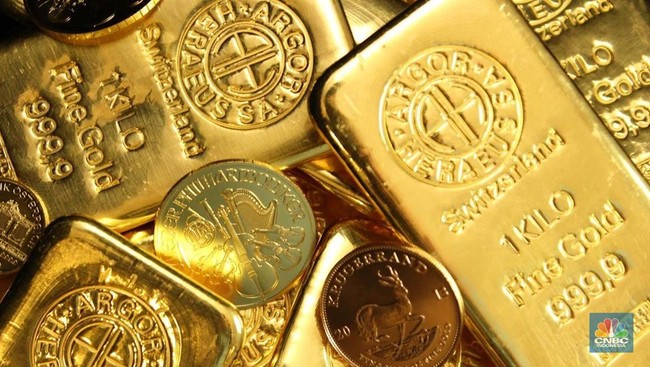
Global gold prices faced renewed pressure at the end of the week. Precious metals recorded a substantial weekly decline even though US labour market data showed signs of weakness and expectations for a Federal Reserve interest rate hike began to subside.
According to Refinitiv, at the close of trading on Friday (2/1/2026), gold prices fell by 0.85% to the level of US$4,142.34 per troy ounce, reversing a 0.52% gain from the previous trading session. Over the course of the week, gold prices corrected further, dropping by 3.36%, marking the second consecutive week of weekly losses.
Gold had actually strengthened by more than 1% during Friday’s trading after data indicated that US job growth was much lower than anticipated. However, this gain was short-lived. Gold prices reversed course as high US Treasury yields and a strong US dollar continued to act as a burden on the precious metal.
Yields on 10-year and 30-year US Treasuries even touched their highest levels since 2002 on Thursday. This condition exerted significant pressure on gold; as a non-yielding asset, the rise in US government bond yields makes interest-bearing assets relatively more attractive. Meanwhile, the US dollar also moved towards a weekly gain. A stronger dollar makes gold more expensive for holders of other currencies.
Han Tan, Head Market Analyst at Bybit, assessed that gold investors are still exercising restraint because the Fed continues to show a tendency towards tight monetary policy. “Gold market participants may still be reluctant to follow the trend for a while, as they know the Fed is maintaining a hawkish stance,” Han Tan said, as quoted by Reuters.
He noted that the direction of gold in the coming months will depend heavily on the Fed’s response to labour market conditions. “In the next few months, most of the direction for gold will depend on how much the Fed is willing to tolerate potential weakness in the labour market, while the focus remains on efforts to curb US inflation,” he added.
Gold prices have fallen by more than 20% since the US-Israel-Iran conflict erupted in late February. The surge in energy prices due to the conflict increased inflation concerns and led markets to anticipate that US interest rates would remain high for longer.
US Labour Market Falls Short of Expectations
Pressure on gold occurred amidst new signs of weakness in the US labour market. Data from the US Department of Labour showed that non-farm payrolls only grew by 29,000 in September 2026. This figure was much lower than the 90,000 jobs addition predicted by economists in a Reuters poll.
August data was also revised downwards significantly. The job additions for that month, previously reported at 162,000, were revised to just 133,000. The US unemployment rate also rose to 4.2% in September from 4.1% in August.
Nevertheless, the US labour market conditions have not yet shown a wave of widespread layoffs. Initial jobless claims remain near 57-year lows, supported by strong corporate profits and resilient domestic demand. Some economists also suggest that the low job growth in September may be influenced by seasonal factors, including the later timing of Labor Day this year.
However, pressure on the labour market could increase in the coming months. High energy prices and supply chain disruptions caused by the US-Israel-Iran conflict are expected to begin impacting businesses from late this year through 2027.
Weaker labour data has also altered market expectations regarding Fed policy. Market participants now estimate the probability of a Fed rate hike at the October meeting to be only around 22%, according to the CME FedWatch Tool, a sharp drop from approximately 70% at the start of the week. These expectations were further bolstered by recent US inflation data that was lower than expected, as well as the stance of at least two senior Fed officials who opposed further rate hikes in October.
Despite the reduced probability of a rate hike, gold has been unable to capitalise on these conditions. Marex analyst Edward Meir assessed that gold’s movement still appears technically weak. “The chart still looks quite bleak, and gold could fall further if the interest rate hike cycle resumes,” Meir said, as quoted by Reuters.
The market will now continue to monitor whether the labour market weakness is significant enough to prompt the Fed to hold interest rates steady, or if inflationary pressures from high energy prices will cause the US central bank to maintain a tight policy for longer.
Source: jawawa.id (https://jawawa.id/newsitem/gold-prices-hit-hard-a-3-36-weekly-drop-what-is-happening-1790988677)
Originally published by CNBC Indonesia (https://www.cnbcindonesia.com/research/20261003061903-128-773007/harga-emas-babak-belur-anjlok-336-sepekan-ada-apa), translated from Indonesian