
Gold Prices Forecast to Range Between Rp 2.55 Million and Rp 2.82 Million per Gram Next Week
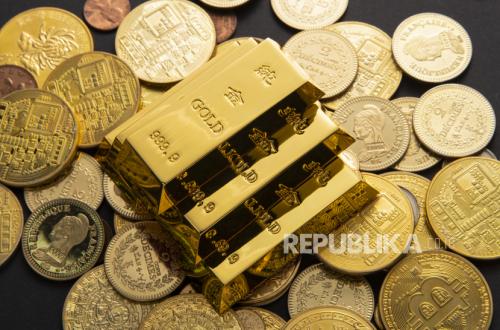
Gold and precious metal prices are predicted to remain subdued yet trend upward over the coming week. The projected movement for gold prices is in the range of Rp 2.55 million to Rp 2.82 million per gram.
Currency and Commodity Observer Ibrahim Assuaibi predicts that, technically, global gold prices next week will be around US$4,151 per troy ounce as a support level, up to US$4,493 per troy ounce as a resistance level.
On Monday (10/8/2026), the support level is most likely at US$4,279 per troy ounce, with resistance at US$4,405 per troy ounce.
“For precious metal prices, Saturday closed at Rp 2.69 million per gram. Over the coming week, precious metal will most likely be traded at Rp 2.55 million per gram, with resistance at Rp 2.82 million per gram,” Ibrahim said in a statement to journalists on Sunday (9/8/2026).
On Monday (10/8/2026), the support level for precious metal is most likely to be traded at Rp 2.67 million per gram, with resistance at Rp 2.71 million per gram.
“So there is a possibility that gold and precious metal prices will strengthen. Although the rupiah is also strengthening, the strengthening of the rupiah makes the increase in precious metal prices somewhat limited,” he said.
At the same time, Ibrahim noted that global crude oil prices are projected to trend downward over the coming week, ranging from US$65.70 per barrel as a support level to US$83.30 per barrel. For the US dollar index, he predicts movement around 98.80–100.50.
“What is causing global gold and precious metal prices to rise? The first is the geopolitical issue, where there is an agreement between Iran and Oman regarding control of the Strait of Hormuz that is likely to be reached soon. This has also been reported to the US,” he said.
Ibrahim noted that, in the absence of such an agreement, Iran has carried out attacks on United Arab Emirates vessels in the Strait of Hormuz area. The attacks by Iran occurred while UAE tankers were crossing through the Strait of Hormuz.
“These attacks by Iran apparently did not cause oil prices to rise again, but the US itself is focused on the agreement between Iran and Oman for control of the Strait of Hormuz.”
Ibrahim said Iran’s real desire is for the US not to interfere with the country by attacking vital points in Iran. The US itself continues to deliberate on the war budget in Congress, which will still be discussed next week. US President Donald Trump is known to have stated that if the US attacks Iran using aircraft, or via air, it is impossible for there to be a war agreement in the Middle East. Therefore, the US is likely to carry out a ground attack to determine the winner of the war.
“This creates its own tension, although so far there have been no flare-ups. So, the geopolitical factor in the Middle East is still quite dominant,” he said.
Besides the war in the Middle East, the war in Eastern Europe is also still one of the factors influencing global commodity movements. To date, Russia is still continuing to carry out attacks using long-range missiles against the Ukrainian capital of Kyiv, causing casualties.
“Russia’s main target now is no longer the outlying areas but the capital city of Kyiv, so that Zelenskyy (President of Ukraine) surrenders unconditionally to Russia and grants recognition of the territories controlled by Russia to Ukraine. This also creates its own tension for crude oil prices. That is from the geopolitical perspective,” he explained.
Another factor is the US central bank’s interest rate policy. Ibrahim said that US economic data updates tend to be quite good, with US labour data showing a decline of 23,000 in July 2026, lower than the expected 85,000.
This data indicates that the US central bank will maintain its interest rate hikes at the upcoming meeting. In line with analysts’ expectations that interest rate hikes will decline by 40 percent in September, Ibrahim said it is possible that oil prices could continue to fall below US$60 per barrel, which would also cause US inflation to decline again.
“There is hope that the decline in oil prices will cause global investors to shift their funds from the dollar and/or crude oil to gold as a safe haven,” he said.