
Gold Prices Fall, Trade Ministry Points to High Interest Rates
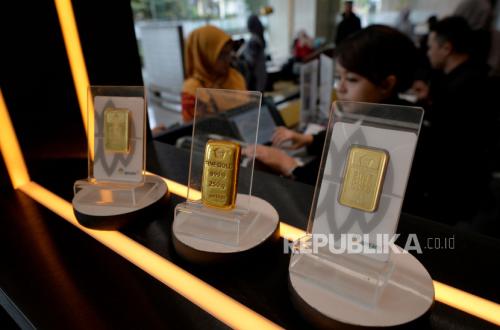
The Ministry of Trade (Kemendag) has stated that the decline in the Export Benchmark Price (HPE) and Reference Price (HR) for gold commodities in the second period of June 2026 was triggered by waning interest in bullion investment. In a statement in Jakarta on Tuesday (16/6/2026), the ministry noted the HPE for gold was set at 143,190.64 US dollars per kilogram, a decrease of 3.51 percent from the first period of June 2026, which stood at 148,396.49 US dollars per kilogram. The HR for gold also fell to 4,453.73 US dollars per troy ounce (toz) from 4,615.65 US dollars per toz.
Director General of Foreign Trade at the Ministry of Trade, Tommy Andana, said the decline in the HPE and HR for gold in the second period of June 2026 occurred due to high interest rate policies in various advanced economies, which suppressed gold prices. “There has been a decline in investor interest in gold as an investment instrument due to high interest rates, which increase the attractiveness of interest-bearing assets,” Tommy said.
From the demand side, global gold purchasing activity has tended to slow amid ongoing international market volatility. Meanwhile, a well-maintained gold supply amidst weakening demand has contributed to a price correction in the international market, impacting the decline in the HPE and HR for gold. Tommy noted that during the data collection period, the value of gold fell by 3.51 percent.
The HPE and HR for gold are stipulated in the Minister of Trade Decree (Kepmendag) Number 1453 of 2026 concerning the Export Benchmark Price and Reference Price for Mining Products Subject to Export Duty. This decree is valid for the period 15-30 June 2026. The HPE and HR for gold are determined based on data and technical input from the Ministry of Energy and Mineral Resources (ESDM), which refers to publications by the London Bullion Market Association (LBMA). The determination process is carried out through cross-ministerial and institutional coordination based on information, data, and input submitted by the Coordinating Ministry for Economic Affairs, the Ministry of Energy and Mineral Resources, the Ministry of Finance, and the Ministry of Industry.