
Gold Price Outlook Shifts: Latest Forecasts from Four Global Institutions
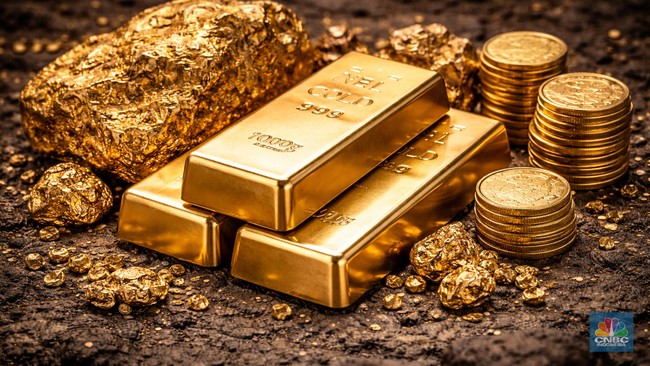
The short-term outlook for gold prices remains overshadowed by uncertainty.
On one hand, the precious metal is receiving a boost from intensifying geopolitical conflict and rising demand for safe-haven assets. On the other, the strengthening of the US dollar, rising US Treasury yields, and the hawkish stance of the US central bank (the Fed) are the main obstacles to gold’s rally.
As of Monday (13/7/2026) at 06.37 WIB, gold prices fell 1.23% to US$4,069.26 per troy ounce, extending the negative trend.
In last Friday’s trading session (10/7/2026), gold closed 0.03% lower at US$4,120.08 per troy ounce.
Overall, gold prices weakened 1.31% last week. The decline was unwelcome news after prices had risen 2.12% in the previous week.
Last week, global gold prices briefly broke through US$4,200 per ounce after the US-Iran conflict sparked concerns over disruption to energy supplies through the Strait of Hormuz.
However, the rally did not last long. Prices reversed to fall to near US$4,020 per ounce after the market digested minutes from the Fed’s meeting showing that several Fed officials still saw room for interest rate rises if inflation remained uncontained.
Market participants remain divided: some analysts expect gold prices to rise, some predict a sideways movement, and others forecast a decline.
Meanwhile, the majority of retail investors remain optimistic that gold prices will strengthen.
For both retail and professional investors, the rationale for including gold in a portfolio is not solely to hedge against geopolitical risk, although historically gold has proven fairly effective in that role.
Although the short-term outlook remains under pressure, gold’s long-term fundamentals are still considered solid.
The World Gold Council (WGC) recorded net central bank purchases of 41 tonnes of gold in May, while 45% of central banks surveyed plan to increase their gold reserves over the next 12 months — the highest in the survey’s history.
This indicates that gold remains the primary hedging asset amid global economic uncertainty, geopolitical risk, and mounting concerns over the stability of the world’s financial system.
Institutions Cutting Gold Forecasts
A number of investment banks have begun cutting their short-term gold price projections amid rising expectations of interest rate increases, inflation concerns, and the strengthening of the US dollar and oil prices.
- Bank of America (BofA)
BofA announced a 14% cut to its average gold price projection for 2026 to US$4,360 per ounce, citing expectations that the Federal Reserve will maintain a more hawkish monetary policy stance.
Nevertheless, BofA still believes gold prices have a chance of reaching US$5,000 per ounce once the Fed’s tightening cycle ends.
- JPMorgan
JPMorgan projects average gold prices at US$4,300 per ounce in the third quarter of 2026, rising to US$4,500 per ounce in the fourth quarter.
Overall, JPMorgan has set a gold price target of US$4,545 per ounce.
- LBMA (London Bullion Market Association)
The consensus of London Bullion Market Association (LBMA) analysts projects average gold prices in 2026 at US$4,742 per ounce. However, the analysts’ forecast range is very wide, at US$4,000 to US$6,050 per ounce, reflecting the diverse macroeconomic scenarios currently hanging over the market.
- HSBC
HSBC has cut its average gold price projection for 2026 to US$4,560 per ounce, taking into account the impact of a stronger US dollar and tighter monetary policy.
Several factors continue to support gold, such as central bank purchases. The following are factors driving gold prices:
Factors Supporting Rising Gold Prices
- Fed Policy and Real Yields
Expectations of Federal Reserve rate cuts in 2026 are seen as positive sentiment for gold. When real yields fall, the opportunity cost of holding non-yielding gold also declines, making the precious metal more attractive as an investment asset.
- Central Bank Purchases
Central bank gold buying continues to be the main pillar supporting prices. According to the World Gold Council (WGC), net central bank purchases have exceeded 1,000 tonnes per year since 2022. This strong demand creates a “floor” for gold prices, limiting the potential for declines.
- Geopolitical Risk
Geopolitical tensions increase demand for gold as a safe-haven asset. The higher the global conflict, the greater the tendency for central banks to add to their gold reserves. In such conditions, some analysts consider a price target of US$6,000 per ounce — roughly 15-30% above current levels — still realistic.
Conversely, a number of factors will weigh on gold, including rising oil prices, the strengthening of the US dollar and US Treasuries, and rising US inflation.
Since the Iran war broke out in late February, gold prices have fallen by more than 20%, as profit-taking ended a three-year rally and briefly dragged gold below US$4,000 per ounce for the first time since November.
So what do the most bullish and bearish gold price projections look like? Here are the latest gold price forecasts from the LBMA survey:
Source: jawawa.id (https://jawawa.id/newsitem/gold-price-outlook-shifts-latest-forecasts-from-four-global-institutions-1783903822)
Originally published by CNBC Indonesia (https://www.cnbcindonesia.com/research/20260713063011-128-750244/prospek-harga-emas-berubah-ini-ramalan-terbaru-dari-4-lembaga-dunia), translated from Indonesian