
Going All the Way to Deal with Roblox
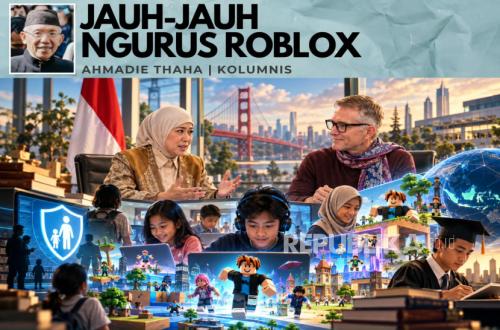
The distance to Silicon Valley, California, in the United States, is thousands of kilometres. A minister travelled all that way to meet Roblox chief executive David Baszucki. The subject was a digital game popular with children.
Communications and Digital Affairs Minister Meutya Hafid asked Roblox to open an office in Jakarta. She also demanded that it appoint a senior executive in Indonesia, comply with national regulations and strengthen child protection.
The question is simple: why is Roblox important enough for the government to take this matter to the heart of the global technology industry? Are we witnessing strategic digital diplomacy, or simply officials busy regulating children’s toys?
The answer depends on what we understand Roblox to be and what the government hopes to achieve through the meeting.
Roblox may look like a game. But calling it merely a game is as misleading as calling the internet merely a cable. Roblox is a digital platform where users can play games and, uniquely, create them too.
On Roblox, users can design characters, interact with others and build virtual worlds. Creators can develop digital experiences using Roblox Studio and the Luau programming language. Its ecosystem also includes virtual currency, transactions and a creator economy.
In this sense, Roblox resembles a digital city. Users come to play, shop, socialise and create. Developers build attractions, while the company provides the infrastructure, rules and transaction mechanisms.
Millions of people from around the world, speaking different languages, can be active on the platform without meeting physically. Like a real city, it offers opportunities while also carrying risks.
Through structured activities, children can learn programming logic, three-dimensional design, problem-solving and collaboration. They can design simple games, test rules, identify errors and fix them. Such experiences could help foster useful digital skills.
But educational potential does not automatically make every activity on Roblox a worthwhile learning experience. A child spending hours chasing virtual rewards is not necessarily learning to programme. A child interacting with strangers is not necessarily developing healthy communication skills.
An educational laboratory built with Roblox can become an attention marketplace if product design prioritises keeping users engaged over building knowledge.
This is where the government’s concerns make sense. When children enter global platforms, they bring vulnerabilities they may not be able to recognise themselves. They could face bullying, psychological manipulation, scams, exposure to inappropriate content and approaches from sexual predators.
Chat features, with messages easily translated into users’ languages, can also become a gateway to communication outside the platform. This is harder for parents to monitor.
Child protection is therefore no trivial matter. The government has a responsibility to ensure that digital companies serving Indonesians respect Indonesian law.
Meutya Hafid’s meeting with David Baszucki, Roblox’s chief executive and one of its co-founders, could serve as an instrument of regulatory diplomacy. Global companies need to understand that the scale of Indonesia’s market also brings obligations.
Government Regulation No. 17 of 2025 on the Governance of Electronic Systems for Child Protection, known as PP TUNAS, provides the policy basis for this approach.
The government wants digital platforms to implement child protection more systematically. Measures include age-based access controls, restrictions on risky communications and accountable oversight mechanisms.
There are also understandable reasons behind the demands for Roblox to open an office in Jakarta and appoint a senior executive in Indonesia. Companies that benefit from the national market should provide clear channels of communication with regulators.
They should also be able to handle complaints effectively and take responsibility for the effects of their services. But a physical office is only an address, and a local boss is only an organisational structure. Neither automatically makes children safer.
The government should measure success by results, not ceremony. How many reports of harmful activity are dealt with? How quickly does the company close avenues for exploitation? How does it demonstrate that age restrictions are accurate?
It must also establish whether parents have an effective complaints mechanism and whether regulators can independently audit compliance. These questions matter far more than a photograph of officials standing alongside a famous chief executive.
Safety must also be built into product design from the outset. This is known as safety by design: developers incorporate protections into a product rather than adding them after incidents emerge.
Systems should restrict age-inappropriate communication, detect risky behaviour, make reporting straightforward and prevent children’s conversations from moving to external channels where exploitation is a risk. The company should also explain how its systems handle age-identification errors and protect children’s personal data.
Age-estimation technology using facial scans, for example, should not simply be accepted as a guarantee of safety. The government needs to assess its accuracy, transparency, the proportionality of data collection and the protection of biometric information.
Source: jawawa.id (https://jawawa.id/newsitem/going-all-the-way-to-deal-with-roblox-1791939085)
Originally published by Republika (https://opini.republika.co.id/berita/tmvflp415/jauhjauh-ngurus-roblox), translated from Indonesian