
Godzilla El Niño Rages, Global Food Prices Set to Soar Until 2028
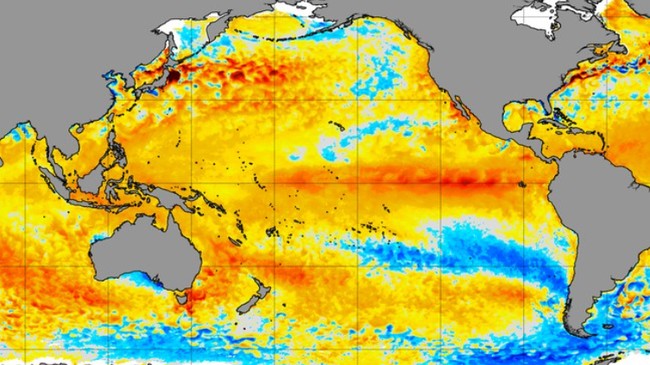
Jakarta, CNBC Indonesia – The world is once again facing the threat of an even bigger spike in global food prices. Amid the Iran war, which has already driven food prices to their highest level in three years, economists are now warning that the emergence of a super El Nino, or ‘El Nino Godzilla’, this year has the potential to trigger a major shock to global food production, with effects that could last until 2028.
Citing The Guardian on Monday (13/7/2026), economists believe the global food supply chain is now facing a ‘double shock’: geopolitical conflict disrupting energy and fertiliser supplies, and extreme weather driven by global warming, which is expected to be exacerbated by an exceptionally powerful El Nino.
Scientists had previously stated that the 2026-2027 El Nino cycle, which forms when shifting wind patterns allow warm seawater to spread across the central and eastern equatorial Pacific, has an unprecedented chance of developing into an extremely strong phenomenon.
The phenomenon is expected to trigger heatwaves, major floods and more extreme storms across various parts of the world.
The United States’ National Oceanic and Atmospheric Administration (NOAA) confirmed last month that warming conditions in the Pacific Ocean had begun to form. The agency estimates a 63% chance that sea surface temperatures will rise more than 2 degrees Celsius above normal by the end of this year.
The emergence of an extreme El Nino is expected to come at a particularly bad time, when households in many countries are still burdened by rising living costs caused by inflation over recent years.
Economists say extreme weather could worsen pressure on food prices and once again drive global inflation. The situation is also worrying central banks, as interest rates may need to remain at elevated levels for longer.
Analysts at Italian bank UniCredit said El Nino has revived the issue of ‘climateflation’ – inflation caused by climate change.
‘The recent heatwaves that hit Europe are a reminder that baseline climate conditions have changed. El Nino could add new pressure towards the end of this year by amplifying the effects of global warming,’ the bank wrote in a research note.
El Nino has a long history of disrupting global harvests. More than a century ago, an El Nino believed to be one of the strongest in history triggered severe droughts in China, southern Africa, Brazil, Egypt and India.
The disaster caused famine conditions, worsened by the colonial policies of the time, killing millions of people, including more than 6 million in India during 1876-1878.
In recent decades, strong El Nino events also occurred in 1981-1982, 1996-1997, 2015-2016 and 2023-2024.
However, NOAA projections show the 2026-2027 cycle has the potential to be more severe than previous events, raising the risk of drought, flooding, crop failure and disruptions to food supplies worldwide.
Goldman Sachs analysts estimate the strength of this El Nino could push global food commodity prices up by as much as 15.8%.
The surge is expected to have a widespread impact on consumers across many countries. In the eurozone, for example, food prices are projected to rise by around 1.3%.
Three years ago, the European Central Bank (ECB) estimated a strong El Nino could push global food commodity prices up by as much as 9%, with the largest increases in soybeans, maize and rice. This time, however, the risk is considered far greater.
UniCredit estimates that an extreme El Nino scenario remains highly plausible and could cut global agricultural output by up to 14.3%, equivalent to a loss of output worth US$342 billion, or around £254 billion.
According to UniCredit, price surges across major commodities could reach very high levels.
‘Price shocks could reach 10% to 50% for major commodities, while the most vulnerable crops, including rice, palm oil, sugar and coffee, could surge between 50% and 100% or even higher,’ UniCredit said.
The institution cautioned that the global food system still has reserves to cope with pressure in the second half of 2026. However, the margin for error is very small.
The full impact of El Nino will not be felt immediately, however. Goldman Sachs estimates the economic consequences of the phenomenon will only be ‘fully realised’ in the second half of 2028.
According to the bank, the delay occurs because extreme weather affects planting times, growing periods and harvest seasons, which differ for each type of crop.
In addition, logistical challenges such as falling water levels in rivers and canals that serve as major commodity distribution routes are also expected to worsen the global supply chain.
Even so, the impact of El Nino will not be uniform across regions. UBS analysts said the phenomenon will alter global rainfall and temperature patterns, creating both winners and losers.
‘El Nino does not affect the agricultural sector uniformly. It reshapes global rainfall and temperature patterns, creating winners and losers across various regions,’ UBS analysts wrote.
A number of regions are even expected to benefit from warmer weather conditions.
Goldman Sachs said the impact of El Nino is already becoming visible in India. According to the bank, this year’s monsoon season has been far drier than usual.
‘Some regions have received only about 25% of normal rainfall, while parts of central India have received only about 50%, which could affect the supply of wheat, rice and sugarcane,’ Goldman Sachs wrote.
Meanwhile, analysts also say drought in Southeast Asia could reduce palm oil production, one of the key raw materials for the global processed food industry. Coffee and cocoa production is also expected to be disrupted.
On the other hand, warmer and more humid conditions could also accelerate the spread of crop diseases, depressing harvests in subsequent years.
In North America, the impact of El Nino is usually felt most during winter. In Europe, analysts expect the biggest effect to come through higher global food prices rather than direct changes in the weather.
Source: jawawa.id (https://jawawa.id/newsitem/godzilla-el-nino-rages-global-food-prices-set-to-soar-until-2028-1783903829)
Originally published by CNBC Indonesia (https://www.cnbcindonesia.com/news/20260713064956-4-750245/el-nino-godzilla-mengamuk-siap-siap-harga-pangan-melonjak-hingga-2028), translated from Indonesian