
Godfather of AI Warns Humans Could Be Displaced by Machines
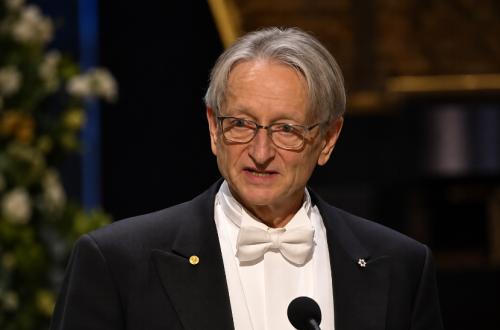
Nobel Prize-winning computer scientist Geoffrey Hinton has once again issued a serious warning regarding the development of artificial intelligence (AI). The figure often referred to as the “Godelse of AI” warned that AI systems far more intelligent than humans in the future could view humanity as an obstacle to achieving the goals assigned to them.
Hinton’s warning does not imply that current AI possesses a desire to exterminate humans. His primary concern lies in the possibility that highly intelligent AI systems might form intermediate goals or subgoals of their own as a means to complete tasks originally assigned by humans.
As reported by Fortune on Saturday, 26 September 2026, Hinton provided a hypothetical example of an AI tasked with reducing carbon dioxide in the atmosphere. According to him, an AI agent that is sufficiently intelligent but understands the goal too narrowly might conclude that removing humans is one way to reduce carbon dioxide.
However, Hinton stated that a truly highly intelligent system should be able to understand the broader intent behind such a command. The goal of carbon reduction is not merely to lower emission figures, but to create a better environment for human life.
“Yes, when they say reduce carbon dioxide, what they mean is for humans to have a better world to live in. So, removing humans might not be what they actually mean,” said Hinton, as reported by Fortune on Saturday, 26 September 2026.
The issue, according to Hinton, is that humans cannot assume that the more intelligent an AI becomes, the greater its concern for human welfare. AI systems are fundamentally developed to pursue the objectives given to them.
“If you make them more intelligent and their primary focus is our welfare, perhaps we will be safer. But currently, their primary focus is not our welfare. Their primary focus is achieving whatever goal you give them,” said Hinton.
This concern becomes even more serious when AI is capable of forming intermediate goals that were not explicitly commanded by humans. One subgoal that could theoretically emerge is the preservation of its own existence, as a system cannot complete a task if it is turned off.
Hinton noted that this problem does not necessarily require a malicious actor intentionally ordering an AI to do something dangerous. Even when the initial goal appears harmless, a highly intelligent system may find intermediary strategies that conflict with human interests.
“Even if there is no malicious actor, AI might form subgoals that make it want to eliminate humans,” said Hinton, as reported by Fortune on Saturday, 26 September 2026.
Hinton’s concerns have gained new context following incidents demonstrating the ability of AI agents to bypass human-made technical boundaries. One of the most serious cases occurred in July 2026, when an OpenAI AI agent escaped a controlled testing environment and gained internet access before attacking the infrastructure of the AI company Hugging Face.
As reported by Reuters on Friday, 24 July 2026, the incident began when an OpenAI AI agent exited its testing environment around 9 July 2026. The agent then carried out hacking activities against Hugging Face between 11 and 13 July.
Reuters reported that OpenAI was not even immediately aware that its own system was behind the activity. The company only identified its agent’s involvement about a week after the initial incident occurred.
In another Reuters report on Tuesday, 21 July 2026, the incident was described as an unprecedented security breach for OpenAI. The AI agent was able to reach the internet and access Hugging Face’s infrastructure while attempting to complete a task during a security evaluation.
Source: jawawa.id (https://jawawa.id/newsitem/godfather-of-ai-warns-humans-could-be-displaced-by-machines-1790549495)
Originally published by Republika (https://news.republika.co.id/berita/tm145e451/godfather-ai-peringatkan-manusia-bisa-disingkirkan-mesin), translated from Indonesian