
Gobel Urges Government to Convene National Exporters to Help Strengthen Rupiah
The real sector will become increasingly cautious regarding business expansion.
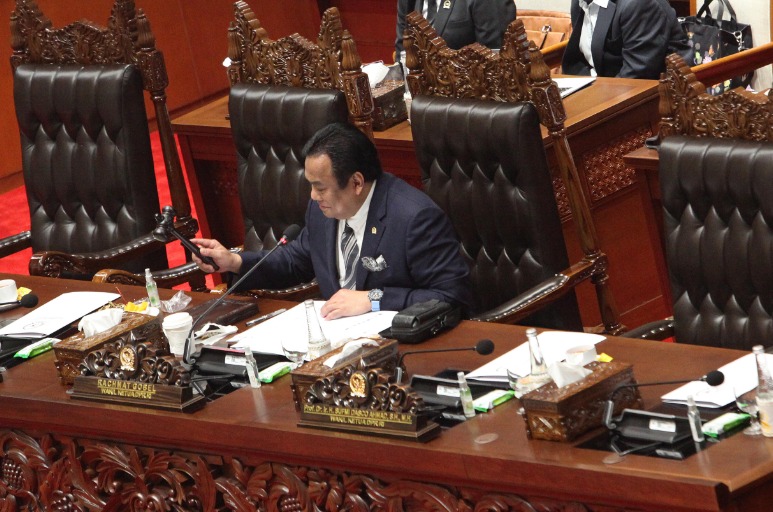
Rachmat Gobel, a member of Commission VI of the Indonesian House of Representatives (DPR RI), has requested the government to invite national exporters to help increase economic growth and strengthen the rupiah exchange rate against the US dollar. “Everyone must work hand in hand to strengthen the national economy,” he said on Wednesday, 10 June 2026.
This statement was made by Rachmat Gobel in response to the initiative of the Deputy Speaker of the DPR RI, Sufmi Dasco Ahmad, who is actively coordinating with the government to improve national economic performance. Dasco has been actively meeting with the Minister of Finance, the Governor of Bank Indonesia, the Minister of Energy and Mineral Resources, the State Secretary, the Minister of Law, and the Head of the State-Owned Enterprises Agency (BP BUMN), who also serves as the COO of Danantara. This coordination is part of an effort to find solutions to the decline in the rupiah exchange rate and the stock index. One of the topics discussed was following up on new government policies regarding export procedures for coal, palm oil, and nickel through the SOE DSI, as well as increasing oil and gas exports and attracting foreign investment.
Rachmat Gobel stated that the government should also assist in increasing non-oil and gas exports and attracting foreign investment outside the mining sector. “Pay attention to the industrial, manufacturing, and food sectors as well. These sectors absorb a large amount of labour and drive economic equality,” he said.
Among the measures the government could take, he noted, are reducing logistics costs, digitising customs, improving container efficiency, upgrading ports, and easing transportation to ports. Through Indonesian Embassies (KBRI) in various countries, he suggested the government could diversify export destinations so as not to rely solely on traditional markets such as the United as States and China. “This could also reduce geopolitical risks and the global economic slowdown,” he added.
As an initial step, Gobel said, the government must invite national exporters, including MSMEs (Micro, Small, and Medium Enterprises). “This synergy is vital to uniting national energy for the sake of national unity and economic resilience,” he said.
Furthermore, Gobel stated that to strengthen exports, the government must encourage MSMEs to penetrate export markets. According to him, Indonesian MSMEs play a significant role domestically, accounting for approximately 97 per cent of labour absorption and 60 per cent of the Gross Domestic Product (GDP). However, the contribution of MSMEs to exports only reaches about 15 per cent. “A paradox exists. The government must assist MSMEs so they can contribute to exports,” he said.
By comparison, in Japan, the contribution of MSMEs to GDP, labour absorption, and exports is approximately 50 per cent, 70 per cent, and 50 per cent, respectively. In China, these figures are 60 per cent, 80 per cent, and 70 per cent, respectively. “There is relatively consistent alignment between the contribution to GDP and labour absorption with the contribution to exports,” he noted. The economic potential of MSMEs, he said, includes food products, spices, fashion, furniture, herbal products, handicrafts, halal products, and the creative economy.
To boost national exports, Gobel said, the government must also provide export credit, trade insurance, and tax incentives. “With rising exports, Indonesia will possess more dollars,” he said.
Gobel reminded that national industries and MSMEs would be more resilient if imports were controlled. “These imports deplete dollars and weaken the rupiah exchange rate,” he said. Therefore, he requested the government to limit imports of products that can already be produced domestically. Additionally, he stated that the government should prohibit the import of textiles and garments featuring traditional Indonesian motifs. “Indonesia’s large market is an asset. This is what the United States does through its tariff policies and what China does by forcing foreign producers to manufacture their goods in China. We are instead destroying our own market,” he said.
An economy based on mining, Gobel argued, is unsustainable and capital-intensive. Therefore, he stated that the government should side more strongly with industry, MSMEs, and food security. “We must think long-term, with a dimension of equality, and build the quality of human resources.” Only through such means, he said, would the stock index and the rupiah exchange rate remain resilient against shocks from speculators.