
Global Trade Disruption Intensifies, Logistics Industry Strengthens Collaboration
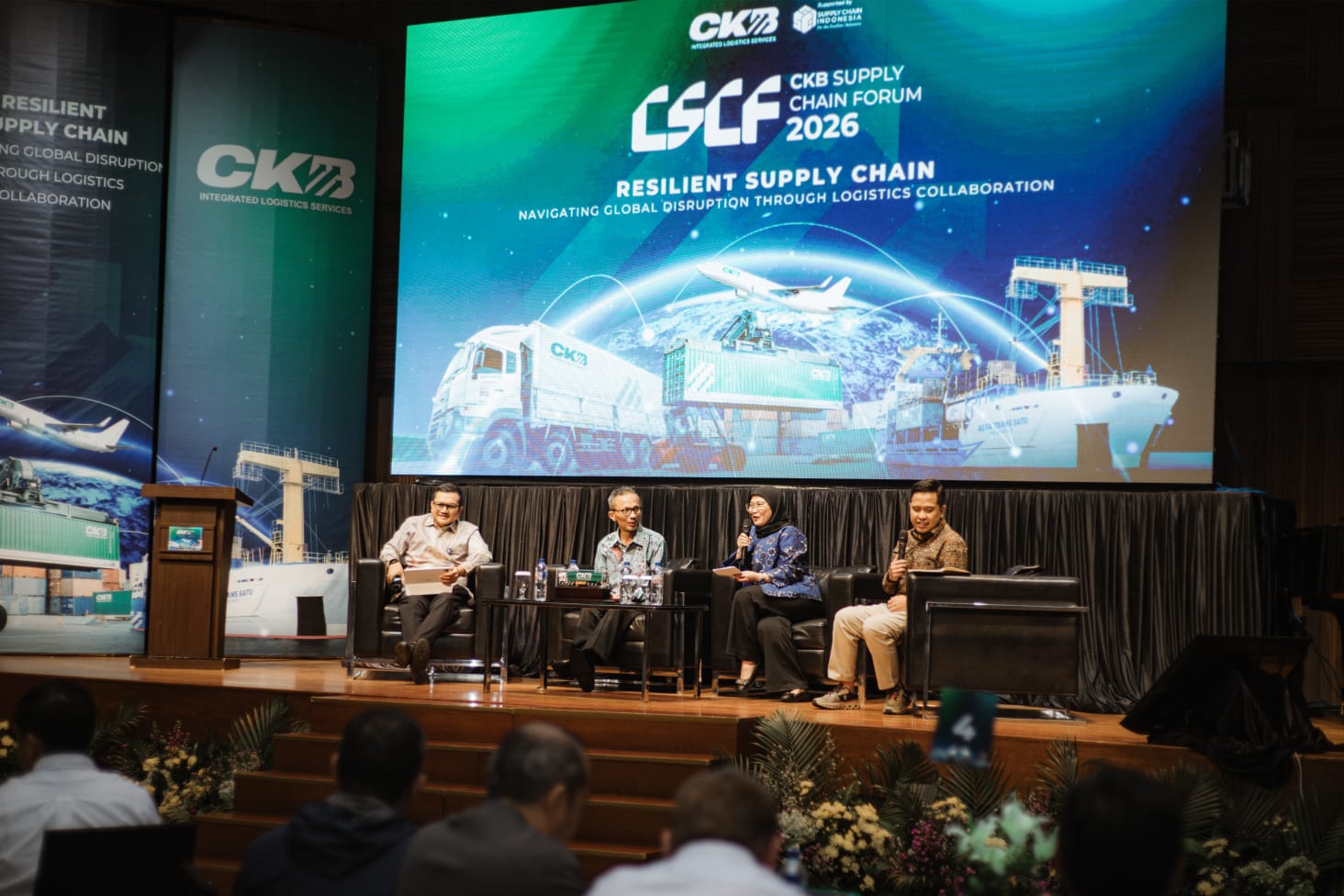
Global economic uncertainty and rising geopolitical tensions are currently presenting significant challenges to the smooth flow of trade. Facing these unpredictable dynamics, collaboration between stakeholders in the logistics sector has become the key to mitigating volatility and ensuring global supply chains remain operational.
To address this crucial need, PT Ciptable Krida Bahari (CKB Logistics) held a strategic forum titled the CKB Supply Chain Forum (CSCF) 2026, themed ‘Resilient Supply Chain: Navigating Global Disruption Through Logistics Collaboration’, in Jakarta on Thursday (25/6/2026).
CKB Logistics partnered with Supply Chain Indonesia (SCI) and the Directorate General of Customs and Excise (DJBC). As a logistics partner, this subsidiary of PT ABM Investama Tbk (ABMM) reaffirmed its readiness to face various industry challenges and global supply chain disruptions. The Director of CKB Logistics, Iman Sjafei, stated that current geopolitical dynamics are triggering volatility in trade routes, which directly hinders the supply chain of goods.
“Global geopolitical tensions are creating real obstacles. Through the CKB Supply Chain Forum 2026, we invite all parties to collaborate in formulating logistics solutions that are resilient, responsive, and integrated. This synergy is absolutely necessary so that we can mitigate risks, face various worst-case scenarios, and ensure the wheels of distribution continue to turn smoothly,” explained Iman.
He explained that CSCF 2026 is designed to transform into a collaborative ecosystem and an interactive network between professionals, academics, and corporate leaders to align steps with the latest customs regulations and produce adaptive business innovations.
“The combination of SCI’s academic expertise, the policies of the Customs authority, and the reliable operational capabilities of CKB Logistics makes this event more than just a place for discussion. This forum can serve as a primary catalyst to drive sustainable national economic growth amidst constantly changing market dynamics,” Iman concluded.
CKB Logistics Director of Logistics and Distribution, Ety Puspitasari, added that the supply chain management of strategic industries needs to transform immediately. Operational approaches can no longer be solely efficiency-driven; they must shift towards being resilience-driven.
“Resilience-driven is not achieved merely by avoiding disruptions absolutely, but through the design of flexible operational networks and close collaboration across the entire logistics ecosystem. The goal is to ensure that business recovery happens much faster when a crisis occurs,” explained Ety, who served as a speaker on ‘Adaptive Distribution Strategies: Mitigating Risk in Supply Chains’.
Ety explained that to overcome operational challenges, companies must implement comprehensive supply chain risk management. This is based on an integrated framework that includes risk governance, visibility, flexibility, collaboration, and continuous improvement.
“Concrete steps include end-to-end risk mapping, the preparation of adaptive contingency SOPs, and the utilisation of Digital Control Tower technology to achieve a high level of operational visibility,” Ety emphasised.
CSCF 2026 also presented an academic perspective from the Founder & CEO of SCI, Setijadi. He presented material titled ‘Building Resilient Supply Chain’ to strengthen the fundamental understanding of industry players. He stated that risk management must be integrated into daily operations, ranging from procurement, inventory, warehousing, and transport to customs, distribution, and customer service.
SCI recommends five pillars of supply chain resilience: risk governance, visibility, flexibility, collaboration, and continuous improvement. Implementation includes end-to-end risk mapping, determining priorities based on business impact, preparing contingency SOPs, identifying alternative suppliers and routes, strategic inventory, early warning systems, and the use of digital control towers.
Representatives from the Directorate General of Customs and Excise (DJBC) appreciated the holding of the CKB Supply Chain Forum 2026. As a regulator, Customs considers the CKB Logistics initiative helpful to the government in socialising export-import regulation updates, ensuring that legal compliance in strategic sectors—particularly mining, oil and gas, and construction—can be well maintained.